

Discover how to vet and hire ai search optimization agency mexico to drive measurable growth in 2026. Learn criteria, questions, and KPIs that deliver results.
The way your customers look for answers has fundamentally changed. Classic SEO isn't dead, but its role is shifting as AI-powered tools like Google's AI Overviews and ChatGPT become the first stop for many users. For B2B companies operating in Mexico, ignoring this isn't just a missed opportunity—it's a direct threat to your future visibility and growth.
The New Search Landscape and Why AI Optimization Is Crucial
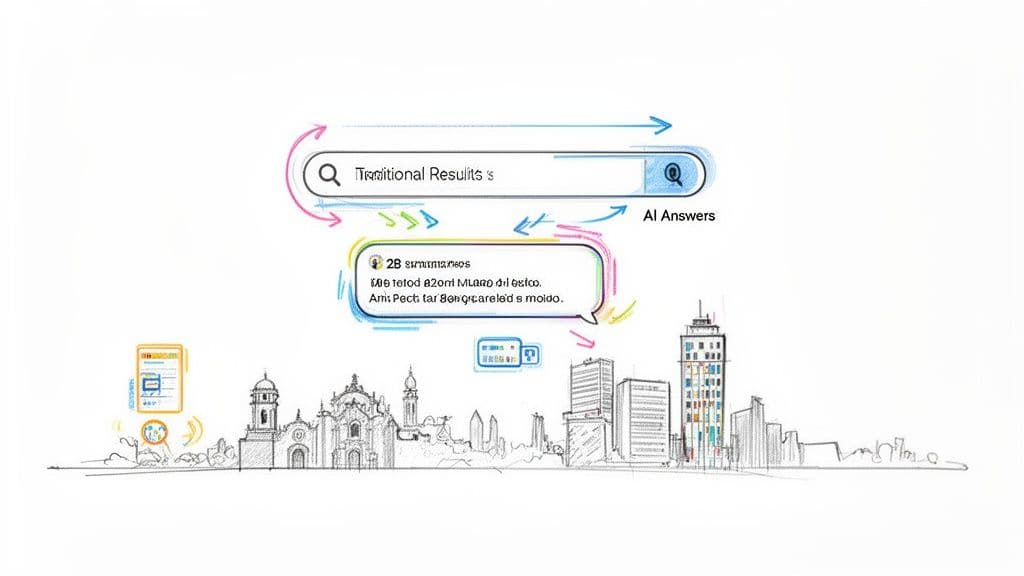
We're moving past the era where a list of blue links was the ultimate prize. Now, users are getting direct, synthesized answers from generative AI. This is the natural evolution from Search Engine Optimization (SEO) to what we now call Answer Engine Optimization (AEO).
For any B2B enterprise in Mexico, the goalpost has moved. It's no longer just about ranking #1 on a Google search. It’s about becoming the trusted, citable source that AI models use to construct the very answers your potential customers see first.
From Clicks to Conversations
We're already seeing click-through rates from traditional search results begin to dip. But here's the interesting part: the traffic that does make it to your site from these AI-powered referrals is incredibly valuable. These aren't casual browsers; they're informed users who are much deeper in their buying cycle and ready to talk.
This creates a new dynamic. The challenge is that your content must be perfectly structured for Large Language Models (LLMs) to parse and trust it. The opportunity, however, is immense. Capturing this high-intent traffic means higher quality leads and, ultimately, better conversion rates.
Of course, this new approach doesn't exist in a vacuum. It's built upon the foundation of proven advanced SEO techniques, which remain as important as ever for establishing authority.
Why an Agency Is Critical for Success
Getting this right requires a specific skill set that most in-house teams simply don't have yet. It goes far beyond standard SEO practices. You need a partner who genuinely understands how LLMs gather, process, and prioritize information.
A specialized AI search optimization agency in Mexico brings two critical things to the table: deep technical expertise in this new field and nuanced knowledge of the local market. This isn't just a line item in your marketing budget; it's a strategic investment in your brand's future relevance.
Working with an expert partner is the surest way to avoid being silenced by the new wave of search. As we detail in our complete guide to AI Search Optimization, the objective is to embed your brand within the answers of tomorrow. An experienced ai search optimization agency mexico is the key to capturing high-value leads in 2026 and beyond.
How to Identify and Vet Potential AI SEO Agencies
Finding a genuine partner for AI search optimization in Mexico isn’t as simple as a quick Google search. The field is still new, and you’ll find plenty of traditional SEO agencies have just slapped an "AI" label on their old services without having the real expertise to back it up. You have to be more deliberate. Your first job is to build a solid list of potential agencies by looking where the real work is happening.
Forget generic searches for now. Instead, dive into LATAM-focused tech publications and industry forums. These are the places where you’ll find the emerging companies and actual thought leaders who are pushing the envelope with AI in marketing. A targeted LinkedIn search can also be surprisingly effective. Look for people with titles like "AEO Specialist" or "AI Search Strategist" located in Mexico—this often leads you directly to the forward-thinking agencies they represent.
Before you even start outreach, it helps to understand the fundamentals of what a real AI SEO Agency should be offering. This gives you a baseline to measure against, making it much easier to spot the pretenders. As you build your initial list, pay close attention to their language. Are they still obsessed with "rankings," or are they talking about "visibility in AI answers"? It’s a subtle but critical difference.
Analyze Case Studies for Real AEO Success
Once you have a shortlist, the real vetting begins. This is where you need to put on your skeptic's hat and dig into their case studies and client results. Don't let flashy presentations or vanity metrics fool you. A legitimate ai search optimization agency mexico will show you results that go far beyond what you'd see in a traditional SEO report.
You're looking for hard evidence of success in Answer Engine Optimization (AEO). A true expert can prove their impact with specifics, such as:
- Brand Mention Tracking: Can they show you tangible proof that they track—and increase—their clients' brand mentions within AI-generated responses from platforms like Google AI Overviews or Perplexity?
- Conversational Content Wins: Do they have examples of content they’ve optimized that now shows up as a source for conversational AI like ChatGPT? More importantly, can they explain exactly why that content was chosen by the model?
- Featured Snippet Evolution: Can they demonstrate how they not only captured featured snippets but also successfully pushed that information into broader AI-powered summaries and answers?
The goal here is to separate the agencies that are just repeating buzzwords from those who have a proven, repeatable process for actually influencing AI models. Ask them to walk you through a project where they successfully moved a client's visibility from old-school search results into AI-driven answer engines.
Identify True Expertise Beyond the Pitch
Real expertise shows up in the details, not just the sales pitch. An agency that truly gets this space will talk about concepts like knowledge graphs, entity optimization, and structured data with an easy confidence. They won’t just say they create "high-quality content"; they’ll be able to explain exactly how they structure that content for machine readability.
Here's a great way to test their depth: ask how their strategy changes for different AI platforms. An expert knows that optimizing for Google's AI Overviews is a different game than optimizing for a standalone chatbot. This kind of direct questioning cuts through the marketing fluff and helps you find a partner with genuine strategic depth. If you're curious about how these nuances play out in other markets, our guide on hiring an AI search optimization agency in the UK offers some great comparative insights.
Key Evaluation Criteria for Your AI Search Agency
Finding the right agency partner isn't about being wowed by a slick sales deck. It's about a rigorous evaluation of their actual capabilities. When you're looking for an ai search optimization agency in mexico, you have to peel back the layers of marketing claims and get to the core of what drives results in this new AI-powered search environment.
The best partners have a potent mix of deep technical knowledge, strategic vision, and an authentic grasp of the Mexican market.
Technical and Strategic AEO Competence
A huge red flag is an agency that just pumps out content using off-the-shelf AI writers. What you need is a team that genuinely understands how Large Language Models (LLMs) think. They should be able to walk you through exactly how they optimize content not just for keywords, but for semantic meaning and machine comprehension.
A competent agency won’t treat Answer Engine Optimization (AEO) as a separate service bolted onto old-school SEO. They'll show you an integrated strategy where traditional SEO builds the foundation—technical health, domain authority—while AEO-focused content is engineered to be the source for AI-generated answers.
They need to provide concrete proof of their skills in a few key areas:
- Entity Optimization: Can they explain their methodology for defining and strengthening your brand's digital identity (its "entity")? This is crucial for AI models to understand who you are, what you do, and why you're an authority.
- Structured Data Mastery: They must demonstrate expertise in advanced schema markup. We're talking about more than just the basics; they should be using structured data to give search engines explicit, unambiguous information about your content, products, and services.
- AEO & SEO Synergy: Ask for case studies. You want to see examples where they’ve successfully improved both traditional search rankings and visibility in AI Overviews. This proves they have a balanced, sustainable strategy.
This diagram illustrates a structured vetting process, helping you move from initial research to a final, evidence-based decision.
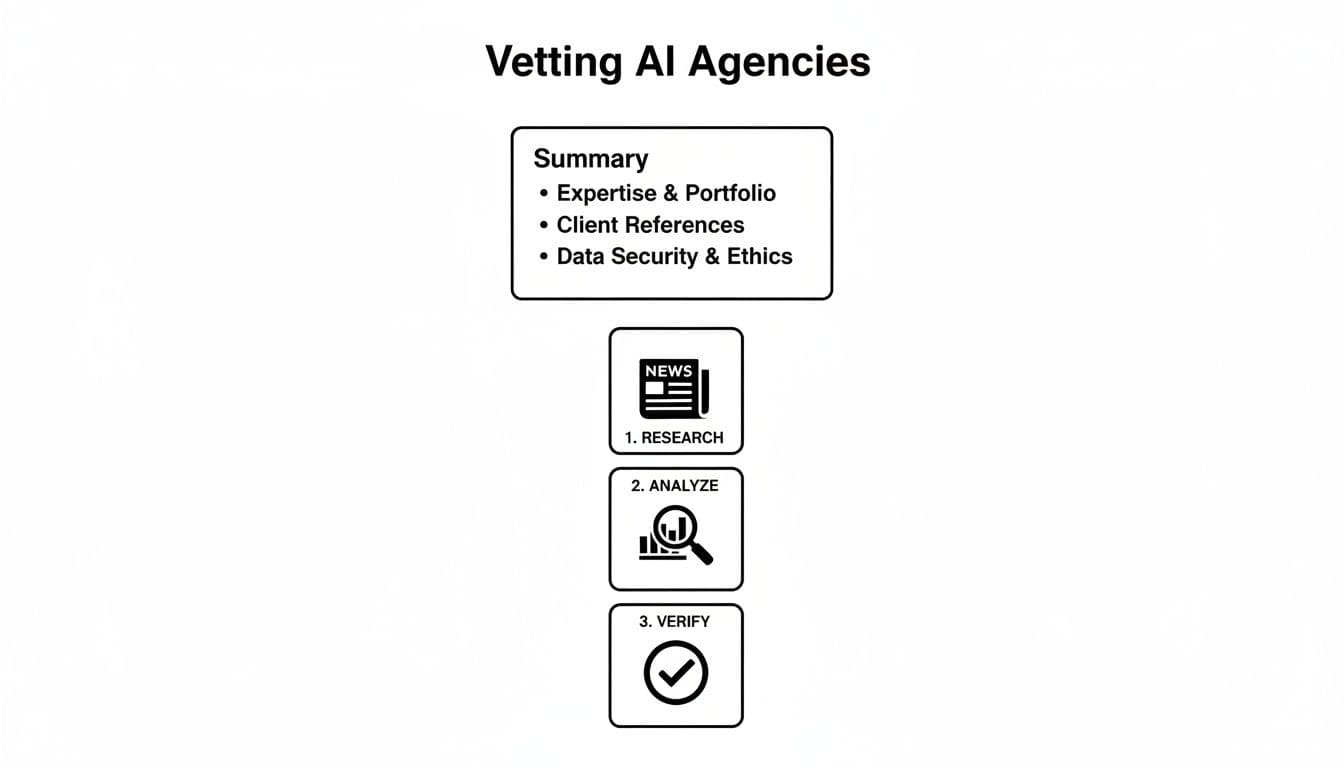
Following a structured process like this is the best way to ensure your choice is based on objective facts, not just a convincing pitch.
To keep your evaluations organized and objective, use a scorecard. This allows you to compare potential partners side-by-side using the same consistent criteria.
Evaluation Checklist for an AI Search Optimization Agency
This checklist helps transform subjective feelings into a data-driven comparison, making your final decision much clearer and more defensible.
Deep Understanding of Local Market Nuances
An agency with a real footprint in Mexico—say, with offices in Mexico City or Guadalajara—has an undeniable edge. They bring a lived-in understanding of local search behaviors, linguistic quirks, and cultural currents that a remote agency just can't match.
This local expertise allows them to create content and strategies that truly connect with your specific audience in Mexico.
A top-tier agency doesn't just translate your message; they transcreate it. This is the art of adapting your brand's voice and value proposition to fit the unique cultural context, slang, and even the professional jargon used in Mexico—a non-negotiable for B2B success.
What’s more, their local network can be a goldmine for digital PR and earning high-authority local backlinks. These are powerful signals for both traditional SEO and AEO.
Reporting on Metrics That Actually Matter
Finally, your agency partner must have evolved beyond vanity metrics. While keyword rankings still have their place, the new game is won by tracking KPIs that measure your direct impact on AI-driven search results.
A forward-thinking ai search optimization agency mexico will build their reports around metrics like these:
- Share of Voice in AI Answers: For your most important non-branded queries, what percentage of the time does your brand appear in the AI-generated response?
- Citation Frequency: How often is your website explicitly named as a source within Google’s AI Overviews or other conversational AI platforms?
- Traffic Quality from AI: They need to analyze traffic coming from AI-generated answers and report on its quality, engagement, and conversion rates.
Knowing which geo-metrics matter most for competitive visibility in AI search in 2026 is a complex topic in itself. The right partner won’t just track these numbers; they’ll interpret them and deliver clear, actionable insights for continuous improvement.
Key Questions to Uncover True Agency Capabilities
This is where the rubber meets the road. The interview is your chance to cut through the sales pitch and see if an AI search optimization agency in Mexico really has the chops. Don't waste your time with softball questions like, "Do you do AI SEO?" Of course, they'll say yes.
You need to ask pointed, scenario-based questions that force them to reveal their actual strategic thinking and hands-on experience. Your mission is to understand their process, not just listen to their promises. An agency that genuinely gets Answer Engine Optimization (AEO) will have confident, detailed answers. This is how you spot real expertise.
Probing for Strategic and Technical Depth
First things first, test their grasp of the entire AI search landscape. A real pro knows that optimizing for a Google AI Overview is a completely different ballgame than targeting a platform like Perplexity or ChatGPT. Their answers should show they understand these distinctions.
Here are a few questions I always use to get to the heart of their capabilities:
- Platform Differentiation: "Walk me through it. You have a piece of B2B content. How does your optimization strategy change for Google's AI Overviews versus Perplexity? What specific structural and semantic tweaks are you making?"
- Performance Attribution: "When you land a client in a zero-click AI answer, how do you prove ROI? What metrics are you tracking to show value when there's no direct click to the website?"
- Content Strategy: "Tell me about a time you told a client not to chase a specific query for an AI answer. What was the situation, and why did you make that call?"
- Tooling and Technology: "What's in your tech stack for tracking brand mentions and 'Share of Voice' inside AI responses? And how are you measuring the sentiment of those mentions?"
If their answers are full of buzzwords or they can't provide concrete examples, that’s a major red flag. A top-tier agency will have a clear methodology they can articulate on the spot.
The single most revealing question you can ask is: "Can you provide a specific example of how you've used structured data to influence an AI-generated answer, and show us the resulting change?" This question cuts directly to their technical execution capabilities and forces them to demonstrate, not just describe, their work.
Evaluating Their Responses
Listen closely to how they talk. A truly competent team will discuss concepts like entity optimization, knowledge graphs, and semantic triples without breaking a sweat. More importantly, they should connect everything back to business goals.
They shouldn't just say, "we increased citations." A better answer explains how those new citations directly led to a measurable increase in qualified inbound leads.
Ultimately, their entire approach to measurement should feel modern. If you're looking to update your own reporting, you can find some ideas on what to include in a contemporary SEO report that incorporates AI analytics. The right partner will already be focused on the KPIs that prove value in this new era of search.
Onboarding Your Agency and Setting Meaningful KPIs
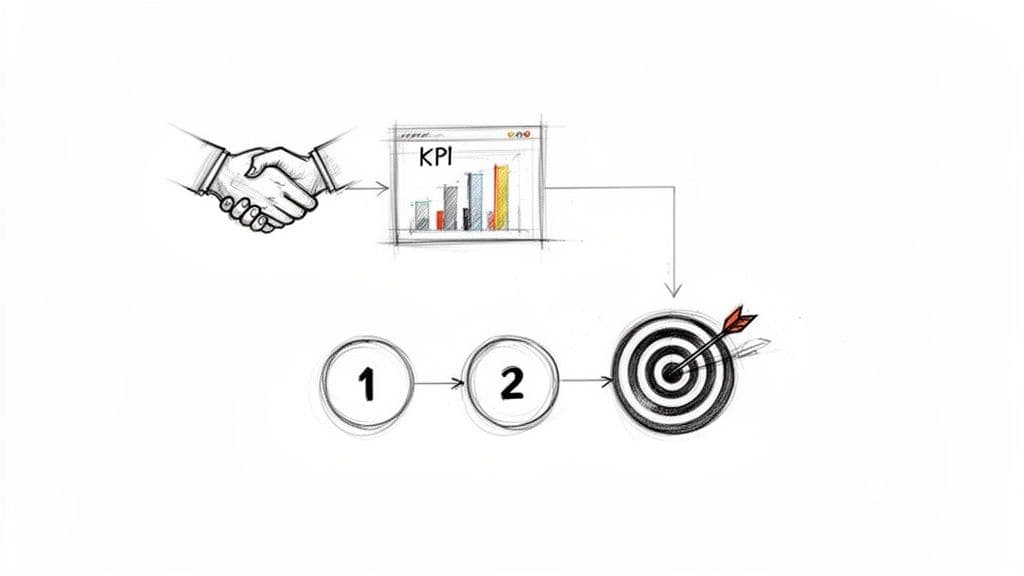
You’ve found your agency and signed the contract. It’s a huge step, but the most critical phase is just beginning. The success of your entire partnership with an AI search optimization agency in Mexico will be determined by how you handle the first 30-60 days.
This isn't just about hand-offs; it's about integration. A sloppy start filled with missed details and poor communication can set you back for months. A smooth, well-planned onboarding, on the other hand, gets your new team up to speed quickly, turning them from a vendor into a true extension of your own marketing department.
Think of it as a mutual deep-dive. They need to absorb your brand, your market, and your goals. You need full transparency into their process. This is where a solid onboarding plan prevents things from falling through the cracks.
The Strategic Onboarding Checklist
The first month should be a structured exchange of information and access. Rushing this is the single biggest mistake I see companies make. It always leads to mismatched expectations and lackluster initial results.
Here’s what a proper onboarding should cover:
- Technical Access & Integration: This is table stakes. Get them secure access to your Google Analytics, Search Console, CMS, and any relevant marketing or CRM platforms. Without this, their hands are tied.
- Brand & Market Immersion: Schedule time to walk them through everything—your most successful (and failed) marketing campaigns, detailed buyer personas, brand voice guidelines, and your own competitive research. They need to understand the nuances of your business in the Mexican market.
- Goal Alignment Workshop: You talked about goals during the sales process, but now it’s time to get granular. A dedicated workshop is essential for locking in the specific, measurable targets for the first quarter and the year ahead.
Onboarding is more than just handing over passwords. It's a strategic alignment. The more context you give your agency upfront, the faster they can build a strategy that actually drives revenue, not just vanity metrics.
Defining the Next Generation of KPIs
The old SEO playbook is obsolete. Tracking keyword rankings alone won't tell you if you're winning in an AI-driven search landscape. You need to measure what actually matters now: your visibility inside AI-generated answers.
Your focus has to shift to a new breed of KPIs. The key is to establish a baseline for these metrics within the first month so you have a concrete starting point to measure progress against.
Key AI Search KPIs to Track:
- Share of Voice in AI Answers: For your most important commercial keywords, what percentage of AI Overviews or chatbot responses mention your brand? This is the new definition of market share.
- Citation & Source Frequency: How often is your website explicitly named as the source of information in an AI-generated answer? Every citation is a powerful vote of confidence in your authority.
- Sentiment of Brand Mentions: It’s not enough to be mentioned; you need to know how. Are the mentions positive and recommending, or are they neutral or negative? This directly impacts brand perception.
- Conversion Rate from AI Referrals: Dig into your analytics to isolate traffic coming from clicks within an AI answer. Is this traffic converting? Are they high-quality leads? This is where you connect AI visibility to bottom-line impact.
Focusing on these indicators gives you a real-time view of your performance. For a deeper dive, our guide on essential search metrics for SEO visibility can help you build out a more comprehensive reporting dashboard with your new agency.
Frequently Asked Questions About AI Search Optimization
As a business leader in Mexico, you're likely grappling with how the rise of AI search changes things for your marketing. It’s a new frontier, and it’s natural to have questions. We hear a lot of the same concerns from CMOs and marketing directors, so let's clear up a few of the most common ones.
My goal here is to give you the straight answers you need to set realistic expectations and make smart decisions for your brand's digital future.
How Is AI Search Optimization Different from Traditional SEO?
This is the big one. The simplest way I can put it is that traditional SEO gets your webpage on the list, but AI Search Optimization (or Answer Engine Optimization) makes your brand the answer.
Traditional SEO built its foundation on things we know well—backlinks, keyword density, and technical site health—all to climb the rankings on a results page. That’s still important groundwork. But AI optimization is a whole different layer. It’s about structuring your company's knowledge in a way that AI models, like the ones behind Google's AI Overviews, can instantly understand, verify, and cite.
It's less about chasing specific keywords and more about owning the concepts, or "entities," related to your business. You're not just optimizing for a search engine; you're creating a verifiable knowledge base for a machine. A solid strategy truly needs both, but focusing on this new layer is what keeps you visible when there's no list of blue links to click on.
What Is a Realistic Budget for AI Search Optimization?
Because this is a more specialized discipline, you should expect the investment to be different from a standard SEO retainer. Based on what we're seeing in the market for a dedicated AI search optimization agency in Mexico, a comprehensive program will typically start at around $5,000 USD per month.
For larger B2B companies or enterprises with a lot of complex products or services, that figure can climb to $25,000+ USD monthly.
This investment isn't just for content and links. It covers a much broader scope of work that often includes:
- Deep-diving into advanced structured data and managing your company's knowledge graph.
- Constant monitoring of how your brand is being mentioned and cited across AI platforms like Google AI Overviews and Perplexity.
- Developing highly specialized content that is written for both human experts and machine consumption.
The best way to frame this is as a strategic investment, not just a marketing cost. The leads that come from a direct AI answer are often incredibly qualified and much further along in their decision-making process, which usually translates to a much stronger ROI down the line.
How Long Does It Take to See Results?
AI optimization is a long game, not a quick win. You're fundamentally teaching AI models that your brand is the definitive, trustworthy authority in your space, and that doesn't happen overnight. It takes time and, above all, consistency.
In our experience, you can expect to see the first positive signals within about 3 to 6 months. These are usually early indicators like an increase in brand citations or seeing your content appear in AI-generated answers for long-tail queries.
However, the more significant business impact—a measurable lift in high-intent leads coming directly from AI-driven sources—generally starts to materialize after the 9 to 12-month mark. The key is to be patient. You're building a powerful, long-term competitive advantage by embedding your brand into the very fabric of the new AI-powered internet.
Ready to see how your brand is actually showing up in AI-generated answers? Attensira offers the analytics and monitoring platform you need to forge a winning AI search strategy. Find the gaps in your visibility and start optimizing your content with genuinely actionable insights.