


Your guide to finding the right AI search optimization agency Munich. Learn how to vet partners, set goals, and measure success in the new era of AI search.
For B2B leaders in Bavaria, the game has changed. For years, the objective was simple: get to the top of Google. Now, with AI handling a huge slice of search queries, that old playbook won't cut it. Finding a skilled AI search optimization agency in Munich is no longer a forward-thinking move; it's a critical step to keep your brand relevant.
The New Search Landscape of 2026
The path your customers take to find you has been fundamentally rerouted. Traditional SEO, which was all about ranking web pages, is quickly becoming outdated. AI platforms like Google’s AI Overviews, ChatGPT, and Perplexity are now answering questions directly, turning search engines into answer engines. For B2B companies in and around Munich, this means you either adapt or you become invisible.
This shift demands a new discipline: Answer Engine Optimization (AEO). The focus here isn't on climbing rankings but on making sure your brand's data and expertise are cited directly in AI-generated answers. You're no longer just competing for clicks. You're competing to become a trusted, authoritative source for the AI models themselves. For a Munich-based tech firm, this is the difference between being recommended as a top solution and being left out of the conversation entirely.
The Urgency of Adaptation
This isn't some far-off trend. The move to AI-powered search is happening right now, reshaping how users find information. By 2026, AI-driven search will account for 30% of all search volume, a massive shift fueled by users conducting hybrid searches across both traditional engines and AI chatbots.
While Google still dominates the overall market, ChatGPT alone now commands over 60% of the AI search market. Industry analysis highlights why a singular focus on Google is a failing strategy.
The data below paints a clear picture of the forces driving this change—AI's growing market share, its rapid uptake by key demographics, and its mobile-first nature.
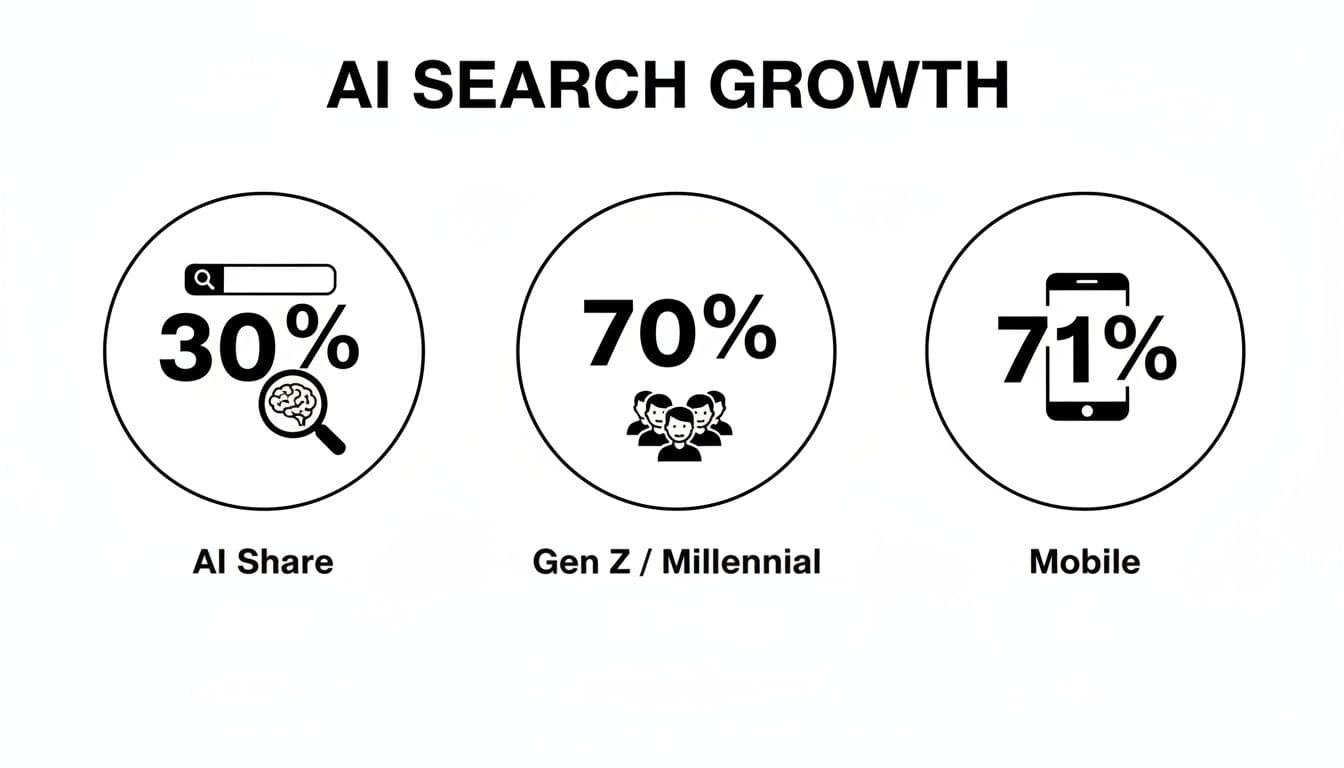
What this really tells us is that your future customers are finding what they need on their phones, often without ever seeing a traditional results page. With Gen Z and Millennials making up over 70% of AI search adopters, this is a reality you can't afford to ignore.
Securing visibility within AI answers is the new competitive imperative. If your brand isn't cited in the response, you don't exist for that user at that moment.
The Role of Specialized Tools
A new environment requires new tools. The old way of just tracking keyword rankings is obsolete when success is now measured by how often your brand is cited in AI summaries. This is where platforms like Attensira come in, built specifically to monitor how your brand is being represented across dozens of AI platforms.
This kind of specialized tracking is non-negotiable for any AI search optimization agency in Munich hoping to measure and refine its strategy. Without it, you’re flying blind. For B2B companies, this means checking not just brand mentions, but also how the AI describes your products, services, and core value propositions.
You can learn more about how to adapt to these changes in our article about Google's AI Mode. Taking a proactive approach is the only way to ensure your messaging stays accurate and authoritative, allowing you to shape your brand’s reputation in the age of AI.
Laying the Groundwork: Define Your Goals Before You Search
Before you even think about contacting an agency, you need a clear picture of what success means for your business. Walking into these conversations without well-defined objectives is like asking an architect to design a building with no blueprint. A vague request to "get better AI visibility" is a recipe for a stalled project.
The process has to start with an honest internal audit. For B2B firms in Munich, this goes far beyond just website traffic. You need to understand where your expertise is—and isn't—showing up when AI models generate answers for your potential customers.
From General Ambitions to Specific Targets
This is the most critical prep work you'll do. You have to translate those broad ambitions into concrete, measurable goals that are tied directly to business outcomes.
Think in terms of tangible results. Here’s what that looks like in practice:
- Competitor Displacement: Aim to replace a specific competitor’s brand in AI-generated answers for a high-value query, like “best B2B SaaS for logistics in Germany.”
- Lead Generation: Target a 25% increase in marketing qualified leads that originate from AI-driven search interactions within the next two quarters.
- Factual Accuracy: Push for a 50% lift in accurate, positive mentions of your product’s core features across platforms like Perplexity and ChatGPT.
This exercise forces you to get specific about what you really need. An agency can’t hit a target you haven't set. When you provide a clear list of objectives, a prospective AI search optimization agency in Munich can immediately start thinking about a strategy that addresses your actual business needs. You can learn more about how to set and track these kinds of goals in our guide on digital marketing performance metrics.
A well-defined objective is more than just a goal; it's a filter. It helps you quickly disqualify the wrong agencies and ensures your initial conversations are about achieving real results, not just ticking off tasks.
Setting a Realistic Budget
Once your goals are crystal clear, you can have a serious conversation about budget. AI search optimization is an investment in the long-term relevance of your brand, not just another line item on the marketing spreadsheet. Your budget should reflect its strategic importance.
Think about the lifetime value of a single customer acquired because an AI recommended your solution. Then, consider the opportunity cost of being invisible when your ideal client asks an AI for a referral. Framing the investment this way elevates the conversation from a simple cost to a vital growth driver. It’s the kind of groundwork that makes for truly productive partnerships.
Evaluating Potential AI Search Partners in Munich
When you're looking for a partner to guide you through the new terrain of AI search, the old evaluation playbook just won't cut it. In this emerging field, it seems everyone is suddenly an "AI expert," but genuine, hands-on experience is incredibly scarce. You have to look past the slick marketing and probe deeper to find a true AI search optimization agency in Munich that can actually move the needle.
Your vetting process really needs to zero in on three critical areas: the technology they actually use, their practical experience across different AI platforms, and their approach to data governance—which is absolutely non-negotiable here in the EU.
What’s Under the Hood? Their Tech and Platform Experience
An agency’s real competence is often hidden in its tech stack. A standard SEO toolkit simply isn't equipped for this new challenge. You're looking for a partner fluent in the platforms built for what we call Answer Engine Optimization (AEO).
Get specific with your questions. Are they still just using traditional keyword trackers? Or are they working with advanced platforms like Attensira that can monitor how your brand is mentioned—and with what sentiment—across dozens of AI models like ChatGPT, Perplexity, and Google's AI Overviews? The ability to deliver that kind of analysis is a huge tell.
Beyond the tools, their experience has to be broader than just Google. Ask them to walk you through strategies they've actually implemented for different AI engines.
- How do they approach optimizing content to be cited by an engine like Perplexity, which heavily favors fact-based, well-sourced information?
- What’s their process for ensuring your brand's narrative is accurate and consistent in a conversational AI like ChatGPT?
- Can they show you how they’ve managed to influence results in niche, vertical-specific AI tools that matter to your B2B sector?
If an agency gives you vague, "one-size-fits-all" responses, they're probably just trying to fit old SEO tactics into a new box. A real expert will get into the weeds, discussing the nuances of optimizing for each type of model.
Data Governance and Why Local Expertise Matters
For any business operating in Germany, data privacy is everything. An AI search optimization agency in Munich must have an ironclad grasp of GDPR and other local regulations. This isn't just about legal compliance; it directly shapes the entire strategy.
When an agency uses your proprietary business information to influence or train AI models, they effectively become a data processor. A fuzzy understanding of GDPR isn't just a red flag—it's a direct route to significant legal and financial risk for your company.
Ask them to lay out their data-handling protocols in plain language. How, specifically, do they ensure any data used for optimization is anonymized and fully compliant? You want to hear a confident, detailed response that shows they're proactive about privacy, not just reacting to it. This local knowledge is a massive differentiator. You can discover more about how a German-based agency offers a strategic advantage in our complete guide.
To make this distinction even clearer, this table shows the fundamental differences between a legacy agency and the kind of modern partner you need.
Traditional SEO Agency vs AI Search Optimization Agency
This comparison really brings the shift into focus. The right partner isn't just adding an "AI" bullet point to their list of SEO services. They've built an entirely new methodology, one designed from the ground up to influence the AI models that are quickly becoming the new reality for your customers.
Getting Straight Answers on Strategy and Cost
You’ve done the research and have a shortlist of agencies. Now comes the most critical part: the interview. This is where you'll quickly tell the difference between a true specialist and a team that’s simply bolted "AI" onto their old SEO services.
Forget the softball questions like, "What results can you promise?" They're meaningless. To get a real sense of their capabilities, you need to probe their strategic thinking with questions that show you understand the nuances of this new field. Any ai search optimization agency in Munich worth its salt will welcome the challenge.
Questions That Uncover Real Expertise
A genuine expert won't just throw buzzwords at you; they'll walk you through their methodology. You want to see that they grasp how different AI search platforms operate and how to influence them.
Try asking these questions to cut through the sales pitch and get to the core of their competence:
- "Can you walk me through how your optimization approach would change for a conversational AI like ChatGPT versus a citation-heavy engine like Perplexity?"
- "How do you handle a situation where an AI model misrepresents our brand or products in its answers? What's your correction process?"
- "Tell me about a time you successfully influenced an AI engine to cite your client's data over a competitor's. What specific actions did you take?"
- "What is your protocol for ensuring all optimization activities are 100% compliant with GDPR, particularly when our proprietary data is involved in the process?"
A strong potential partner will answer these thoughtfully and, just as importantly, start asking you questions in return—about your data, your subject matter expertise, and your core business goals.
The real goal here isn't just to confirm they can do the work. It's to understand how they think. You're looking for a partner who sees AI search as a complex ecosystem to be navigated, not just a new place to stuff keywords.
Making Sense of Agency Pricing Models
Once you're confident in their strategic abilities, the conversation will inevitably shift to budget. In a new discipline like AI search optimization, pricing isn't always standardized, but you'll generally find agencies using one of three common models.
For a more detailed look at the numbers, we've put together a guide on agency pricing models and what to expect.
Each structure has its pros and cons. The key is to find the one that aligns with your company’s goals and how you prefer to manage budgets.
A Look at Common Pricing Structures
At the end of the day, the right ai search optimization agency in Munich will be flexible. A transparent partner will clearly define what’s included in their fee, working with you to find a model that fits. This ensures you're on the same page from day one as you tackle the new frontier of search together.
Onboarding Your Agency and Measuring What Matters
You’ve signed the contract. But the real work of building a successful partnership with your AI search optimization agency in Munich is just getting started. The first few weeks are critical for setting the tone and turning your strategic goals into tangible actions.
A smooth kickoff goes beyond a simple meet-and-greet. It's about integration. This means methodically setting up secure, role-based access to your core systems—your CMS, analytics platforms, and any internal databases they’ll need. At the same time, you need to lock in your communication rhythm. Who are the daily contacts? What's the process for escalating an urgent issue? Nailing this down early prevents friction later.
Moving Beyond Clicks to Measure Real Influence
Once the operational groundwork is in place, the conversation has to shift immediately to performance. And this is where many companies get stuck in the past. In a world where AI-powered answers are resolving user queries directly on the results page, old-school metrics like click-through rates (CTR) are becoming dangerously irrelevant.
The data on this is stark and impossible to ignore. Since AI Overviews began rolling out, organic CTR for top-ranking pages has cratered by a massive 65.3%. Other analyses show that nearly 60% of searches now result in zero clicks. If your agency is still leading its reports with website traffic and clicks, they're measuring yesterday's game. You can see more of these eye-opening generative search statistics to grasp the scale of this change.
In Answer Engine Optimization (AEO), visibility is the new click. Success isn't about driving a user to your site; it's about your brand being cited as the definitive source within the AI's answer itself.
The New KPIs for AI Search Success
To accurately measure your agency's impact, you need a modern dashboard built around KPIs that reflect this new reality. These metrics track authority and influence, not just website visits.
Your reporting should now be centered on these key indicators:
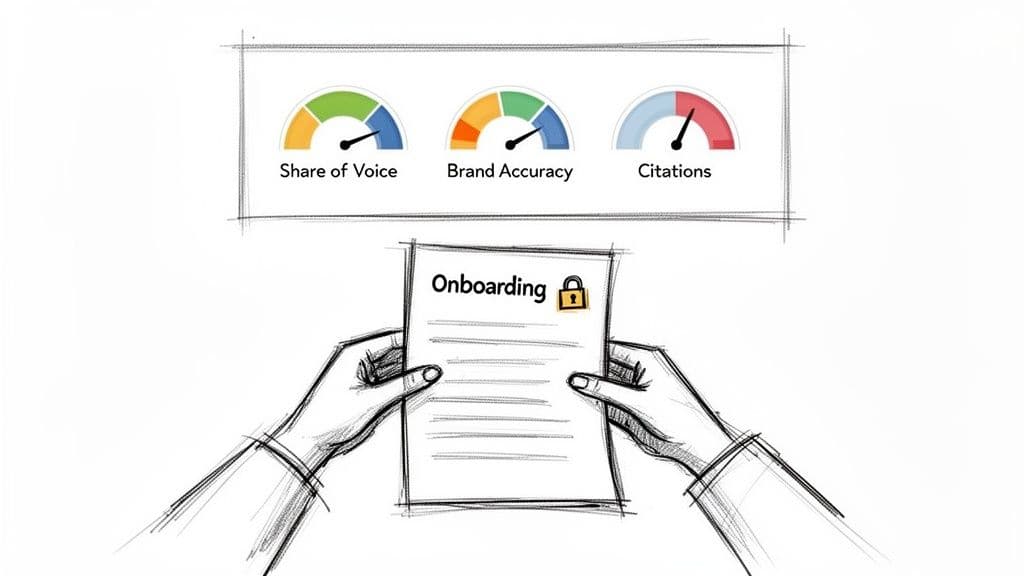
- Share of Voice (SoV) in AI Responses: For your most important commercial queries, how often is your brand named compared to your competitors? This is the ultimate test of relevance, and you'll need a platform like Attensira to track it accurately across the dozens of different AI models in use.
- Factual Accuracy and Sentiment: Are the AI's answers about your company correct? Do they reflect your brand and products positively? This KPI is about actively managing your reputation by identifying and correcting misrepresentations in the AI's knowledge base.
- Citation Volume and Quality: This metric tracks how many times your high-value content—your whitepapers, research, and case studies—are used as the source for an AI-generated answer. It’s a direct measure of your content’s authority and credibility.
Adopting this new measurement framework is non-negotiable. For a closer look at how to connect these brand-building activities to the bottom line, our guide on how to measure marketing ROI provides a blueprint. By focusing on these modern KPIs, you and your agency can align on what truly drives value: cementing your brand as the trusted authority in your space.
A Few Common Questions I Hear About AI Search Optimization in Munich
When I talk to B2B leaders about this shift to AI-powered search, the same core questions tend to surface. It's a new game with different rules, so it's natural to want some clarity before you commit.
Here are my direct answers to the things I get asked most often. Think of this as a starting point for framing the challenge and opportunity for your own brand as you look for an AI search optimization agency in Munich.
How Is This Really Different From the SEO We Already Do?
The goal has completely changed. Traditional SEO is a battle for clicks—you want to rank your webpage high enough in a list of blue links that someone chooses you. AI Search Optimization, which you might hear called Answer Engine Optimization (AEO), isn't about getting a click. It's about becoming the answer itself.
This means we have to think differently. Instead of just chasing keywords and building backlinks, the new priority is to establish your company as a rock-solid, authoritative source that a large language model will trust and cite. It's a strategy built on creating fact-heavy content, using structured data that machines can easily parse, and proving your topical authority so the AI has no choice but to reference your information when it generates a response.
What Kind of Budget Should We Expect for an Agency in Munich?
This is specialized work, and the pricing reflects that. While every project is different, it helps to have a realistic budget in mind from the start.
- Entry-Level Engagement: For foundational work like monitoring key queries and some initial optimization, you're likely looking at a retainer starting around €3,000 to €5,000 per month. This gets you in the game with basic tracking and reporting.
- Comprehensive Strategy: For a full-blown engagement—think deep content creation, technical audits to make your site AI-ready, and constant monitoring—budgets often run from €7,000 to over €15,000 per month.
It’s important not to view this as just another marketing line item. This is an investment in your brand’s long-term authority. The return isn’t measured in website visits, but in your ability to control your brand message and own your space in the new AI information ecosystem.
In the AI search landscape, visibility isn't about getting clicks—it's about becoming the answer. The value lies in being the trusted source an AI presents to a potential customer, shaping their perception before they ever visit a website.
Why Does a Local Munich Agency Matter for This?
AI might be a global technology, but its effective application is intensely local. For any business with a serious presence in Germany or the EU, working with a Munich-based agency offers some very real, practical advantages.
For one, a local team has a built-in understanding of the German B2B market—the industry shorthand, the competitive dynamics, and the specific ways your customers search for information.
Even more critical, though, is their command of GDPR and EU data privacy regulations. An AI search optimization agency in Munich lives and breathes these rules. When you're using company data to guide your strategy, having that local, practical expertise isn't just a nice-to-have; it's essential for staying compliant.
Ready to secure your brand's place in the future of search? Attensira provides the critical intelligence you need to see how your brand is represented across AI platforms and gives you the tools to influence those conversations. Get started with Attensira today.