

Find how ai search optimization agency switzerland boosts visibility with proven criteria to vet, hire, and manage AI-driven search partners in 2026.
Relying on yesterday's SEO tactics in Switzerland is like navigating the Alps with a map from the 1990s. The landscape has changed, but many are still using the old guides. An AI search optimization agency in Switzerland isn't just a forward-thinking choice anymore; it's a strategic necessity for getting your brand seen where customers are actually looking: inside AI-generated answers.
Why Traditional SEO Is Failing Swiss Businesses
The way people discover information online is undergoing its most significant change in decades. For years, the game was straightforward: get your webpage to the top of Google's blue links. That model, built on a foundation of keywords and backlinks, worked. But that entire system is being upended, and the old rulebook is becoming obsolete.
For B2B companies in Switzerland, this isn't some distant threat. It's happening now. The core problem is the fundamental shift in user behavior, driven by large language models (LLMs) like ChatGPT, Perplexity, and Google's own AI Overviews.
The Rise of the Answer Engine
People have stopped just "searching." They're now asking complex questions and expecting a single, synthesized answer. Instead of clicking through ten different links to piece together information, they want the final summary delivered directly. This evolution from "search engine" to "answer engine" makes your website's ranking far less important than your brand's presence within the AI-generated response.
The old goal was to win a click on a results page. The new goal is to become a trusted source that the AI cites, embedding your expertise directly into the answer a potential customer receives.
This new reality requires a different approach, one we call Search Everywhere Optimization. It’s about ensuring your company's data, expert opinions, and solutions are visible and verifiable wherever your audience might ask a question—whether that's a classic search engine, an AI chatbot, or a voice assistant.
The Data Doesn't Lie
The move to AI-powered discovery isn't just a theory; the numbers are stark. One recent study showed that referral traffic from LLM platforms exploded by 527% year-over-year. You can find more of the AI search statistics that are reshaping digital strategy on Semrush's blog.
This isn't a trickle; it's a flood. Some websites are already seeing AI chatbots drive over 1% of their total sessions, and that figure is climbing fast.
What this means for your business is clear. Early predictions of a 25% drop in organic search traffic by 2026 once seemed alarmist, but we're already seeing this play out. In some sectors, traffic has already fallen by as much as 22% where AI suggestions have taken over. Ignoring this trend is like ignoring the shift to mobile a decade ago—a critical mistake many businesses are still paying for. You can review these kinds of missteps in our guide on common SEO mistakes to ensure you don't repeat them.
For Swiss B2B firms, this presents a clear threat but also a massive opportunity. Sticking with outdated SEO will lead to a slow erosion of visibility. But for the early adopters who partner with a specialized AI search optimization agency in Switzerland, this is a chance to secure a powerful competitive edge. You can establish your brand as an authority in the AI era and capture market share while your competitors are still trying to figure out what changed.
The table below summarizes the new search reality that Swiss businesses must confront and the strategic mindset required to thrive.
The New Search Reality for Swiss Businesses in 2026
Ultimately, the businesses that will win in this new environment are those that adapt their strategy from chasing rankings to building true, verifiable authority.
How To Spot a Genuine AI Search Partner in Switzerland
Finding the right agency in this new AI-driven search era means looking past the polished homepages and "AI" badges. Let’s be honest—many traditional SEO firms have just slapped on the AI label without fundamentally changing their old-school tactics. A true specialist thinks differently. Their focus is on what we call Generative Engine Optimization (GEO) and positioning your brand as a citable, authoritative source for AI models.
Your first job is to cut through that noise. You need a partner whose expertise goes beyond simple keyword rankings and into the very mechanics of how AI like Perplexity or Google's AI Overviews construct an answer. They need to know how to influence this process, both ethically and effectively.
What Real AI Search Expertise Looks Like
When you're sizing up a potential AI search optimization agency in Switzerland, you have to look for tangible proof of their expertise. Their own website and content are the first, most obvious places to start. A genuine partner will be openly discussing their methodology and showing their work.
They should be talking about:
- Generative Engine Optimization (GEO): This is the key term. If they aren't using it and explaining their strategies for it, they're likely still thinking in terms of traditional SEO.
- LLM Behavior: Do their articles and case studies show they actually understand how Large Language Models process information, vet sources, and synthesize answers?
- Swiss Data Privacy: Any credible Swiss agency must demonstrate a deep, practical knowledge of the Federal Act on Data Protection (FADP) and how it applies to AI data processing. This isn't just a talking point; it's a legal necessity.
A true AI search partner isn’t just trying to get you a click. They're trying to make you a foundational source of truth for AI models in your industry. The goal shifts from winning a top spot on a list to winning the AI’s trust.
This isn't just a minor tweak to old strategies; it's a complete evolution in how we approach search.
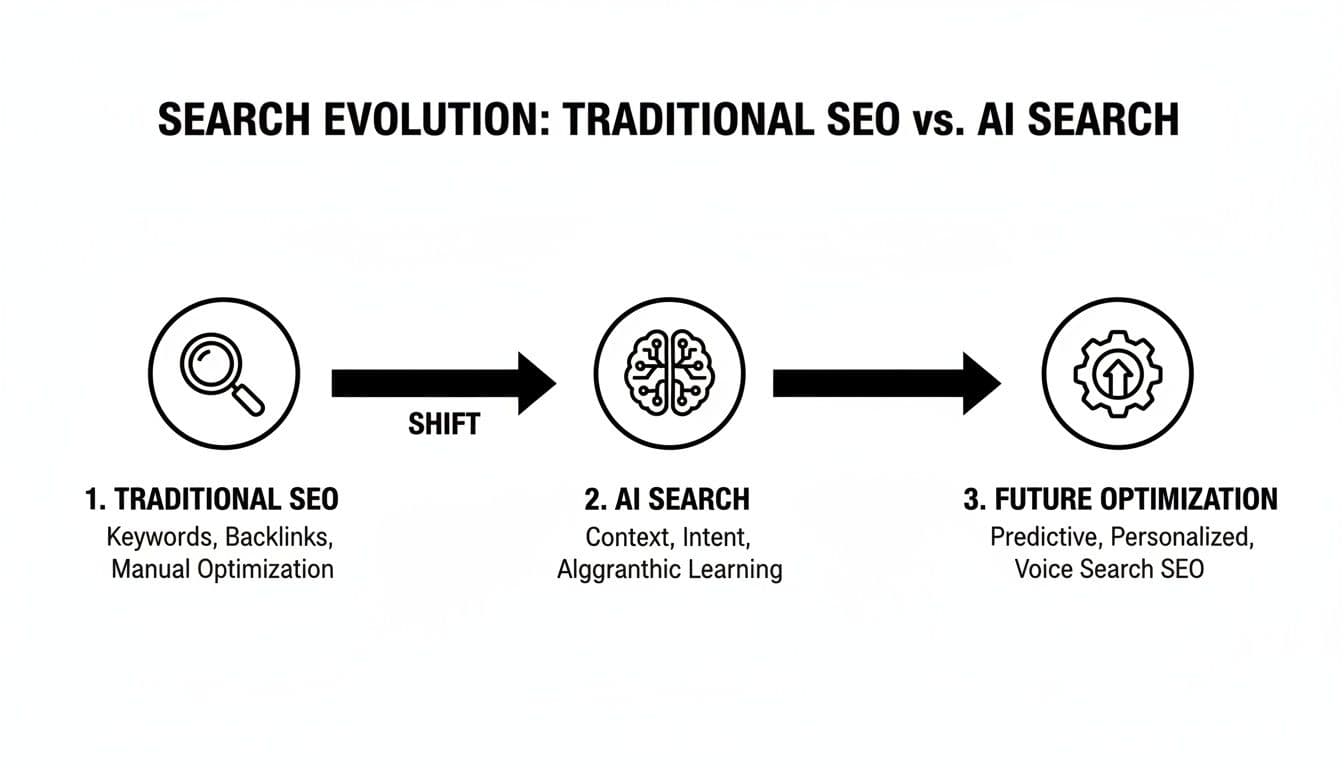
As you can see, the game has moved from just being visible in a list to being deeply integrated into an AI's knowledge base. That requires a much more sophisticated strategy built on data, authority, and verifiability.
Where to Find These Specialist Agencies
These specialized firms aren't always the ones with the biggest marketing budgets. They often cluster around innovation hubs, so start by looking for agencies with a presence in Swiss tech centers like Zurich, Geneva, and Lausanne. Industry-specific forums and professional networks on platforms like LinkedIn are also great places to ask for recommendations.
It also helps to see how other advanced markets are tackling this. For a bit of perspective, our guide on finding an AI search optimization agency in Canada outlines trends and vetting criteria that are just as relevant for the Swiss market.
When you start shortlisting agencies, dig into their case studies. A generic claim like "we increased organic traffic by 50%" is a red flag. That’s an old-world metric. Instead, look for details on performance indicators that actually matter for AI search, such as:
- Increased citations and brand mentions in AI-generated answers.
- Noticeable growth in referral traffic from AI chat platforms.
- A measurable lift in "AI Share of Voice"—a metric that tracks your brand’s visibility within AI responses.
A Quick Vetting Checklist
Before you even get on a call, use this quick checklist to filter out the pretenders. A real specialist should tick all these boxes.
- A Battle-Tested Methodology: They don't just talk about GEO; they have a clear, documented process they can walk you through.
- A Focus on Data and Verifiability: Their strategy should be obsessed with structured data, entity optimization, and building a verifiable knowledge graph around your brand.
- Proprietary Tools or Advanced Techniques: They're either using specialized platforms (like our own Attensira tool) to track AI visibility or can show you advanced, custom methods for monitoring it.
- Niche-Specific Insight: They demonstrate an ability to quickly grasp the nuances of your specific B2B sector in Switzerland.
- A Transparent, Educational Approach: A good partner wants to educate you, not just sell you a black-box service. They should be making you smarter about AI search.
An agency that meets these criteria is much more likely to be a genuine partner who understands this isn't just a technological shift—it's a fundamental strategic one.
Evaluating Your Shortlist Beyond the Sales Pitch
You’ve got your shortlist. Now the real work begins. The glossy brochures and confident sales calls have done their job, but it’s time to look past the pitch and dig into their actual capabilities. This is the moment you figure out if you're talking to a genuine AI search optimization agency in Switzerland or just a traditional SEO firm that’s learned some new buzzwords.
Your goal is to shift the conversation from what they promise to how they'll deliver. You need a solid evaluation framework that tests their technical skills, strategic thinking, and whether they truly get your business.
Assessing Niche Expertise and Strategic Grasp
A one-size-fits-all approach to AI search is a waste of time and money. The right partner needs to have a firm grasp of your specific B2B niche within the Swiss market. They should understand your customers' pain points and speak their language.
On your calls, challenge them to outline a high-level strategy for your company. A sharp agency won't just talk about generative AI; they'll suggest concrete actions. They might propose building out a "digital entity" for your CEO to establish expertise, or creating a structured knowledge graph from your company's proprietary data so LLMs can easily cite it.
One of the most telling signs is whether an agency acts like a strategic partner or a task-taker. Are they asking you deep questions about your business objectives, or are they just asking for a list of keywords? The first is a partner; the second is a vendor you’ll have to micromanage.
A truly competent agency will also raise the unique challenges of the Swiss market unprompted. This goes beyond data privacy and FADP compliance. They should be talking about the linguistic nuances across German, French, and Italian cantons and how that affects the way local AI models interpret and surface information.
Scrutinizing the Tech Stack and Methodology
An agency's results are only as good as the tools and processes behind them. Don't be shy about asking exactly what platforms they use to track and influence your visibility in AI-generated answers. If they give you a vague answer, that’s a huge red flag.
You’re looking for specific tools built for this new reality. Do they use a platform like Attensira to monitor when and how your brand appears in AI responses? Can they explain how they measure your "AI Share of Voice"? If they can't show you how they track this, they can't reliably improve it.
A documented methodology is also non-negotiable. Ask them to walk you through their standard process:
- How do they conduct an initial AI visibility audit?
- What’s their framework for optimizing content for Generative Engine Optimization (GEO)?
- How do they find opportunities to get your brand cited in AI Overviews?
Their answers should reveal a structured, repeatable system, not just a random collection of tactics. To make this comparison easier, it's best to formalize your questions in a Request for Proposal (RFP).
Crafting a Focused Request for Proposal
An RFP for AI search needs to be different from a standard SEO brief. Its primary purpose is to compel agencies to prove their AI-specific expertise.
Here’s a sample brief you can adapt to build your own RFP:
Sample RFP Brief for an AI Search Optimization Project
This structured request forces them to give you a substantive, analytical response, not just marketing fluff. It makes it far easier to compare proposals side-by-side and see who really knows their stuff. This detailed evaluation, starting with a clear audit of where you stand today, is the foundation of a successful partnership. To get a feel for what that initial audit involves, you can learn more about how to perform an SEO audit and adapt those core principles for the AI search landscape.
Alright, you’ve sifted through the proposals and sat through the sales decks. Now comes the most critical part: the face-to-face (or screen-to-screen) conversation. This is where you find out if you’re talking to a genuine strategist or just a slick salesperson.
Your real job here is to get past the polished presentation and dig into their actual problem-solving abilities. Generic questions will only get you generic, rehearsed answers. You need to ask questions that force an AI search optimization agency in Switzerland to think on its feet and reveal how deep their expertise truly runs.
Forget the easy stuff like "What's your process?" or "Tell me about your team." Any decent agency has a canned answer for those. We're going to focus on situational questions that simulate the real pressures of this new AI search environment.
Getting to Their Real-World Strategy
Let's start by putting them in the hot seat with a scenario. You're not looking for a perfect, pre-baked solution here. What you're testing is their thought process—how they diagnose a problem and what levers they know how to pull.
Here are the kinds of questions that cut right through the fluff:
- "Walk me through a specific time you successfully improved a client's visibility in AI-generated answers. What was the exact tactic, how did you track it, and what was the final, quantifiable result?"
- A strong answer will be incredibly specific. They won't just say "we optimized content." They'll name the platform, like Google's AI Overviews or Perplexity, and detail the tactic—maybe it was restructuring content around verifiable facts, building out a Knowledge Panel, or implementing very specific schema. Most importantly, they'll give you a real KPI, like a 35% jump in what they call "AI Share of Voice," and mention tracking it with a tool like Attensira.
- "Let's imagine a major LLM update just tanked our brand's visibility in AI answers overnight. Give me your first three steps, and then outline your long-term recovery plan."
- What you're listening for is a clear, logical diagnostic process. A great response will sound something like this: First, they'd analyze which types of content got hit. Second, they'd immediately start investigating what new sources the LLM is now citing instead. Third, they'd run a competitive analysis to see who benefited from the shift. Their long-term plan won't be about one magic bullet; it will be about diversifying authority signals so you're not vulnerable to a single point of failure again.
A top-tier agency answers these questions with a confident, methodical breakdown of their process. They talk about analyzing SERP features, reverse-engineering the AI's new sources of truth, and adapting content structure. A weak, vague answer like, "We'd analyze the situation and adjust our strategy," is a major red flag.
Making Sure They Can Measure What Matters
Next, you have to be absolutely sure they can prove their own value. Old-school SEO metrics like keyword rankings are becoming less relevant. A forward-thinking agency has already moved on to new KPIs that reflect the AI-driven search landscape.
Drill down on their measurement capabilities with these questions:
- "How do you actually define and measure 'AI Share of Voice' for a Swiss B2B company? What specific tools are you using to track this?" This question quickly separates the talkers from the doers. A solid answer will describe a clear methodology for tracking brand mentions, product citations, and key executive quotes across multiple AI platforms.
- "Moving beyond traffic, how do you measure the quality of the visitors we get from LLM referrals? How can you prove to my CFO that this is driving real business value?" A great response will immediately shift to business outcomes. They'll talk about tracking user engagement signals, lead quality scores, and assisted conversions from this specific traffic source, connecting their work directly to your bottom line.
- "Can you show me a sanitized client report? I want to see exactly how you communicate progress and justify the investment." This is the ultimate proof. A good report is clear, concise, and focused on business outcomes, not just a list of tasks they completed.
Finally, when you ask for references, don't just ask for their best-case scenario. Be direct and ask this instead: "Tell me about a project that didn't go according to plan. What went wrong, and what did your team learn from that experience?"
An agency that can openly and honestly discuss a failure—and more importantly, the lessons they learned from it—is an agency you can trust. It demonstrates maturity, transparency, and the foundation of a true partnership.
Onboarding Your Agency and Measuring Real ROI

Signing the contract with an AI search optimization agency in Switzerland isn't the finish line; it’s the starting gun. Now the real work begins. The next steps are all about a smooth, structured onboarding process and, crucially, defining the metrics that will prove this partnership is actually delivering value.
A solid start is built on two things: clear communication and secure access. Your new agency needs access to your core digital assets to get started, and setting this up properly from the get-go prevents frustrating delays and security headaches. This isn't just about handing over logins; it’s a strategic transfer of knowledge.
The Essential Onboarding Checklist
A thorough onboarding process is the difference between an agency hitting the ground running and one that spends weeks trying to find what they need. The goal is to get them productive quickly and securely, without disrupting your team's day-to-day work.
Here’s a practical checklist to get things moving:
- Secure Access and Credentials: This is day one stuff. Grant access to your Google Analytics 4 (GA4), Google Search Console, and any SEO tools you're already using. Always use a secure password management system to grant permissions, not email. You need to retain ultimate ownership and control.
- Content and Asset Repository: The agency needs to understand your brand inside and out. Give them access to your CMS, brand guidelines, product documentation, past marketing campaigns, and any internal data or customer research you have. This knowledge is what allows them to match your brand's voice and expertise.
- Communication Channels and Cadence: Set up a dedicated Slack or Teams channel for quick questions and updates. Plan on a recurring weekly or bi-weekly call to review progress and a more in-depth monthly meeting for strategic planning.
- Stakeholder Introductions: Make the introductions. The agency team needs to know who your head of content is, who leads product marketing, and who the key subject matter experts are. This direct line fosters collaboration and makes it infinitely easier for them to tap into your company's deep expertise.
Moving Beyond Obsolete Metrics
Once the agency is onboarded, the conversation has to shift immediately to measurement. I’ve seen too many partnerships get bogged down by vanity metrics. Traditional SEO indicators like keyword rankings and raw organic traffic numbers still have their place, but they're becoming dangerously insufficient.
These old metrics simply don’t capture what's happening inside AI-generated answers, which is where your audience is increasingly getting its information.
Relying solely on keyword rankings to measure AI search performance is like trying to measure the volume of a concert with a ruler. It’s the wrong tool for the job. Success is now defined by your influence and authority within AI-driven conversations.
An expert AI search optimization agency in Switzerland will come to the table with a new dashboard of key performance indicators (KPIs) built for this new world. These are the metrics that show a clear line to business impact and true ROI.
Here are the new benchmarks you should be tracking:
- AI Share of Voice (SOV): This is your new north star metric. It calculates how often your brand, experts, or products are cited in AI-generated answers for your most important topics. Specialized tools like Attensira are designed specifically to track this, showing your visibility as a clear percentage compared to your competitors.
- LLM Referral Traffic Quality: Don't just count the clicks coming from platforms like ChatGPT or Perplexity. You need to analyze what those visitors do. A great agency will be laser-focused on the bounce rate, time on page, and conversion rates for this specific traffic segment to prove it’s not just noise. For a practical guide on tying this to financial results, our framework on how to measure marketing ROI is a great resource.
- Brand Citation Frequency: This tracks every single mention of your brand within AI responses, even when there's no direct link. It’s a powerful leading indicator of your growing authority and mindshare in your niche.
The urgency here is backed by hard data. The presence of AI-generated content in search results has shot up from just 2.27% in 2019 to a projected 17.31% by 2025. And yet, an astonishing 92% of brands are completely invisible to AI like ChatGPT.
Focused strategies for Generative Engine Optimization (GEO) have been shown to boost brand citations by over 150%. This makes tracking AI Share of Voice and LLM traffic quality non-negotiable for success in 2026. You can dig into more of these 2026 generative search insights and statistics to see the full picture. By adopting this modern measurement framework, you can hold your agency accountable for results that actually move the needle.
Common Questions About AI Search Optimization Agencies
When we talk about AI-driven search, it’s natural for business leaders to have questions. This isn't just a minor shift; it's a completely new playing field. Here are some of the most common questions we hear from B2B decision-makers in Switzerland, with direct, no-nonsense answers.
What Is the Real Difference Between Traditional SEO and AI Search Optimization?
Many people assume this is just a new name for SEO, but the two are worlds apart.
Traditional SEO is all about getting a webpage to rank on Google's list of blue links. You target keywords, you optimize a page, and you hope someone clicks on your link. The goal is to win the click.
AI Search Optimization, which you might hear called Generative Engine Optimization (GEO), has a much different goal. The objective is to have your brand, your data, and your expertise cited directly within the AI's generated answer. Think Google's AI Overviews or a response from ChatGPT.
Instead of just ranking a page, you’re aiming to become a trusted, verifiable source the AI model relies on. This means your strategy has to be built on structured data, provable facts, and deep subject matter authority—a big change from the old keyword-centric playbook.
How Long Does It Take to See Results from an AI Search Strategy?
While becoming a pillar of authority in your field is a long-term game, you can see the needle move on some AI optimization efforts faster than you might think. The timeline really depends on where you're starting from, how competitive your industry is, and how quickly your team can publish genuinely expert content.
From what we’ve seen, progress tends to happen in phases:
- Quick Wins (Weeks): If you already have a library of high-quality content, you can see results in weeks. By adding schema markup and verifiable citations, you're essentially making it easier for AI to find and trust your existing assets.
- Building Momentum (3-6 Months): This is where you really start establishing a foothold. Consistently creating new, GEO-optimized content and strengthening your brand's digital authority leads to more frequent and prominent citations in AI answers.
- Sustained Authority (6+ Months): Becoming the go-to source for AI in your niche is an ongoing effort. After six months of dedicated work, you’re not just participating; you’re building a durable competitive advantage that’s hard for others to replicate.
Think of it as a marathon with clear milestones, not a sprint. Any credible ai search optimization agency switzerland should be upfront about this from day one.
Can Our In-House Marketing Team Handle This?
It’s possible, but it’s a big ask. Your team would need a rare blend of skills that are in short supply right now: deep expertise in how Large Language Models behave, advanced schema markup, knowledge graph management, and proficiency with the tools needed to track brand mentions across different AI platforms.
For most Swiss companies, the most direct path to results is partnering with a specialist agency. It lets your team tap into an expert-led strategy immediately, while they learn the processes and can gradually take on more of the work themselves.
This hybrid model gives you the best of both worlds—you get to market quickly while building up your team's capabilities for the long run.
Is This Relevant for Businesses Not Targeting a Tech Audience?
Absolutely. This is a critical point that many B2B leaders in Switzerland miss. Professionals in every single industry—from finance and law to manufacturing and logistics—are using AI to get quick answers and make better-informed decisions.
Just think about the questions being asked right now:
- A procurement manager asks an AI, "Compare logistics software providers in Europe with a strong Swiss market presence."
- A CFO prompts, "Give me a summary of recent changes to Swiss corporate tax law affecting international trade."
- An architect wants to know, "What are some sustainable building materials compliant with Minergie standards in Switzerland?"
If your business has the answers, you must show up in the AI's response. If you're invisible here, you're being cut out of the conversation before it even begins. Being absent from these AI-powered queries is a direct threat to your sales pipeline. We cover this in more detail in our comprehensive look at AI search optimization.
Ready to see how visible your brand is in the AI-driven search world? Attensira provides the tools to track your AI Share of Voice and turn insights into a competitive advantage. Discover how you rank and start optimizing your presence at https://attensira.com.