

Discover how ai search optimization agency tokyo can boost ROI with practical criteria, benchmarks, and actionable steps for B2B growth.
An AI search optimization agency in Tokyo focuses on a very specific challenge: getting your brand featured directly within AI-generated answers, like Google's AI Overviews or chatbot responses. This isn't your standard SEO. It's a completely different discipline centered on Generative Engine Optimization (GEO), where the goal isn't just to rank, but to become part of the authoritative answer itself.
For any company trying to gain traction in Tokyo’s crowded market, getting this right is becoming a matter of survival.
Navigating the New AI Search Frontier in Tokyo

The classic list of blue links is fading. Search is now a conversation, and with the rapid integration of AI Overviews, ChatGPT, and similar platforms, your brand's visibility depends on whether it's cited inside those AI-powered summaries.
If your key information isn't pulled into an AI response, you essentially become invisible to a huge and growing portion of your audience. This isn't something you can fix by simply tweaking old SEO playbooks. It demands a fresh strategy from the ground up.
The Rise of Generative Engine Optimization
This new field is called Generative Engine Optimization (GEO). At its core, GEO is the practice of structuring your digital footprint so that Large Language Models (LLMs) see your brand as a trusted, primary source. The objective is to shape how these AI systems understand and present your company, ensuring your narrative is woven directly into their answers. As you start to explore this space, it’s helpful to understand the foundational shifts driven by AI SEO and the impact of LLMs.
The data shows this isn't a future trend; it's happening now. We've seen a staggering 527% year-over-year jump in AI search traffic. Some websites are already seeing over 1% of their total sessions coming from sources like ChatGPT. This momentum is why the GEO market is projected to explode from 848 million in 2025 to **33.7 billion by 2034**.
The fundamental challenge has shifted. It's no longer about fighting for the number one spot. It's about becoming the answer. If your content isn't built for AI consumption, you risk being left out of the conversation entirely.
Why a Specialized Tokyo Agency is Crucial
Successfully navigating this requires a very specific skill set. A dedicated ai search optimization agency in Tokyo brings an essential combination of technical know-how and deep local market insight. Their work is laser-focused on:
- AI Visibility Monitoring: Constantly tracking how your brand is being represented across dozens of AI platforms.
- Content Structuring for LLMs: Reworking your website's data, articles, and information architecture so it’s easily processed by AI models.
- Japanese Market Nuance: Tailoring your entire strategy for Japanese language queries, cultural context, and local search behaviors.
Without a partner that lives and breathes this stuff, you're essentially playing a new game with an old rulebook. To get a better handle on the basics, our guide on the fundamentals of AI search optimization is a great place to start. This level of expertise isn't a nice-to-have anymore—it’s a core requirement for protecting your market share and driving future growth in Tokyo.
Defining Your Goals and Crafting an Effective RFP
Hiring an agency without a clear destination is a recipe for wasted time and money. Before you even begin looking for an ai search optimization agency in Tokyo, you need to have an honest internal conversation about what success actually looks like for your business.
"More traffic" just won't cut it anymore. That's a relic of old-school SEO. In the age of generative AI, you need specific, measurable goals that reflect the new search landscape.
What does a win look like for your brand now? Is it being cited as the definitive source in an AI Overview for a high-value B2B query? Or perhaps it's ensuring your CEO’s name and insights appear when a potential customer asks a conversational AI about industry leaders. It might even be as direct as increasing qualified leads that originate from these new AI-powered search results.
You can pursue all of these, of course, but you have to prioritize. Your top priority is what will ultimately dictate the strategy.
Establishing Your Core AI Search Objectives
The first step is to translate your big-picture business goals into tangible AI visibility targets. This alignment is the bedrock of any successful agency partnership; it tells them exactly what you need them to accomplish.
Let's imagine you're a B2B software firm in Marunouchi trying to land more enterprise-level demo requests.
- A weak, outdated goal: "We want to rank higher for 'enterprise resource planning software'."
- A strong, AI-focused goal: "Within 12 months, we aim to be the featured solution in at least 40% of AI Overviews for queries like 'best ERP for Japanese manufacturing firms' or 'how to integrate supply chain software'."
See the difference? This gives a potential partner a clear mission. You're no longer talking about vague rankings—you're talking about directly influencing the answers your ideal customers see.
A well-defined objective is your most powerful tool. It transforms your search for an agency from a vague inquiry into a precise request for a solution, ensuring that proposals are directly relevant to your business needs.
How to Build an RFP That Attracts Top Agencies
Once you know exactly what you want, you can build a Request for Proposal (RFP) that attracts the right kind of talent. A lazy RFP gets you copy-paste responses. A thoughtful one, on the other hand, brings in strategic proposals from the best agencies in the business.
Your RFP should challenge agencies to show you how they think, not just what services they offer.
Here are the key things I always recommend including to find a genuine ai search optimization agency in Tokyo:
- Company & Goal Overview: Give a concise background on your company and market position, but most importantly, clearly state the AI search objectives you just defined. Be explicit.
- Scope of Work: Don't just say "AI SEO." Get specific. Detail the services you anticipate needing, like AI visibility monitoring, content analysis for LLM ingestion, structured data implementation, and knowledge graph optimization.
- Market-Specific Questions: This is critical. Ask pointed questions about their experience in Japan. For example: "Describe a campaign where you improved a client's visibility in AI answers for Japanese-language queries. What were the main challenges and how did you solve them?"
- Technology & Methodology Inquiry: Make them open the kimono a bit. Ask what tools they use to track mentions in models like Gemini and ChatGPT. Ask about any unique processes or proprietary tech they use to influence AI results.
This level of detail signals that you're a sophisticated client, which in turn attracts agencies that are serious about their craft.
Sample RFP Questions to Vet Expertise
To really separate the contenders from the pretenders, you need to ask questions that force a strategic answer. Avoid anything that can be answered with a simple "yes" or a list of features.
Questions like these will quickly expose which agencies have simply added "AI" to their services list and which ones are true specialists who can navigate this complex new field and drive real business value.
How to Properly Vet an AI Search Optimization Agency
Picking the right AI search optimization agency in Tokyo is a completely different ballgame than hiring a traditional SEO firm. The required skills are new, the metrics are still evolving, and the stakes feel a lot higher. You’re not just buying some content or a few backlinks; you’re choosing a partner to directly influence how powerful AI models perceive and talk about your brand.
A polished sales pitch doesn't mean they have the right stuff. You have to get past the presentation and systematically vet any potential agency on a few critical fronts—from their actual tech stack to their real-world grasp of the Japanese market.
This decision path is a great way to visualize the process, moving from your high-level business goals to a concrete RFP.
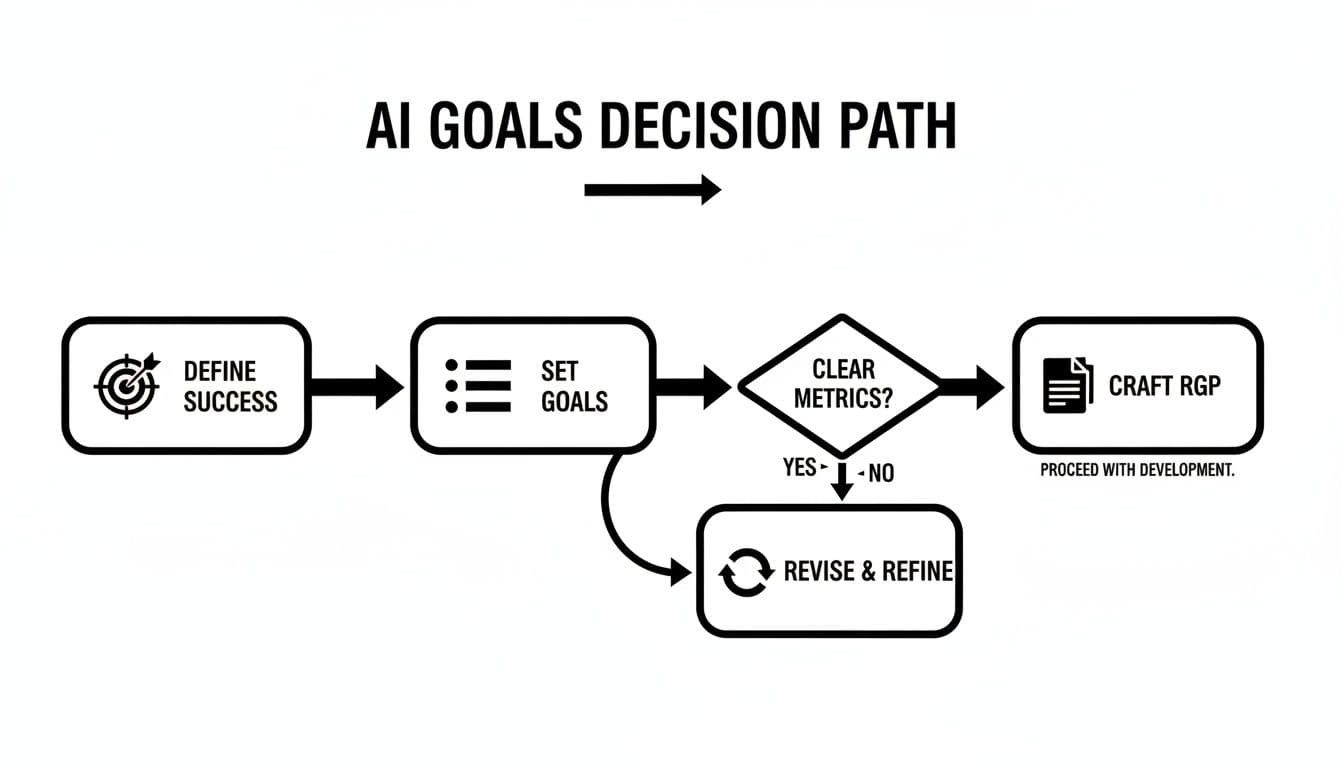
Starting with this kind of clarity is the only way to approach agencies. It ensures you’re asking the right questions from day one.
Assessing Their Technical and Platform Expertise
A genuine AI search optimization agency needs to prove they've mastered the specific tools and platforms that actually matter in this space. This goes well beyond the standard SEO software suite. When you're in the evaluation stage, you need to press them on their technical methodology.
Here are the kinds of questions you should be asking:
- Which AI models are you actually monitoring? A capable agency should be tracking your brand's presence across a spectrum of platforms, like Google’s AI Overviews, Perplexity, and others that are gaining traction in the B2B world.
- How do you measure visibility inside these answers? Ask to see their reports. They should be able to show you tangible metrics like Share of Voice within AI-generated answers, sentiment analysis of your brand mentions, and how accurate the source information is.
- What’s your process for structured data and knowledge graphs? Their ability to manage Schema markup is non-negotiable. This is how you feed LLMs clear, factual information about your company, its products, and its expertise.
When sizing up potential partners, it's also smart to look for those offering in-depth SEO audit services. A thorough audit gives you a baseline and is the foundation for any intelligent Generative Engine Optimization strategy.
Agency Evaluation Checklist: Technical vs. Strategic Fit
To make this process more systematic, I recommend using a scorecard. It helps you move beyond a gut feeling and compare agencies on the criteria that truly matter. Here’s a checklist to get you started.
Using a checklist like this forces a more disciplined evaluation, ensuring you select a partner that is not only technically proficient but also strategically aligned with your specific needs in the Japanese market.
Verifying Their Grasp of the Japanese Market
This is the make-or-break criterion for any company that's serious about winning in Tokyo. An agency that just translates its global strategy and calls it a day is guaranteed to fail. The nuances of the Japanese language, local culture, and search behavior are incredibly complex, and AI models are still catching up.
You have to drill down into their local expertise:
- Can they show you examples of how Japanese user intent is different from Western markets for your industry?
- How do they handle the complexities of Japanese formality levels (Keigo) in the content they create, ensuring AI can interpret and represent it correctly?
- Do they have native Japanese strategists leading the charge? Someone who can go beyond simple keyword translation to tap into genuine local search intent.
If an agency stumbles on these questions or gives vague, generic answers, it's a huge red flag. They must prove they can navigate the subtleties of Japan's digital ecosystem.
Don’t Overlook Data Privacy and Security Protocols
Handing an agency the keys to your digital kingdom requires a massive amount of trust. In the age of AI, this is more critical than ever. Your RFP and vetting process must hit them with direct questions about how they handle data.
Ask them to walk you through their data privacy policies. How do they firewall client data? What are their specific protocols for using third-party AI tools for analysis or content creation without exposing sensitive business information?
A vague response or a casual attitude toward data privacy should be an immediate dealbreaker. A professional agency will have this all documented and will be more than willing to discuss it openly. That transparency is what protects your business and builds a secure, lasting partnership. To get a better sense of this process, see our breakdown of what a generative engine optimization service entails.
The hard truth is that visibility in AI-generated answers is the new front line. While AI Overviews are already showing up for 25.11% of search queries, they are also reducing clicks to traditional website links by 34.5%. This is precisely why an agency's ability to secure your brand's place within these AI summaries is so important—especially when you consider that visitors from AI search tend to convert 4.4 times better than classic organic traffic.
So, you've signed the contract with your new AI search optimization agency in Tokyo. That’s a huge step, but the real work starts now. The first 90 days are absolutely crucial. This is where you and your new partner will build the foundation and rhythm that will determine whether your campaign succeeds or stalls out.
Think of it less as a formal "onboarding" and more as two teams merging into one.
The first month is all about getting under the hood. A good agency will immediately jump into a deep, comprehensive audit of your AI visibility—and this goes way beyond a standard SEO review. They'll be digging into how your brand shows up (or doesn't) across major AI platforms, pinpointing where you're strong and where you’re vulnerable.
We always tell our partners: the first thing we need is a clear, data-backed baseline. You can't measure progress if you don't know your exact starting point. Before any work begins, you should have a detailed report on your current Share of Voice in AI answers.
The First 30 Days: Discovery and Groundwork
The initial month is an intense period of information sharing. Your agency needs to become an extension of your own team. They have to understand not just your products, but your specific place in the market, the competitive pressures you face in Japan, and even your internal politics and workflows.
Expect these key activities in the first few weeks:
- Deep-Dive Workshops: These aren't just intro calls. The agency should be interviewing your key people from marketing, sales, product, and leadership to get the full picture.
- Technical & Content Audit: A truly thorough review of all your digital assets. This isn't a quick scan; it's a forensic analysis. Our site audit checklist gives you a sense of the depth we're talking about here.
- Initial AI Visibility Snapshot: This is non-negotiable. The agency must use its tools to capture a benchmark of your brand's presence in AI Overviews and chatbot responses before they touch a thing.
This phase is also about breaking down internal silos. For instance, if the agency finds a content gap and recommends a new pillar page on "AI-driven supply chain logistics," your content team can't hear about it for the first time a month later. They need to be in that conversation from day one to make sure the strategy aligns with your brand voice and existing editorial calendar.
The Next 30 Days: From Audit to Action Plan
With a mountain of data and a deep understanding of your business, the second month is about turning all those insights into a concrete, actionable strategy built specifically for the Tokyo market.
This is when you’ll see the first drafts of their AI optimization plan. It should detail priority topics, target user intents, and the specific content and technical fixes required to make an impact. This isn’t a document they hand over and walk away from; it's a living plan you'll be refining together. A technical insight about how AI models crawl your site, for example, might directly influence how your product marketing team structures new feature pages.
A central platform like Attensira is a lifesaver here. It becomes the shared dashboard where both your team and the agency can track the same data from a single source of truth. It cuts through the noise and keeps everyone focused on the same performance indicators.
Days 60-90: Execution and Early Feedback
The third month is where the rubber meets the road. The strategy moves from a document to live implementation. The agency will start executing on the plan, whether that means publishing new, AI-optimized content, deploying sophisticated schema markup, or re-architecting key sections of your website.
By the end of this period, you should be looking at the first version of your new reporting dashboard. It won't look like a traditional SEO report. Instead, it will focus on crucial new metrics like:
- Changes in AI Share of Voice for your most important queries.
- The sentiment of your brand mentions within AI-generated summaries.
- Click-through rates from AI answers back to your site.
This intensive 90-day process ensures you're a true partner, not just another client on a roster. It establishes a collaborative rhythm, data-driven decision-making, and shared accountability—all of which are essential for getting real results in this new era of AI search.
Measuring Success with AI-First KPIs and Reporting
When you bring on an ai search optimization agency in Tokyo, your definition of success has to change. The old dashboard—the one obsessed with keyword rankings and a simple organic traffic count—is rapidly becoming a relic. In the age of AI search, you need to measure what actually matters: your brand’s direct influence within AI-generated answers.
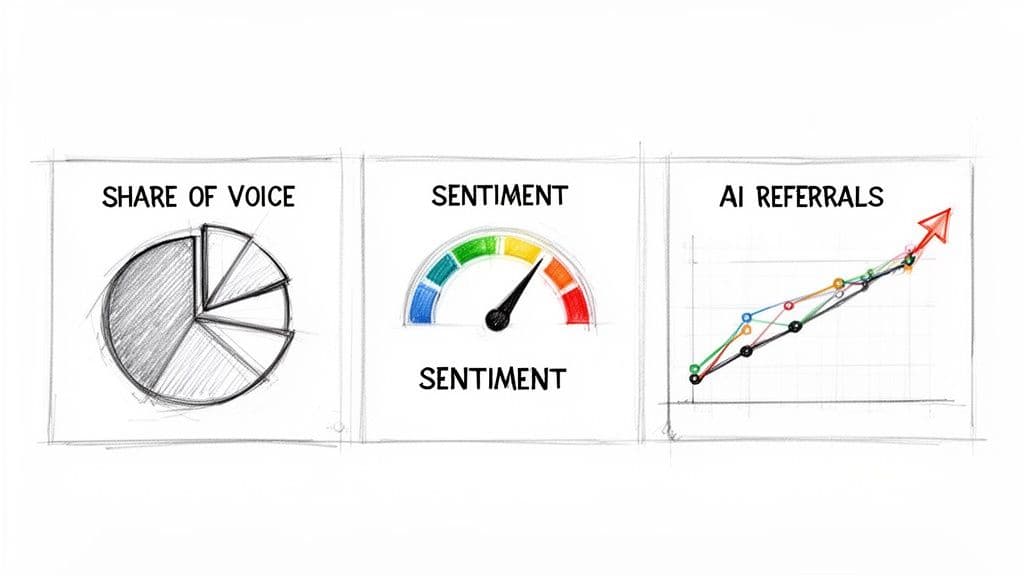
If your monthly report still celebrates moving from #5 to #3 in a list of blue links, you’re looking in the rearview mirror. It's time to build a reporting model that actually tracks the business impact of your brand appearing in a customer's AI-powered search results.
Moving Beyond Vanity Metrics
The biggest adjustment is mental. A high ranking on a traditional search results page means less and less when that query is now answered by an AI Overview. The real victory is becoming a cited, authoritative source inside that AI summary.
This means you have to let go of legacy metrics. An experienced agency will help you pivot to a set of AI-first KPIs that paint a much clearer picture of your brand's authority where your customers are actually looking.
A top-tier agency won't just show you that you climbed from position #5 to #3. They’ll show you hard data on how your brand's share of voice within AI summaries increased by 15% quarter-over-quarter for high-intent business queries. That’s a real win.
Key Metrics for AI Search Optimization
A forward-thinking reporting framework will be built around a few core pillars that tell a story about your brand’s performance in the new generative AI ecosystem. Your dashboard should be highlighting:
- Share of Voice in AI Responses: This is your new north star. It measures what percentage of AI-generated answers for your key topics mention your brand, your products, or your people. It's a direct reflection of your market presence in the AI's knowledge base.
- Mention Accuracy and Sentiment: Being mentioned isn't enough—the context has to be right. A sharp agency will monitor if the information cited is correct and analyze the sentiment. Are you appearing in a positive, neutral, or negative light?
- Quality of AI Referral Traffic: When someone clicks a citation link from an AI Overview and lands on your site, what do they do? This KPI digs into the quality of that traffic, tracking engagement, conversions, and whether these visitors are actually your ideal customers.
These metrics provide a far more accurate way to measure ROI. You can learn more about how to approach this new world of search metrics for true SEO visibility in our detailed guide.
Building Your AI Reporting Framework
Your agency partner should work with you to create a reporting dashboard that visualizes these KPIs based on what you need to achieve. This is never a one-size-fits-all template; it's a customized view of the data that connects directly to your business goals.
For example, a Tokyo-based B2B SaaS company and a local logistics firm will care about very different outcomes.
For the B2B SaaS Company: Their custom dashboard would focus on tracking things like the Share of Voice for queries such as "best compliance software for Japanese banks," the number of citations for their CTO's white papers, and the demo request conversion rate from AI-referred traffic.
For the Logistics Firm: Their report would zero in on the accuracy of mentions for their services in summaries about "cold chain logistics in the Kanto region," the sentiment around their brand when "supply chain reliability" is discussed, and the quality of leads coming from their "get a quote" page via AI referrals.
This level of detail shifts the conversation from vague "visibility" to tangible business results. It provides undeniable proof of how the agency's work is shaping your audience's perception and actively driving them toward conversion.
Common Questions About AI Search Optimization in Tokyo
It's natural to have questions when you're exploring a new frontier like AI search. As you think about bringing on an AI search optimization agency in Tokyo, you need real clarity on what this work involves and why a local partner is so critical. Here are some straightforward answers to the questions we hear most often from business leaders.
What Is the Difference Between Traditional SEO and AI Search Optimization?
Most people think of traditional SEO in terms of ranking—getting your website to the top of that familiar list of blue links on a results page. The goal has always been to secure the highest position possible for a set of keywords.
AI search optimization, or Generative Engine Optimization (GEO), plays a completely different game. The aim isn't just to rank; it's to embed your brand's facts, messages, and unique value directly inside the AI-generated answers, like Google’s AI Overviews. You're not just trying to be on the page; you're trying to become part of the answer itself.
This shift requires a new playbook. It’s less about keyword density and more about building a foundation of exceptionally clear, factual content, using strong structured data, and answering user intent so directly that Large Language Models (LLMs) choose your information to build their responses. You can dive deeper into the core concepts behind AI search in our glossary.
How Long Until We See Results from an AI Strategy?
With traditional SEO, it’s common to wait 6-12 months to see meaningful results. The timeline for AI search optimization is often different. We've seen clients get initial wins—like correcting factual errors or appearing in specific niche answers—much faster, sometimes within just 1-3 months, as AI models index and process newly optimized content.
However, building a dominant and consistent Share of Voice in AI responses is a long-term play. The speed of your results will absolutely depend on a few key things:
- How competitive your industry is.
- The authority and trust your website already has.
- How frequently the AI models themselves are updated.
A good agency will be upfront about this. They'll map out a plan for quick wins, like cleaning up how your brand is currently mentioned in AI, while simultaneously building the foundation for long-term influence.
Why Do We Need a Specialized Agency in Tokyo for This?
The Japanese market has its own linguistic and cultural DNA. A generic, one-size-fits-all AI strategy simply won't work here because an AI model’s output is a direct reflection of its training data—which is saturated with local context.
A Tokyo-based agency gives you an edge that is hard to replicate. They know how Japanese professionals phrase complex B2B queries, they understand the cultural intent behind a search, and they know how to craft content that actually connects with a local business audience. For instance, knowing how to apply Keigo (formal, honorific language) correctly is vital for maintaining a professional brand image, and it's a nuance that AI needs to be guided on to interpret properly.
Without this deep local expertise, your efforts could fall flat. Even worse, you risk having AI generate inaccurate or culturally clumsy answers about your brand, which can do real damage to your reputation in the Japanese market.
Can Our In-House Team Manage This with a Platform?
Yes, you certainly can. A platform like Attensira is built to give in-house teams the tools they need. It provides the data, monitoring capabilities, and content guidance to manage your AI optimization strategy internally, even if you don't have a dedicated GEO specialist on staff.
Many companies successfully run their entire program this way. That said, partnering with an agency can put your results on a much faster track. You're combining powerful software with an expert team that brings strategic insight, creative execution, and the extra hands needed to implement changes at scale.
Often, the best setup is a hybrid model. Your internal team works hand-in-hand with the agency, using a shared platform like Attensira as the single source of truth for all data, insights, and reporting. It’s a transparent, efficient, and incredibly effective way to work.
Are you ready to see how your brand is showing up in AI search? Attensira provides the visibility and insights you need to optimize your presence in AI-generated answers and stay ahead of the competition. Get started today and transform your AI search performance. Learn more at https://attensira.com.