



A practical guide to AI visibility for architects. Learn to audit, optimize, and measure your firm's presence on AI platforms to attract new clients.
The way clients find and vet architecture firms has been completely upended. It's no longer just about a high Google ranking. Now, potential clients are asking AI assistants like ChatGPT and Perplexity for direct recommendations, which means you need a solid strategy for AI visibility for architects. If your firm's online footprint isn't built for this new world, you're on the fast track to becoming invisible.
The New Blueprint for Getting Discovered
The old playbook of stuffing keywords and chasing backlinks is quickly becoming a relic. We're in a new era where AI platforms are the conversational gatekeepers. They don't just list websites; they synthesize information from all over the web to give users a single, authoritative answer. This is both a massive challenge and a huge opportunity for firms ready to adapt.
The heart of the matter is this: AI doesn't just "search" anymore—it understands. It hunts for clear, factual, and trustworthy information. For your firm, this means your website has to be more than a pretty portfolio. It needs to be a structured, machine-readable database of your expertise, your projects, and your unique value.
Why This Matters Right Now
The urgency here is real, especially when you look at the industry's tech adoption. In the architecture, engineering, and construction (AEC) world, AI integration is surprisingly slow. As of 2025, a mere 8% of architecture firms have woven AI tools into their core operations. This lag creates a serious visibility gap, as noted in expert insights on Autodesk.com.
This gap is your opening. Firms that get this right, right now, will leapfrog the competition. The game has changed. You're no longer just trying to get on the first page of Google; you need to become a primary, citable source in an AI's response. For a deeper look at the mechanics, check out our guide on AI search engine optimization.
The objective is no longer just to rank on a results page, but to become a citable, recommended source within the AI's generated response. This is the new frontier of client acquisition.
From Keywords to Verifiable Facts
Optimizing for AI requires a mental shift. Forget the flowery, abstract project descriptions. You need to think in terms of hard data and undeniable facts. An AI is far more likely to recommend your firm for a sustainable housing project if it can find concrete details on your site, such as:
- The project achieved LEED Platinum certification.
- We specified reclaimed timber and a geothermal heating system.
- The design delivered a 40% reduction in energy consumption for the client.
This is the kind of granular, factual detail that AI models are trained to find and trust. It's how they confidently answer a prompt like, "Find me an architect who specializes in net-zero residential design." For a broader look at how these technologies are reshaping the profession, a practical guide to AI in architecture is a fantastic resource.
Comparing Traditional SEO with AI Visibility
To really grasp this evolution, it helps to see the old and new approaches side-by-side. The focus has moved from pleasing search algorithms to feeding intelligence systems.
As you can see, the fundamental strategy has changed. While the old rules haven't disappeared entirely, they are now just one part of a much bigger, more complex picture.
Auditing Your Firm’s AI Visibility
Before you can fix how AI models see your firm, you need to establish a clear baseline. An AI visibility audit is that critical first step, giving you a real, data-driven snapshot of where you stand right now. This isn't about hunches or guesswork; it’s about systematically asking AI platforms the same questions your potential clients are asking.
The whole process starts with putting yourself in a client’s shoes. Head over to the major AI chat platforms—think ChatGPT, Gemini, and Perplexity. You’ll want to start with broad, high-level prompts and then slowly drill down into your specific niche. The mission here is to document every single mention, misrepresentation, or—just as importantly—every time you’re left out of the conversation.
How to Craft Your Audit Prompts
To get the full picture, you can't just ask one or two questions. You need to test a whole range of prompts that mimic the real-world discovery process. Your list of queries should cover your brand directly, your areas of expertise, your flagship projects, and how you stack up against the competition.
Here are a few prompt structures I've found effective in my own work:
- Direct Brand Queries: "Tell me about the architecture firm [Your Firm Name]." or "What are the most significant projects designed by [Your Firm Name]?"
- Expertise & Niche Queries: "List the top architecture firms in [Your City] specializing in sustainable design." or "Who are the leading architects for net-zero commercial buildings in the Northeast?"
- Competitive Intelligence Queries: "Compare [Your Firm Name] with [Competitor Firm Name]." or "What are the strengths and weaknesses of [Competitor Firm Name]?"
As you do this, you have to be meticulous. Fire up a spreadsheet and track the exact prompt, which AI you used, the full response it gave, and any inaccuracies you spot. This document isn't just a record; it becomes the strategic blueprint for everything you do next.
This diagram really captures how the client discovery journey has changed. It's no longer a straight line from a Google search to your website.
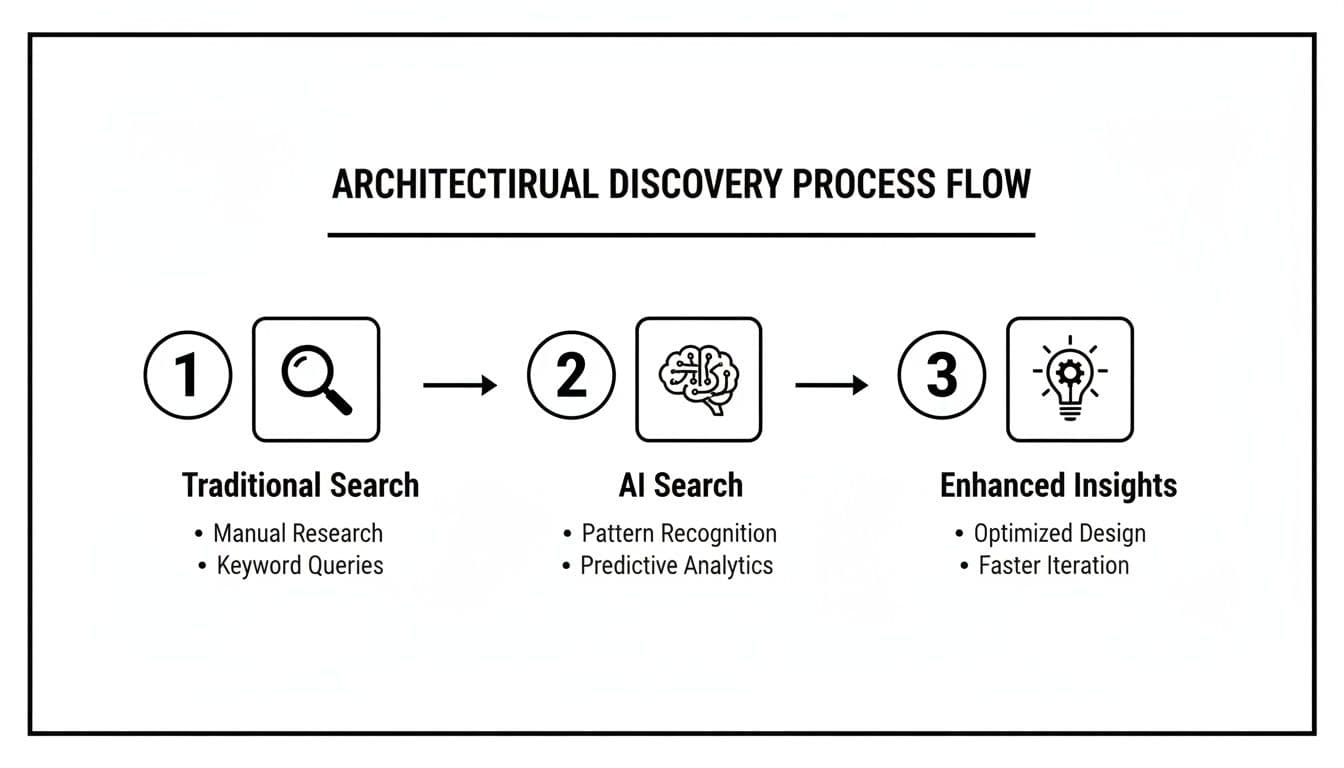
The key takeaway here is that AI now sits between the user and the information, acting as an interpreter that synthesizes data instead of just spitting out a list of links.
Making Sense of the Audit Findings
Once you've gathered all this data, it's time to connect the dots. Start looking for patterns. Are you consistently missing from lists of specialists in your core practice area? Does the AI get the details wrong on your most important projects? These are the exact gaps you need to plug.
I often find that while a firm’s website looks beautiful, the project descriptions are written for humans, not machines. They lack the structured, factual data that AI models crave to understand and accurately relay a firm's expertise.
For example, an AI might vaguely describe your LEED-certified building as "eco-friendly" but completely miss the specific certification level (Gold, Platinum) or the quantifiable energy savings. Those are the details that signal true authority. If you're looking for a more traditional way to find gaps, our comprehensive site audit checklist offers a great framework that complements this AI-focused approach.
Your analysis should zero in on four core questions:
- Presence: Does our firm even show up for relevant, non-branded searches?
- Accuracy: When we are mentioned, is the information right? Does it highlight our best projects and awards?
- Positioning: How is our expertise framed? Does it actually match our business development goals?
- Competition: Which other firms keep showing up, and how are they being described?
The answers will tell you exactly where your digital presence is falling short. This isn’t just a simple check-up; it's a diagnostic tool that will directly inform the technical fixes and content upgrades you'll need to make. A solid audit ensures your efforts are targeted where they'll have the biggest impact.
Optimizing Your Digital Assets for AI
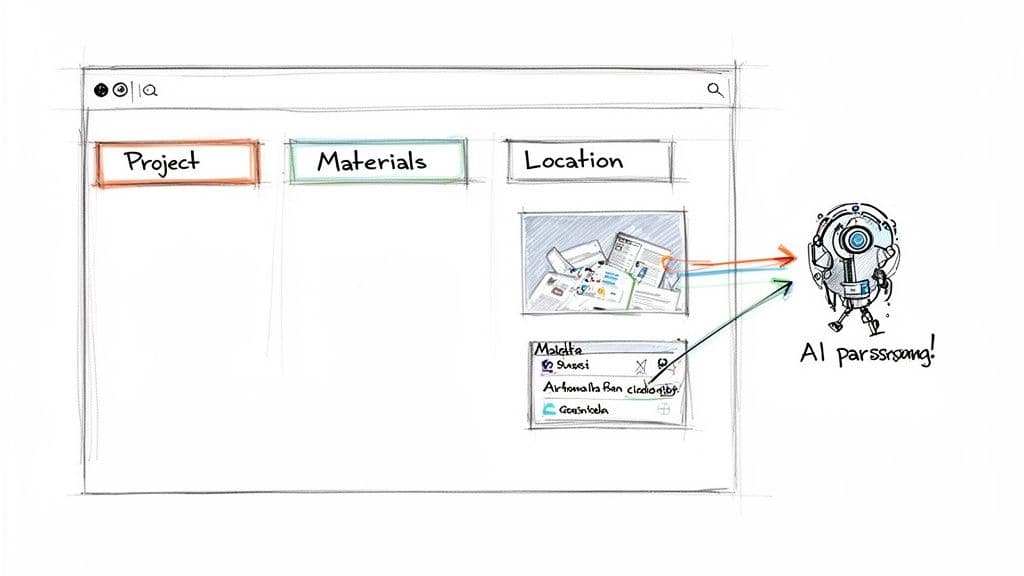
With your audit data in hand, it’s time to move from diagnosis to action. This is where you start strategically reshaping your firm’s digital presence so machines can understand it. AI visibility for architects isn't about chasing algorithms; it’s a deliberate shift from purely narrative descriptions toward a more structured, data-first approach to your content.
The core principle here is simple but profound: write for clarity, not just style. AI models aren't swayed by poetic language about a building's "dialogue with its environment." What they are influenced by are specific, verifiable facts they can parse, categorize, and synthesize into a confident answer for a user.
Rewriting Your Content for Machine Readability
The first, most impactful place to start is your project portfolio and service pages. These pages are the digital bedrock of your firm's expertise, and they must be engineered to be completely unambiguous to a machine.
Think of your website as a dataset that an AI will scrape to learn about your firm. Your job is to make that data as clean and structured as possible. This means transforming every project description from a story into a structured report.
Here’s a practical example of how to reframe a typical project description:
- Before: "This award-winning office tower redefines the city skyline with its fluid, organic form, creating a dynamic new public plaza that fosters community engagement and a connection to nature."
- After: "The Horizon Tower is a 35-story, 500,000 sq. ft. commercial office building located at 123 Main Street, Anytown. The project achieved LEED Platinum certification, utilizing a triple-glazed curtain wall system that reduces solar heat gain by 40%. The ground floor features a 15,000 sq. ft. public plaza designed in collaboration with landscape architects [Firm Name]."
The second version is packed with entities—location, size, certifications, specific materials, hard numbers—that AI models can easily identify and cross-reference. For a deeper dive into these tactics, our guide on AI content optimization breaks it down even further.
Implementing Structured Data
While rewriting content for clarity is a crucial first step, structured data (or schema markup) takes this to another level. Think of it as adding invisible tags to your website's content that explicitly tell search engines and AI what each piece of information represents.
You can use schema to label key project attributes, leaving zero room for a machine to misinterpret your work.
This level of detail is becoming non-negotiable. It's predicted that by 2026, AI will be deeply integrated into core AEC workflows, capable of generating design alternatives and automating tasks like BIM model development. This evolution hinges on structured, standardized information, making well-organized data a competitive necessity.
Building Proactive FAQ Sections
Your audit likely uncovered the direct questions potential clients are asking. Answering them preemptively on your service and project pages is a powerful strategy that directly feeds AI models the exact answers they're looking for.
Create dedicated FAQ sections that tackle common queries with concise, factual answers. For a page about your sustainable design services, you might include:
- What green building certifications does your firm specialize in?
- What is your process for integrating energy modeling into a project?
- Can you provide examples of projects that have achieved net-zero energy?
This Q&A format perfectly mirrors the conversational nature of AI interactions, making your information highly relevant and easy for a large language model to pull into a generated answer.
Optimizing Your Visual Assets
Finally, don't overlook your images. Your portfolio photos and renderings are rich data sources, but only if they're labeled correctly. AI models don't "see" an image like a human does; they rely on the text-based data you provide.
A common mistake is to leave image filenames as generic strings like IMG_8452.jpg. This is a massive missed opportunity to provide context.
Instead, every single image needs a descriptive filename and detailed ALT text that explains what the image actually shows.
- Bad Filename:
final-render-03.jpg - Good Filename:
net-zero-energy-corporate-campus-daylight-atrium.jpg - Good ALT Text: "Interior view of the sunlit central atrium at the Oak Ridge Corporate Campus, showing the exposed mass timber beams and extensive indoor plantings."
This metadata transforms each visual into another structured data point, reinforcing your firm's expertise in specific project types and design strategies. To get the most out of this process, it's worth exploring the various best AI tools for digital marketing that can help.
By meticulously optimizing these core digital assets, you provide the clear, factual, and unambiguous signals that AI models need to recognize your firm as an authoritative and relevant answer.
Building Your Firm's Topical Authority
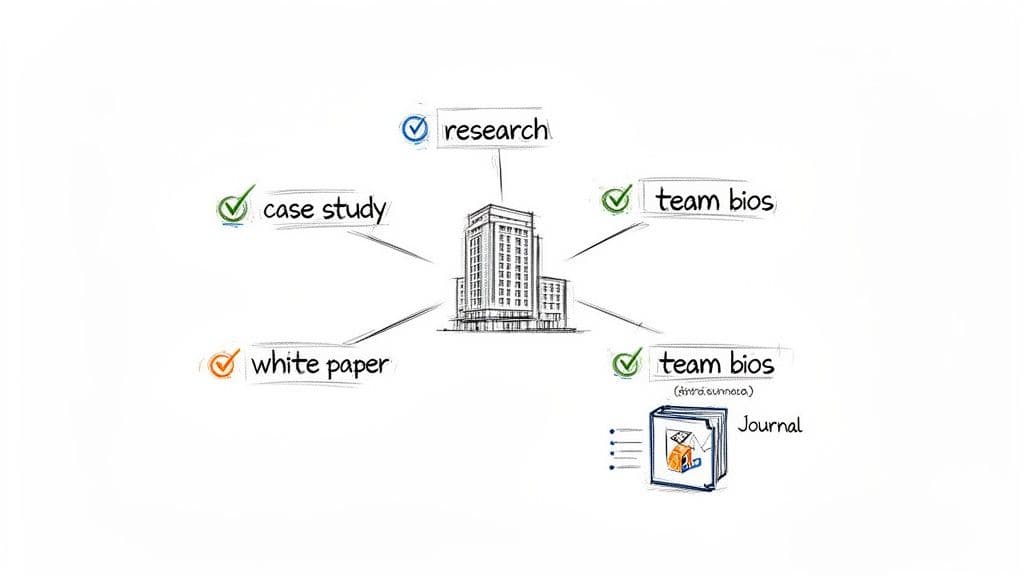
Having a machine-readable website is just the price of entry. It gets you in the game, but it doesn’t guarantee you'll be recommended by AI. The real goal is to establish topical authority—to become a definitive, go-to source in your specific niche.
AI models are trying to mimic human trust. They connect dots across the web, looking for depth, consistency, and external validation to figure out who the real experts are. One well-optimized project page is a start, but a deep, interconnected web of content that showcases your unique point of view is exponentially more powerful.
This is how your firm shifts from being just another name in a massive database to a resource an AI feels confident citing. You're aiming to create a body of work so substantial that for an AI to construct a complete answer about your field, it has to include your insights.
Creating Deep-Dive Content Assets
To build this kind of authority, you need to think well beyond standard project descriptions. Your website should function as a library of your firm’s intellectual capital. It needs to show not just what you’ve built, but the deep thinking behind how and why you built it.
This isn’t about churning out blog posts. It’s about creating substantial assets that put your firm’s unique processes, research, and design philosophy on display.
Think about developing a content plan that includes assets like these:
- Detailed Case Studies: Go past the glossy final photos. Dive into the real story—the challenges, the design process, and the measurable outcomes. Talk about the material selection debates, the structural engineering hurdles you overcame, and any post-occupancy performance data you have.
- Process Breakdowns: Do you have a proprietary method for achieving net-zero energy? A unique community engagement framework for public projects? Document it. Show your work.
- White Papers: Publish original research on a niche topic. This could be anything from the performance of innovative building materials in your specific climate to a new model for sustainable urban infill.
This is the kind of rich, detailed context AI models feast on. It gives them the substance they need to understand the full scope of your expertise. If you want to go deeper on how AIs synthesize this information, our guide on answer engine optimization is a good next step.
Showcasing Your Team's Credentials
Your firm's authority is a direct reflection of your people's expertise. I've found that team bios are one of the most underutilized assets for building credibility. Most firms treat them as an afterthought, but they should be structured as individual pillars of authority.
Instead of a brief, generic paragraph, structure each bio to highlight specific, verifiable credentials. Done right, your team page becomes another rich dataset for an AI to parse.
Think of each principal architect’s bio as a miniature authority hub. It should clearly connect their individual expertise to the firm's broader specializations, reinforcing the firm's overall authority on those topics.
For every key team member, make sure their bio explicitly states:
- Specializations: Clearly list their areas of focus (e.g., "specializes in historic preservation for adaptive reuse projects").
- Credentials: Mention specific licenses, key accreditations like LEED AP or Passive House certification, and professional affiliations.
- Published Works: Link directly to any articles, research papers, or books they have authored.
- Speaking Engagements: List the industry conferences or universities where they have presented their work.
This structured approach validates your team's expertise in a way that’s crystal clear to both potential clients and AI systems.
The Power of External Validation
Here’s a simple truth: real authority is rarely self-proclaimed; it’s confirmed by others. AI models are built to understand this concept of trust by analyzing how your firm connects to the broader web of credible information.
This means you need to actively link your firm's insights to reputable, third-party sources. When you publish a case study on a sustainable project, don't just state your amazing results. Link out to the industry reports, academic research, or building science journals that informed your design decisions.
This practice creates what’s known as a "citation network," and it signals to AI that your claims are grounded in established knowledge. It shows that you’re an active participant in a larger professional conversation, elevating your content from marketing material to a citable resource. This is absolutely fundamental to achieving sustained AI visibility for architects.
How to Measure and Refine Your Strategy
Getting your firm visible in AI search isn't a "set it and forget it" project. If you want to build a real, lasting advantage, you need a disciplined way to monitor what’s working, learn from the data, and make smart adjustments. This creates a powerful feedback loop where every insight sharpens your next move, ensuring your strategy for AI visibility for architects evolves as quickly as the technology itself.
The whole point is to move beyond a one-time audit and build a continuous system of measurement. This system will tell you if your content changes are actually having an impact, where new opportunities are popping up, and how AI models are starting to perceive your brand. Without this data, you're just guessing.
Defining Your Key Performance Indicators
Your old SEO metrics, like keyword rankings and organic traffic, still matter, but they don't paint the full picture anymore. For AI, you need to track a new set of key performance indicators (KPIs) that are built for how these platforms actually work. The focus shifts from where you rank on a results page to whether you're present in the synthesized answer.
Here are the core KPIs you should start tracking right away:
- Prompt Visibility Percentage: Pick a set of crucial, non-branded prompts (think "best healthcare architects in the Midwest"). What percentage of AI responses actually mention your firm? This is your most direct measure of presence.
- Mention Accuracy Score: When your firm does get mentioned, is the information correct? Grade the accuracy on a simple scale of 1-5, making notes of any mistakes in project details, specializations, or team credentials.
- Sentiment Analysis: What's the tone of the language used to describe your firm? An AI describing your work as "innovative" and "award-winning" is a huge win. "Competent" is neutral. You get the idea.
- Share of Voice: In your primary niche, how often is your firm mentioned compared to your top three competitors? This gives you a competitive benchmark you can track over time.
This kind of focused tracking is exactly what separates the early winners from everyone else. The firms in the AEC industry who jumped on AI early are already seeing massive returns. In fact, of the 27% of firms using AI, a staggering 94% are planning to use it even more. These early movers have reclaimed 500 to 1,000 hours on key tasks, which could translate to savings of 50,000 to 100,000 per project. You can dig into these numbers in a recent report on the impressive ROI for early AI adopters in AEC.
To get started, it's helpful to organize these metrics into a clear framework. This table breaks down what each KPI measures and how you can use that information to make better decisions.
Key Performance Indicators for AI Visibility
Tracking these metrics gives you a dashboard for your AI visibility efforts, turning abstract goals into concrete numbers you can work with.
Establishing a Tracking Cadence
Consistency is everything. For most architecture firms, a monthly tracking schedule is the sweet spot—it's frequent enough to catch trends early without becoming a major time sink.
Your monthly check-in should be simple and repeatable:
- Run Your Core Prompts: Test the same list of 10-15 strategic prompts on your target AI platforms (like ChatGPT, Gemini, and Perplexity).
- Log the Results: Keep a simple spreadsheet to record the date, AI platform, prompt, and the full response.
- Update Your KPIs: Tally the numbers to calculate your prompt visibility percentage, accuracy score, and other key metrics for that month.
- Pinpoint Action Items: Looking at the data, what needs to happen next? Do you need a new case study to fill a content gap? Or do you need to correct a recurring error about a flagship project?
A word of caution: don't get thrown off by inconsistent results from day to day. AI models are probabilistic, which means they can give slightly different answers to the same prompt. You're not looking for the exact same response every time. What you want to track is the overall trend of your visibility and accuracy improving over several months.
This cycle of testing, measuring, and refining is how you turn your initial work into a compounding asset. For a deeper dive into this process, you can explore our dedicated article on setting up your AI search monitoring.
From Data to Actionable Insights
Data is meaningless until you do something with it. The last step in your monthly process is turning what you've found into a clear set of actions. This is where your high-level strategic goals connect directly to your ground-level AI visibility work.
For example, if your visibility for "sustainable residential design" is low, that’s a direct signal to publish more in-depth content on that topic. If an AI keeps misstating the square footage of your award-winning museum, it's a clear sign you need to reinforce that specific data point on your site, maybe with schema markup. Each data point should trigger a specific task that makes your digital presence stronger and your firm easier to find.
Common Questions About AI Visibility
Making the leap to an AI-first mindset naturally brings up a lot of questions. For architecture firms and marketers, this is new territory. Let's tackle some of the most common ones I hear and get you some clear, practical answers.
How Is AI Visibility Different From the SEO I Already Know?
It’s a fundamental shift in thinking. Traditional SEO is all about climbing the ladder of a search results page. You play the game of keywords and backlinks to earn a top spot on that list of 10 blue links.
AI visibility, on the other hand, is about becoming part of the answer itself. The goal isn't just to be linked; it's to have your firm’s projects, data, and expertise woven directly into the AI's synthesized, conversational response.
This means your strategy has to evolve. Instead of just focusing on keyword density, you need to obsess over factual clarity, structured data, and verifiable authority. For an architect, that means a project page needs more than just beautiful prose. It needs hard data an AI can grab and trust—think specific materials used, precise square footage, and certified sustainability ratings.
What’s the Single Most Important First Step We Should Take?
Before you touch a single word on your website, you need to run a comprehensive AI audit. You can't fix a problem you don't fully understand. Your first job is to see your firm through the eyes of an AI.
Get on platforms like ChatGPT, Gemini, and Perplexity and start asking questions. Use prompts like, “List the top sustainable architecture firms in Portland” or “Describe the signature projects of [Your Firm Name].”
Document everything. Are you invisible? Misrepresented? Or are the AIs getting it right? This audit gives you the data-driven baseline you need before you can build a real strategy.
Your audit isn't just about spotting your own flaws; it's a golden opportunity for competitive intelligence. If a rival firm keeps showing up for your specialty, dig into their content. See how they structure their project pages and expert articles. It’s invaluable insight.
Do We Need a Huge Budget or a Tech Team to Do This?
Not at the beginning, no. While it sounds technical, many of the most impactful first steps are content-based. Your existing marketing team or a savvy partner can handle the core work.
The heavy lifting is in rewriting your web copy for absolute clarity, building out project descriptions that are rich with facts and data, and producing genuinely authoritative articles that prove your expertise.
Sure, a technical expert is great for implementing advanced schema markup down the line, but the initial investment is really about changing your content process. You have to start prioritizing structured, verifiable facts over vague, promotional language. It’s more of a strategic pivot than a massive tech spend.
How Long Until We Actually See Results?
You might see initial changes faster than with traditional SEO, but this isn't an overnight fix. Once you've updated your site with clearer, structured information, AI models could start reflecting those changes in a few weeks or a couple of months, depending on how often they refresh their data.
But building true topical authority—the kind that makes you a go-to source for AI responses—is a long game. That comes from consistently publishing deep, expert-driven content over time.
Realistically, plan on dedicating focused effort for 6 to 12 months to build a strong, authoritative presence that AI platforms will learn to trust and recommend.
Ready to stop guessing and start measuring your firm's visibility in the new AI-driven landscape? Attensira provides the tools to track your mentions, analyze your positioning, and get actionable insights to ensure your firm is the one clients find. Get started with Attensira.