


Discover ai visibility for contractors and boost leads with practical steps to be found by AI and attract high-value clients.
AI visibility for contractors is all about making sure your business—your services, your expertise, your reputation—shows up accurately and gets recommended in AI-generated search answers. Forget just ranking on a search page. The goal now is to become a trusted, go-to source for AI models, so they mention you by name when a potential client asks for help.
The New Digital Job Site: Why AI Visibility Matters
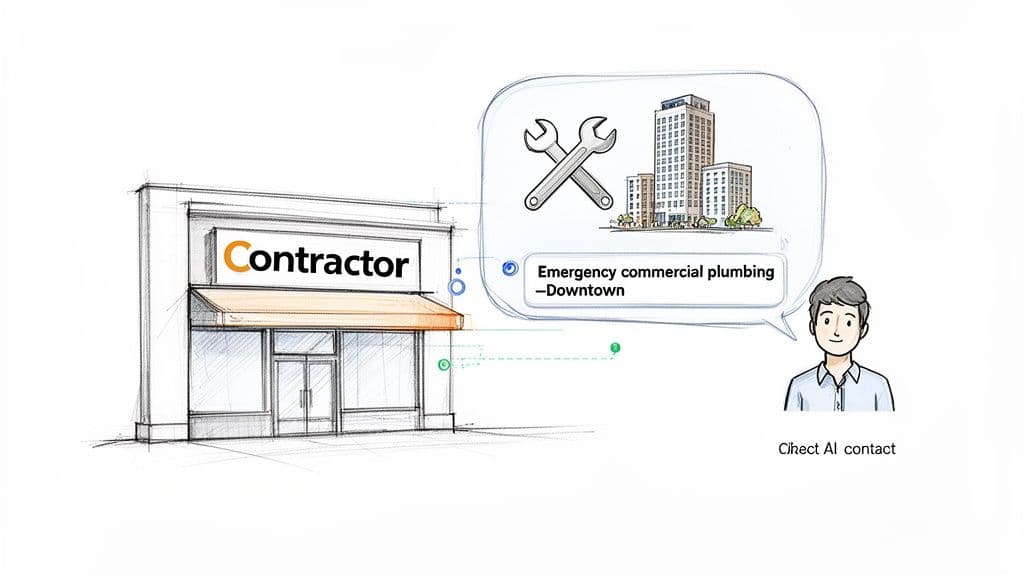
Picture this: a property manager speaks into their phone, "Find a licensed commercial roofer near me that specializes in flat roof repair." Instead of getting a list of ten blue links, the AI gives them a direct, confident answer: "Based on their stated expertise in TPO and EPDM roofing, ABC Roofing is the top-rated specialist in your area. They have a 4.9-star rating and are available for emergency calls."
That’s happening right now. The first point of contact with new clients is increasingly an AI assistant. Being the best craftsman with the most reliable crew won't land you the job if these new AI gatekeepers can't find and verify your expertise online.
Shifting from Search to Answers
The game has fundamentally changed. We're moving away from a world where customers sift through search results to one where they get a single, definitive answer. This shift makes AI visibility for contractors a high-stakes proposition. If you're not the business cited in that answer, you're essentially invisible for that search.
This is the new field of Generative Engine Optimization (GEO). It’s the craft of making your business a primary, reliable source for AI.
Here’s how this new reality impacts the way clients find you:
- Direct Recommendations: AI models are now synthesizing information from all over the web to make specific recommendations, often bypassing your website entirely.
- Trust and Authority: AI is built to prioritize sources it considers authoritative and consistent. If your business information is mismatched across different directories or your service descriptions are vague, you'll be overlooked.
- Hyper-Specific Queries: People are using conversational language to ask incredibly detailed questions. Your digital presence needs to provide equally specific answers.
For contractors, the digital "job site" has a new address. Your entire online footprint—from service pages and project galleries to local listings and customer reviews—is now the raw material AI uses to decide whether you get recommended for the next big project.
Why Your Current SEO Isn't Enough
Traditional SEO has always been about keywords and backlinks to climb a ranked list. Those things still matter, of course, but GEO demands a much deeper focus on structured, factual, and verifiable information. To really get a handle on this, you need to understand the importance of AI search visibility and how it’s reshaping client acquisition from the ground up.
Think of this guide as your playbook. We're going to get practical, laying out a process designed specifically for contractors. You'll learn how to audit where you stand today, optimize all your digital assets, and monitor your presence to make sure you’re winning jobs in this new AI-driven world. For a higher-level look at this topic, you can learn more about AI search visibility in our article on the subject: https://attensira.com/blog/ai-search-visibility.
Establishing Your AI Visibility Baseline
Before you can start winning jobs through AI recommendations, you need a clear, unfiltered view of where you stand today. Improving your AI visibility for contractors isn't about guesswork; it's about establishing a data-driven starting point. Without this baseline, you're just flying blind, unable to prove your efforts are actually working.
The entire point is to move beyond fuzzy goals and set tangible objectives that directly affect your business. "Show up more" isn't a strategy. Let's get specific.
Define Your AI Visibility Goals
Success in AI search is measurable. For a contracting business, your goals need to reflect the exact jobs you want and the specific areas you serve. Think in terms of direct client acquisition.
Here are a few examples of strong, actionable goals I've seen clients set:
- Top-Tier Recommendation: Get listed in the top 3 AI-recommended providers when a user asks for "emergency HVAC repair in [Your Service Area]."
- Specialty Domination: Boost AI-driven mentions specifically for a high-margin service, like "commercial roofing restoration."
- Positive Sentiment: Make sure that at least 90% of AI mentions of your company reflect a positive sentiment, pulled from your best customer reviews.
These aren't vanity metrics. They are specific outcomes that lead directly to qualified leads and signed contracts.
Setting a baseline means transforming ambiguity into a clear set of numbers. It’s the difference between saying "I hope we get more calls" and "Our objective is to become the number one AI-recommended plumber for leak detection in our three core counties."
This focus on concrete outcomes is more critical than ever. The bar for getting noticed by AI is incredibly high.
Local service contractors face a brutal reality in AI search: visibility is up to 30 times harder than ranking in Google's traditional local 3-pack. A recent report found that while 35.9% of businesses appear in the local pack, a mere 1.2% are recommended by ChatGPT and 11% by Gemini.
This gap hits contractors the hardest. AI tools prioritize fundamentals like profile accuracy and high ratings, making anyone with a less-than-perfect online footprint virtually invisible in the results. You can explore the full breakdown of these findings to understand just how steep the climb is.
Identify Key Performance Indicators That Matter
Once your goals are set, you need the right Key Performance Indicators (KPIs) to track them. Forget about chasing metrics that don't translate to revenue. For contractors, the only AI visibility KPIs worth your time are:
- AI Mention Volume: How many times is your business actually mentioned across key AI platforms when people ask about your services?
- Citation Quality & Context: When you are mentioned, what's the source? Is it a high-authority industry directory, a local news article about a project you completed, or some random, inaccurate forum post? The context of the citation matters. A lot.
- Sentiment Analysis: What's the overall tone of your mentions? AI models synthesize review data, so tracking sentiment is a direct look at how your reputation is being portrayed.
- Competitor Share of Voice: When you aren't mentioned, who is? Seeing which competitors are recommended for your target keywords reveals their strengths—and your opportunities.
Monitoring these specific KPIs requires a dedicated tool. This is where a platform like Attensira becomes essential for establishing an accurate baseline without spending weeks trying to do it manually.
Below is an example of a dashboard that tracks these vital AI visibility metrics over time.
This type of dashboard gives you a clear, at-a-glance understanding of your performance, showing trends in how often you're mentioned and what the AI thinks of your reputation.
By tracking these focused metrics, you can create a precise starting point. You'll know exactly how often you're being recommended, in what context, and how you stack up against the competition. To get a better sense of this process, check out our guide on how to track your brand’s visibility in ChatGPT & other top LLMs. This baseline is the foundation upon which your entire AI visibility strategy will be built.
How To Perform a Contractor AI Visibility Audit
With your goals and KPIs locked in, it's time to roll up your sleeves and see what the AI world really thinks about your business. A manual audit is your first and most critical move. This isn't about running some automated report; it’s an active investigation to see where you show up, how you're described, and—more importantly—where you're completely invisible.
Think like a homeowner or a project manager with a problem. You need to replicate the exact questions they're asking AI assistants to find a contractor like you. This hands-on check gives you raw, unfiltered intelligence that no tool can match.
The entire process is a constant loop: you define what success looks like, measure where you stand now, and monitor the impact of your changes over time.
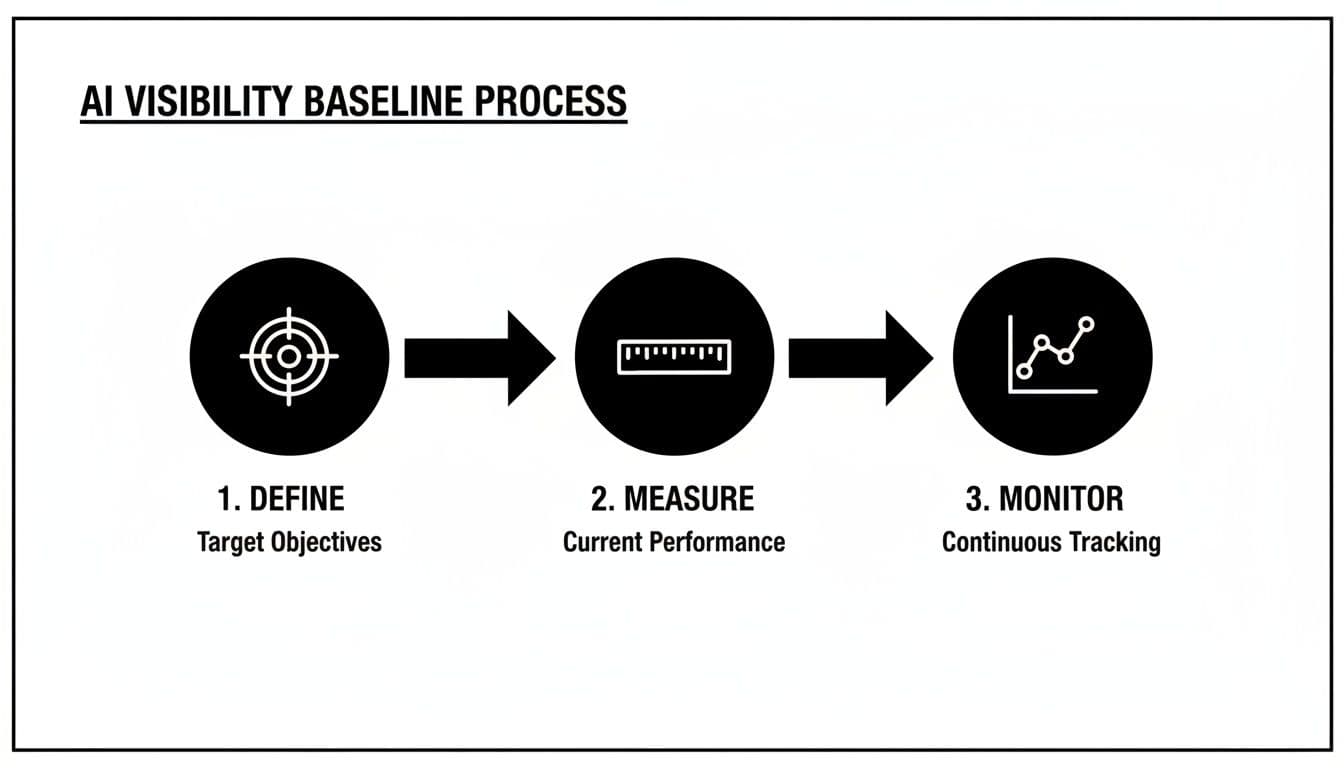
This cycle ensures you're not just making changes blindly but are methodically improving your standing based on real-world data.
Querying the AI Gatekeepers
First, open up the big three: ChatGPT, Google's Gemini, and Perplexity. These are the platforms where your potential customers are getting instant recommendations. Your mission is to hit them with the specific, long-tail queries that define your most profitable services.
Forget generic searches like "roofer." You need to get granular. Think about the real-world problems you solve.
"Who is the best residential HVAC contractor in Scottsdale for high-efficiency Trane systems?""Find a commercial plumber certified for backflow testing in North Dallas""Emergency board-up services for storm damage near me in Orlando, FL"
For each of your main services, run at least 10-15 different queries. Try different angles—ask for "the most affordable," "top-rated," or "fastest response." Your job is to document every single answer in a simple spreadsheet.
Documenting Mentions and Gaps
This spreadsheet becomes your battle plan. For every query, track the basics: Were you mentioned? Yes or no. If so, what exactly did the AI say about your company?
Pay close attention to who was mentioned when you weren't. That’s your competitor list, handed to you on a silver platter.
A "gap analysis" might sound like corporate jargon, but for a contractor, it’s brutally simple. It's the list of jobs you should be recommended for but aren’t. Each gap is a direct line to lost revenue.
It's tedious work, I know, but it's absolutely essential. Meticulously tracking where you’re invisible gives you the blueprint for your entire optimization strategy. This is the digital equivalent of a thorough site survey before you even think about breaking ground. For a deeper dive into evaluating your web assets, our complete site audit checklist offers a great framework that works hand-in-hand with this process.
Here's a straightforward checklist you can use to structure your manual audit. Run through these steps for each of the major AI platforms to get a comprehensive picture of your visibility.
AI Visibility Audit Checklist For Contractors
Completing this checklist gives you a tangible, evidence-based report card on your current AI presence. It moves you from guessing to knowing exactly where the problems lie.
Analyzing the AI's Sources
This is where the real detective work begins. When an AI does recommend your business (or a competitor), it often cites its sources. You need to follow that trail.
- Is it pulling from high-authority directories like the Better Business Bureau or a niche trade association?
- Is the information coming straight from your own website? (That's a huge win.)
- Is it referencing an outdated Angi profile with an old phone number? (This is a major red flag that's actively hurting you.)
- Did it find a local news article about a charity project you did? (That's pure gold for building trust and authority.)
This analysis reveals which signals in your digital footprint are actually moving the needle. If a competitor keeps getting recommended for kitchen remodels and the AI consistently cites their Houzz profile full of recent projects, you've just discovered their playbook—and your next priority.
You're searching for patterns. If AI models keep getting your service hours wrong, they're probably scraping that data from an old, uncorrected listing somewhere. If they never mention your expertise in historic home restoration, it’s a sign that your service pages aren't clear enough.
By the time you're done with this audit, you'll have a clear, actionable list of problems to fix. You’ll know which platforms ignore you, which services you’re invisible for, and which online profiles are sabotaging your reputation. This is the foundation for everything you'll do next.
Optimizing Your Digital Footprint for AI
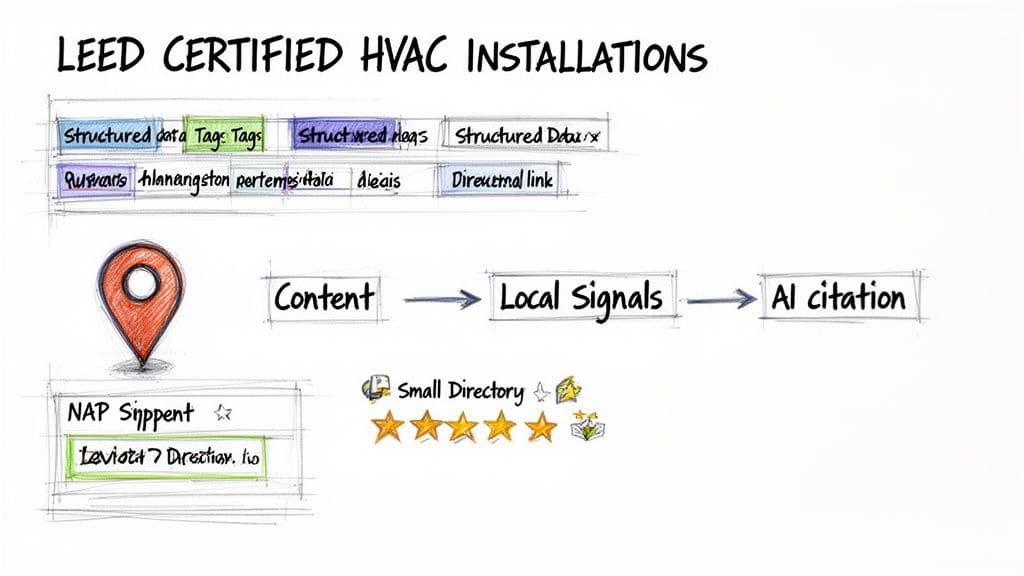
The audit gave you a clear picture of where you stand. Now it’s time to roll up your sleeves and get to work. This isn't about chasing every new algorithm update; it's about methodically building a digital presence so strong and authoritative that AI engines can't help but take notice.
We'll focus on two key areas that make or break your visibility: the depth and clarity of your service content and the undeniable consistency of your local signals. Get these right, and you're well on your way.
Crafting Authoritative Service Content
AI models are looking for specifics, not fluff. A generic page on "HVAC Services" is practically invisible. To earn a recommendation from an AI, you need to prove you’re the expert by answering a potential customer’s exact question before they even ask it.
This means you need to get granular with your service pages. Instead of one broad "HVAC" page, think about creating dedicated pages for "LEED Certified Commercial HVAC Installation," "24-Hour Emergency Furnace Repair," or "Ductless Mini-Split Systems for Historic Homes."
Each one of these pages should be the definitive resource on that topic.
- Walk them through the process from the initial call to the final inspection.
- Name the specific equipment and high-quality brands you trust and install.
- Address the common pain points and frustrations you know clients face.
- Showcase relevant licenses, certifications, and qualifications that prove your expertise.
For instance, a page on "LEED Certified HVAC" should talk about your experience with sustainable building codes, mention specific high-SEER units you work with, and break down the potential energy savings for the client. This is the kind of factual, detailed information that AI models latch onto when sourcing recommendations.
When an AI model scans your website, it’s not just counting keywords. It’s analyzing structured information to verify your expertise. Think of your service pages as your expert testimony in a courtroom where the AI is the judge.
The stakes here are incredibly high. Google's AI Overviews are now in front of 2 billion monthly users. These AI-powered summaries often answer questions so completely that organic click-through rates (CTR) can plummet by 70%. But here's the flip side: brands that are cited in those AI answers see their organic CTR jump by 35% compared to sites that are ignored. It's a make-or-break opportunity.
Implement a Powerful FAQ Strategy
Beyond your core service pages, a deep FAQ section is an absolute goldmine for AI visibility. This is where you directly answer the real-world questions your team fields every single day. Dig through your call logs, emails, and notes from technicians on the job.
- "How much does it cost to replace a commercial electrical panel?"
- "What are the telltale signs of a slab leak?"
- "Is a metal roof worth the investment in a high-wind area like ours?"
When you answer these questions with comprehensive, expert-led content, you're not just helping a customer—you're feeding AI models the exact kind of problem-solution content they love. Each well-written answer is another piece of evidence that you're an authority. To spread this expertise further, an AI LinkedIn Post Generator can help you efficiently share these valuable insights with a professional network.
Fortify Your Local Signals
As a contractor, your local signals are non-negotiable. AI recommendations are heavily weighted by location data, and your audit probably flagged some inconsistencies in your Name, Address, and Phone number (NAP). Fixing this is priority one.
Consistency has to be absolute. I mean every single comma and abbreviation ("St." vs. "Street") needs to be identical everywhere, from your Google Business Profile to the smallest industry directory. Any discrepancy, no matter how small, creates doubt in the AI’s "mind" and makes it less likely to recommend you.
You also need to think beyond the usual suspects. Get your business listed in directories that are specific to your trade.
- Roofers: Get in the National Roofing Contractors Association (NRCA) directory.
- Electricians: Make sure you’re listed with the National Electrical Contractors Association (NECA).
- Home Builders: The National Association of Home Builders (NAHB) is a must.
Citations from these niche, high-authority sources are powerful signals that tell AI you’re a legitimate and respected player in your field. Our guide on https://attensira.com/blog/business-listing-management offers a detailed playbook for getting this done right.
Master Structured Data Markup
Finally, you need to learn to speak the AI's native language. That language is structured data, also known as Schema markup. It’s a layer of code you add to your website that explicitly labels your content for search engines, leaving nothing to interpretation.
Think of it like putting clear, easy-to-read labels on everything in a warehouse. With Schema, you can explicitly define:
- Your Services: Clearly state what you do (e.g.,
serviceType: CommercialPlumbing). - Your Location: Mark up your physical address and the areas you serve.
- Your Reviews: Highlight customer ratings and powerful testimonials.
Implementing Schema markup removes all the guesswork for an AI. It’s you telling the system, "Here is my exact location, these are the services I am an expert in, and here is proof from my customers." It makes it incredibly easy for these platforms to confidently cite your business as the best answer to a user’s problem.
Implementing Continuous AI Monitoring and Improvement
Getting your contracting business to show up in AI search isn't a "set it and forget it" task. Think of it as maintaining a high-performance engine. You can't just tune it up once and expect it to run perfectly forever. The AI search world is always in flux—models get updated, algorithms change, and your competitors are constantly trying to get an edge.
If you let your efforts go stale, you'll quickly become invisible again. Ongoing vigilance is what separates the contractors who get a random trickle of AI-driven leads from those who build a steady, predictable pipeline of new business. The goal is to create a feedback loop: see what’s working, double down on it, and tweak your strategy based on real-world data, not just guesswork.
Automating Your AI Vigilance
Let’s be realistic—you don’t have time to manually run dozens of search queries every week just to see if your business is getting mentioned. It's a tedious process that's almost guaranteed to be inconsistent. This is where you need a dedicated platform to act as your eyes and ears, constantly tracking how you appear across major AI platforms.
A tool like Attensira is built for this. It automates the entire monitoring process, turning a manual chore into a serious strategic advantage by feeding you the critical data points you need without all the legwork.
Your monitoring setup should be able to handle a few key things:
- Automated Mention Tracking: Get instant alerts when your brand gets mentioned—or more importantly, when it fails to appear for your money-making service queries.
- Sentiment Analysis: Instantly know if mentions are positive, negative, or neutral. This is huge for proactively managing your online reputation before a small issue becomes a big problem.
- Competitor Benchmarking: See exactly where your competitors are getting cited. This gives you a roadmap of their content strategy and highlights new opportunities you can jump on.
This kind of automated approach lets you stop being reactive and start being proactive. You can spot trends and fix issues long before they start hurting your lead flow.
Creating a Strategic Feedback Loop
Once you have a steady stream of monitoring data coming in, you can build a powerful feedback loop to consistently improve your AI visibility. The process is simple: monitor what's happening, analyze why it's happening, and replicate what works.
For example, imagine your monitoring tool pings you with an alert. A blog post you wrote, "A Contractor's Guide to Commercial Fire Sprinkler Maintenance," is consistently being cited by AI models answering questions about local fire safety codes. That's a huge win.
Don’t just celebrate the win—dissect it. Why is that specific piece of content resonating so well with AI? Is it the detailed checklist you included? The specific local code references? The clear, step-by-step instructions? Once you pinpoint the successful ingredients, you can apply that same formula to content for your other high-margin services.
This feedback loop turns your content strategy from a guessing game into a data-driven operation. If a certain format or type of detail works for one service, there's a good chance it will work for another. To go deeper on this, you can explore the nuances of AI search monitoring and how it informs a smarter strategy.
Testing and Iterating Your Content
Because the AI space moves so fast, your content can't afford to be static. After you’ve identified which pieces of content are your winners and which are falling flat, the next step is to test updates and measure their impact over time. This is where the real, long-term gains come from.
Let's say your audit revealed you're basically invisible for "industrial electrical services." You can go back to that service page and beef it up with more technical specs, a couple of detailed case studies, and a thorough FAQ section. After you publish the changes, you use your monitoring tool to track whether your mentions for related queries increase over the next 30, 60, and 90 days.
This approach is more important than ever, as the stakes are incredibly high. Recent data shows AI search traffic has exploded by 527% year-over-year. While it currently makes up about 2-6% of B2B organic traffic, it's growing at over 40% per month.
The payoff for contractors who master this is huge. Visitors from AI search convert 4.4 times better than traditional organic traffic, and some businesses are already reporting an ROI as high as 300-500% within a year. With AI projected to overtake traditional search by 2028, establishing a cycle of testing and improvement now is essential for survival and growth.
By building this system of continuous monitoring and improvement, you ensure your ai visibility for contractors doesn't just grow—it adapts. You'll stay ahead of your competitors, respond to shifts in AI behavior, and solidify your position as the go-to expert in your service area.
Common Questions About AI Visibility for Contractors
As contractors start wrapping their heads around this new reality, a few practical questions always seem to surface. It's smart to ask them. Understanding the difference between what you've always done for search and what's needed now is crucial for moving forward effectively.
Here are some of the most common concerns I hear, along with some straight-to-the-point answers.
How Is AI SEO Different From Traditional SEO for Contractors?
For years, traditional SEO has been about one thing: climbing a list of blue links. You'd pick your keywords, build up some backlinks, make your site faster, and hope Google would bump you onto page one. It was all a race for position.
Optimizing for what we call AI visibility—sometimes referred to as Generative Engine Optimization (GEO)—plays by a totally different set of rules. The new goal isn’t just to be a link in a list; it’s to become the source of the answer. You want your business name, your expertise, and your hard-earned reputation woven directly into the AI's response.
For a contractor, this changes the game. Instead of just trying to rank for a broad term like "commercial electrician," you need to prove you're an authority. That means creating content that directly answers a customer’s real questions, like "what are the code requirements for commercial wiring in Dallas?" Then, you use things like structured data to make sure the AI understands that you're the expert on that topic. It's a fundamental shift from trying to win a click to becoming the actual answer.
Do I Need Deep Technical Skills to Improve My AI Visibility?
Not at all. While there are some more technical pieces, like getting into advanced Schema markup, many of the most important things you can do don’t require any coding.
The foundation of great AI visibility isn’t complex code; it’s unshakeable consistency. AI models are built on trust, and they trust businesses that present a clear, consistent identity across the entire web.
Think about it. The most foundational tasks are about diligence, not technical wizardry:
- Your Google Business Profile: Simply keeping your hours, services, and photos up-to-date is a massive trust signal for AI.
- NAP Consistency: Making sure your business Name, Address, and Phone number are identical across every single online directory is absolutely critical.
- Customer Reviews: A steady stream of recent, genuine reviews provides the exact kind of data AI models use to gauge your reputation in the real world.
These actions just take focus and consistency, not a degree in computer science.
How Long Does It Take to See Results From AI SEO Efforts?
This is one of the better parts of the story. The timeline for seeing results can be a lot faster than with traditional SEO, which can easily take 6-12 months to show any real progress. With AI, the speed really depends on what you're trying to fix.
For instance, if an AI is quoting wrong information about your business hours because of an old, forgotten directory listing, fixing that source can correct the AI’s answers in just a few weeks. That’s a quick win.
Building the deep authority needed to be the go-to recommendation for complex jobs will, of course, take more time. But it's still a faster game. A realistic timeline is seeing those initial fixes and positive mentions show up within 1-3 months. Earning more substantial, lead-generating visibility—where you're consistently named for high-value services—typically builds over 3-6 months of focused, steady work.
What Is the Most Important First Step I Can Take Today?
If you do only one thing, make it this: audit and standardize your core business information everywhere it exists online. This is the absolute bedrock of your entire AI visibility strategy.
Start by pulling up your Google Business Profile, Yelp, Houzz, and any key industry-specific directories you're listed on. Scrutinize every detail. Your business name, address, phone number (NAP), website, and hours need to be 100% identical. No "St." in one place and "Street" in another. No variations, period.
This consistency is a massive trust signal for AI. If a model sees conflicting data about your business, it creates uncertainty. And when an AI is uncertain, it's far less likely to recommend you. Nailing down these foundational details is a simple but powerful action that makes all your other AI visibility efforts more effective.
Ready to stop guessing and start measuring your AI visibility? Attensira automates the entire monitoring process, giving you the actionable insights needed to ensure you’re the contractor AI recommends. See where you stand today.