

Unlock actionable steps to boost ai visibility for education companies and drive enrollment - grab our 2026 playbook now.
When we talk about AI visibility for education companies, we're talking about something very specific. It means your institution, your programs, and even your standout faculty members are being directly named and recommended by AI tools like ChatGPT, Perplexity, and Google’s AI Overviews. As more and more prospective students lean on these platforms to do their initial research, showing up in those AI-generated answers has become a make-or-break factor in shaping enrollment decisions. This is the new frontier for student recruitment.
The New Enrollment Funnel Where AI Citations Matter Most
The traditional path to enrollment—think college fairs, direct mail, and hours spent browsing individual websites—is being redrawn in real-time. Students are now outsourcing their initial legwork to AI assistants. They're asking complex questions, comparing programs side-by-side, and building their shortlists, often before ever landing on a single .edu homepage.
This shift has created a dangerous 'AI search gap' where many excellent institutions have simply become invisible.
This isn’t some far-off trend; it's happening right now, and the business impact is already being felt. Recent studies reveal a major disconnect: while 50% of prospective students are using tools like ChatGPT at least weekly for their college search, only about a third of higher education institutions have any formal strategy to appear in those results.
The problem gets worse when you consider that 79% of these students read Google's AI Overviews when they pop up for informational searches like "best university for computer science." When you're not in the answer, you don't exist.
The Shift in Student Research Behavior
The way students gather information has fundamentally changed. The old, linear path has been replaced by a dynamic, AI-powered discovery process. This table breaks down the contrast between traditional and emerging research habits, highlighting why a new approach to visibility is no longer optional.
As you can see, the initial touchpoints have moved. If your information isn't primed for AI models to find and understand, you're missing the most critical stage of the modern student's journey.
Why AI Citations Are the New Currency of Credibility
Getting cited by an AI is far more than just a passing mention—it's a powerful, third-party endorsement. When an AI model sifts through the entire web and decides to include your university in its answer, it’s signaling that your institution is a credible and authoritative source. This has a direct and measurable effect on student perception.
- Building Trust: The data doesn't lie. 56% of students say they are more likely to trust brands that are cited by AI. An AI recommendation feels unbiased, cutting through the usual marketing fluff.
- Influencing Shortlists: Being included in an AI-generated list of "top programs for nursing" or "best online MBAs" is the digital equivalent of a trusted counselor handing a student your brochure. It places you on their radar at the exact moment they're deciding who to consider.
- Driving Qualified Inquiries: Students don’t just take the AI’s word for it and enroll. A huge 77% still see university websites as the ultimate source of truth for final verification. This means AI-driven discovery sends highly motivated, high-intent traffic directly to your enrollment pages.
This reality transforms AI optimization from a niche marketing task into a core growth strategy. The goal is no longer just to rank in a list of blue links, but to be the cited authority. You can dig deeper into this strategic shift in our guide on Answer Engine Optimization.
Practical Scenarios of AI Visibility in Action
Let’s make this tangible. Imagine a high school senior asks ChatGPT, "What are the most innovative undergraduate engineering programs that focus on robotics?" The AI will synthesize data from dozens of university sites, research papers, and news articles. If your program page clearly and compellingly details its robotics curriculum, faculty expertise, and unique lab facilities, you have a strong chance of being featured in the answer.
Now, picture a mid-career professional asking Perplexity to "compare the executive MBA programs at [Your University] vs. [Competitor University] on cost, flexibility, and alumni outcomes." The AI is going to crawl both websites looking for structured, comparable data points. The institution that presents this information most clearly will earn a more favorable and detailed summary, directly influencing that user’s next move.
Understanding these dynamics is central to attracting new students, whether you're a major university or a niche tutoring service exploring strategies for growing a tutoring business. The principles are the same: be the clear, authoritative answer your audience is looking for.
Auditing Your Brand's Current AI Footprint
Before you can even think about improving your visibility in AI search, you have to get a clear, honest picture of where you stand right now. This isn't about running a few random searches on a slow afternoon. We're talking about a systematic audit to establish a firm baseline. This process will show you exactly where your blind spots are and, more importantly, where your biggest opportunities for growth lie.
Without this foundational data, any attempt to boost your AI visibility for education companies is just a shot in the dark. A thorough audit gives you that crucial "before" picture, which is essential for measuring progress and proving the value of your efforts down the line.
Think about it from the student's perspective. Their journey increasingly starts not with a traditional search engine, but with an AI chatbot. This new path has distinct stages, and your visibility at each one can make or break their decision.
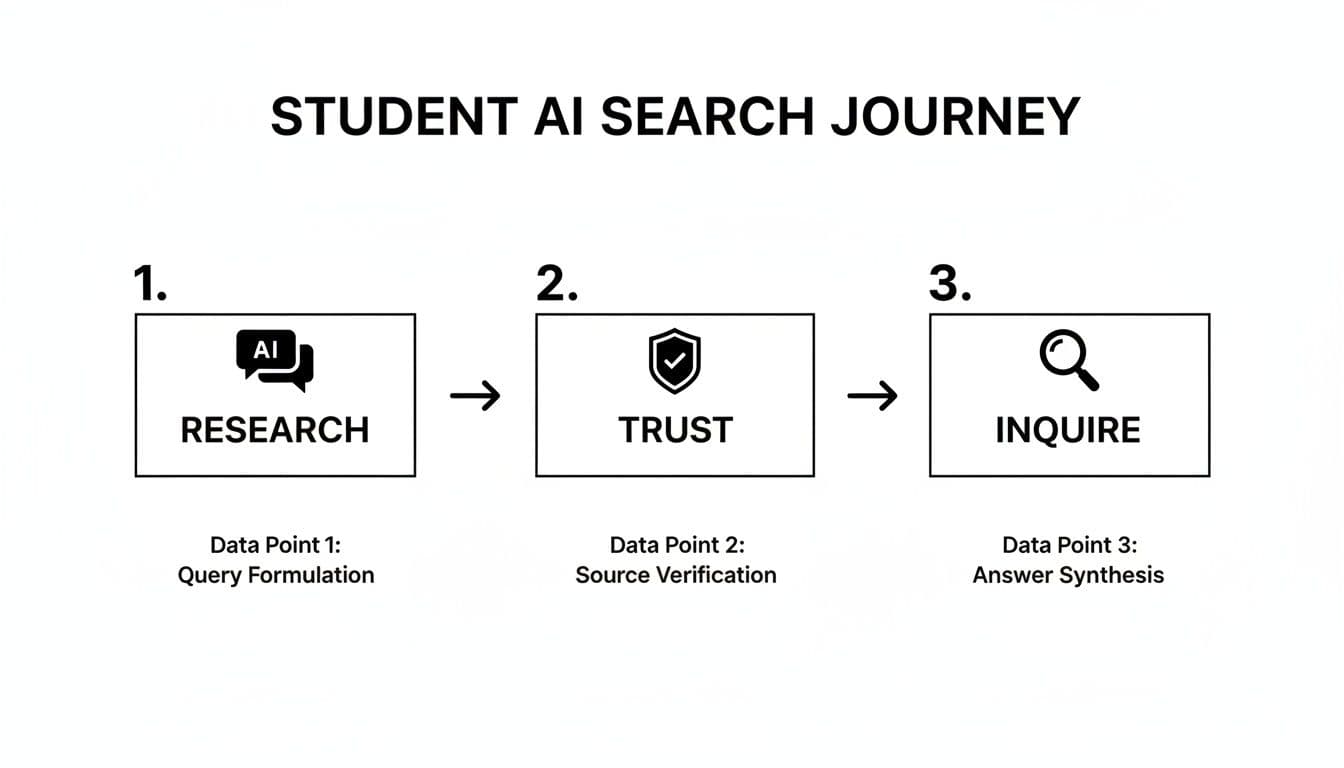
As you can see, the process flows from initial AI-powered research to building trust through citations, which ultimately encourages a direct inquiry. If you're invisible during that first research phase, you never even get a chance to make your case.
Gathering Your Baseline Intelligence
The first step is to put yourself in a prospective student's shoes and start asking questions. It's critical to test your queries across several AI models because you'll find their answers can differ dramatically depending on their unique training data and algorithms.
Your testing should focus on the platforms where students are actually spending their time:
- ChatGPT (OpenAI): This is usually the go-to for broad, exploratory questions.
- Gemini (Google): Its direct pipeline into Google's massive search index gives it a distinct flavor.
- Perplexity AI: A favorite for research because it excels at providing cited sources.
One of the most common mistakes I see is teams only testing a handful of obvious keywords. To get the full story, you need to mix up your query types. Document every single result in a shared spreadsheet—track the query, the AI platform, whether your school was mentioned, which competitors showed up, and any source links the AI provided. For a more detailed process, we've put together a guide on how to track your brand's visibility in ChatGPT and other top LLMs.
Expert Tip: Always run your audit in an incognito window or a clean browser profile. This little step prevents your personal search history from skewing the AI's responses, giving you a much more objective look at how the general public sees your brand.
Structuring Your Audit Queries
To make sure your audit is comprehensive, organize your queries into three core categories. This framework mirrors the student's journey, from initial awareness all the way to making direct comparisons.
1. Branded Queries These are searches that mention your institution by name. The goal here is to understand how AI models perceive your brand and what key information they associate with you.
- "What is [Your University Name] known for?"
- "Review of [Your University Name]'s online MBA program"
- "Tuition cost for [Your University Name]"
2. Non-Branded, High-Intent Queries This is where the real competition is. These queries come from students who are actively looking for programs but haven't decided on a specific school yet. Showing up here is a huge win.
- "Best universities for data science in the Midwest"
- "Top-ranked undergraduate nursing programs"
- "Affordable online master's in education"
3. Comparative and Long-Tail Queries These searches signal a student who is much further along in their decision-making process. They're comparing specific schools or digging into very specific details.
- "Compare [Your University] vs. [Competitor University] for engineering"
- "What universities have strong alumni networks in the tech industry?"
- "Which colleges offer study abroad programs focused on sustainability?"
Analyzing the Data and Identifying Gaps
Once you have all this data in your spreadsheet, it's time to start connecting the dots. Are you consistently appearing for your own brand name but completely invisible for competitive, non-branded searches? Are certain competitors totally dominating the conversation for key programs like "online MBA" or "cybersecurity degrees"?
This analysis is where the real value emerges. The reality is, tracking AI visibility is still a massive blind spot for most institutions. Recent data from higher ed shows that while 50% of prospective students are using AI tools every week, a staggering 57% of institutions don't even know if their brand appears in AI answers. It gets worse: 27% admit to only seeing occasional mentions without any real tracking. And even among those who are monitoring, only 64% use any kind of dedicated tool.
This haphazard approach is incredibly risky. Especially when you see that AI Overviews have exploded globally, jumping from 6.49% of searches in January 2025 to 13.1% by March 2025. The ground is shifting fast.
The patterns and gaps you uncover in your audit will become the foundation of your content and technical SEO strategy. The objective is to turn this raw intelligence into an actionable roadmap for getting your brand seen where it matters most.
Building Your Authority Engine with Citable Content
Once you've mapped out your AI footprint, the real work begins: building the assets to fill those visibility gaps. To get noticed by AI, you can't just "do SEO" anymore. You need to create content that AI models don't just understand, but actively want to cite as a trusted source. This means thinking less like a marketer and more like a librarian, building a deep well of authority.
The core principle is surprisingly simple. Create content so clear, factual, and well-supported that it becomes the most logical, reliable source for an AI to use when answering a prospective student's question. This isn't about gaming an algorithm; it's about being the best answer.
Go Beyond Generic and Publish Original Data
One of the fastest ways I've seen clients become an authority is by publishing unique data that simply doesn't exist anywhere else. AI models are hungry for novel information. When you become the primary source for a key statistic or finding, citations just naturally follow.
For an education company, this isn't as hard as it sounds. It could look like:
- Annual Industry Reports: A business school could publish an annual "Future of FinTech" report, packed with survey data from its alumni network and corporate partners.
- Granular Program Outcomes: Don't just list a job placement rate. Publish detailed breakdowns of alumni roles, average salaries by region, and the top companies hiring your grads. A powerful, citable data point like Torrens University saving $2.4 million in resources by using AI is incredibly sticky.
- Local Community Research: A university's sociology department could publish research on local economic trends, instantly becoming the go-to source for regional journalists and, by extension, the AI tools they use.
The goal here is to generate data that other people will want to reference. That creates a powerful, defensible moat around your expertise.
Structure Content as Self-Contained Resources
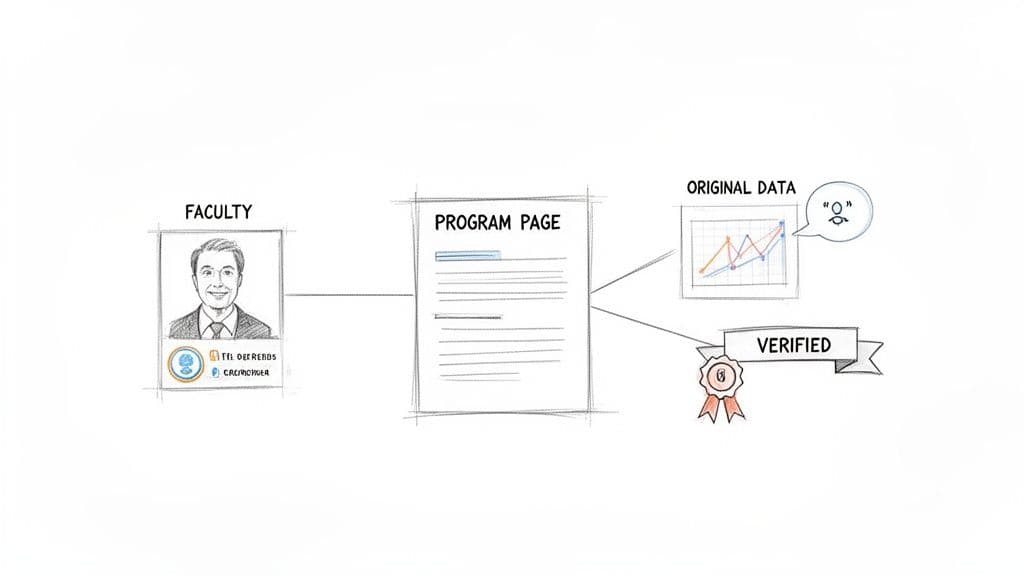
AI models love efficiency. They favor content that provides a complete, satisfying answer to a question on a single page. This means your program pages, faculty bios, and research hubs should be built as definitive, self-contained resources.
Put yourself in the shoes of an AI. A student asks, "What is the curriculum for the cybersecurity master's at [Your University]?" An AI is far more likely to pull from your page if it has everything it needs right there.
An ideal program page isn't a marketing brochure. It's a mini-encyclopedia for that specific degree. It should have the full curriculum, faculty highlights, potential career paths, tuition breakdowns, and application deadlines—all clearly labeled with subheadings.
This approach makes it easy for the AI. It doesn't have to guess or stitch together information from five different pages, which dramatically increases the odds of an accurate, favorable citation. This is a basic tenet of good user experience, but it's also a masterclass in web content creation for an AI-first world.
Applying E-E-A-T in the Education Vertical
Google’s E-E-A-T framework—Experience, Expertise, Authoritativeness, and Trustworthiness—is the playbook for AI visibility. AI models use these exact same signals to figure out who to trust. Here’s how you apply it in a practical way:
- Showcase Faculty Credentials (Expertise): Your faculty bio pages are goldmines. Don't just list degrees. Detail their published research, keynote speeches, media appearances, and patents. Critically, link out to this work. It creates a rich trail of evidence that proves their expertise. A specific statistic, like Brisbane Catholic Education educators saving an average of 9.3 hours per week with AI, is a perfect example of demonstrable experience.
- Demonstrate Institutional Authority (Authoritativeness): Be loud and proud about your accreditations, awards, and rankings. Feature testimonials from prominent alumni. If your nursing program is ranked in the top 10 nationally, that fact should be impossible to miss.
- Use Clear, Accessible Language (Trustworthiness): Academic writing can be dense. On your public-facing website, that's a liability. Use clear, simple language. Define complex terms. This makes your content easier for both humans and AI models to understand, which builds trust.
- Highlight First-Hand Experience (Experience): This is where you bring your institution to life. Share student stories, case studies from research projects, and "day-in-the-life" videos from current students. This is the kind of real-world, hands-on experience that the latest AI models are learning to value and prioritize.
Refresh Existing Content with Citable Signals
You don't have to start every project from a blank page. A content refresh can deliver some of the biggest and fastest wins. Go through your most important pages—your flagship programs, your "about us" page, your most popular blog posts—and ask these questions:
- Can we add a unique statistic from our own internal data?
- Can we insert a direct quote from a department head or lead professor?
- Could we embed a short video of a student talking about their capstone project?
- Is all our data clearly presented in tables or lists for easy parsing?
Each one of these additions acts as a powerful signal of authority. By consistently embedding these citable, trust-building elements across your site, you systematically build an engine that establishes your institution as the definitive source in your field.
Using Technical Signals to Build AI Trust
Great content is a huge piece of the puzzle, but it’s not the whole game. For an AI to actually trust and cite your information, you need a rock-solid technical foundation to back it up.
Think of it this way: your beautifully written program page is the star student. Your technical signals are the official transcripts, the letters of recommendation, and the stamped diplomas that prove their credentials to the AI admissions committee.
These aren't just technical busywork. They translate what we see on the screen into a language that AI crawlers can process with zero ambiguity. It’s an absolutely critical step for building the kind of AI visibility for education companies that actually moves the needle on enrollment.
Translate Your Expertise with Structured Data
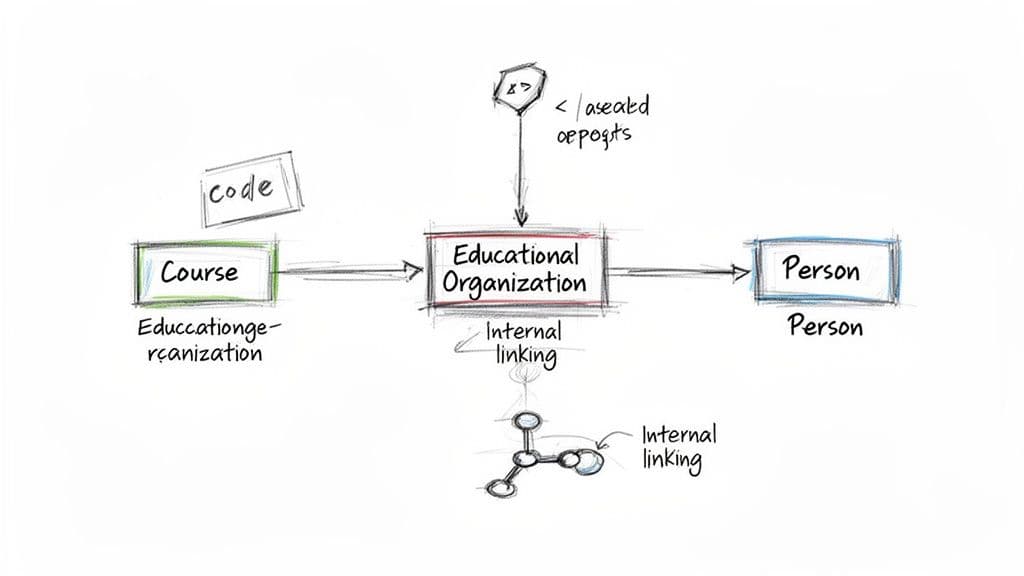
Structured data, most commonly implemented via Schema.org, is your most potent tool for this translation. It's a specific vocabulary of tags you add to your site’s HTML that explicitly tells search engines and AI models what your content is about. Instead of making the AI guess what a page is describing, you’re handing it a perfectly labeled diagram.
For any education brand, a few schema types are non-negotiable for clarifying what you offer and why you’re the expert.
EducationalOrganization: This tag belongs on your "About Us" page and acts as the anchor for your brand's identity. It defines your official name, address, and logo, connecting all your other information back to your institution.Course: This is your bread and butter. For every single degree, certificate, or program you offer,Courseschema lets you define the program name, a clear description, and—most importantly—theprovider(which links directly back to yourEducationalOrganizationschema).Person: Here’s where you connect your most valuable assets—your faculty—to your programs. By marking up faculty bios withPersonschema, you can list their name, title, and affiliations, and then explicitly link them to the specificCourse(s) they teach.
Putting it all together creates a clean, logical relationship that an AI can follow instantly: this Person is an expert who works for this EducationalOrganization and teaches this Course. This verifiable chain of trust is exactly what AI models are looking for when sourcing answers. Getting these technical details right is a fundamental part of any serious content strategy, which always starts with a comprehensive site audit checklist.
Practical Example: An AI answering "best online MBA programs" is far more likely to trust and feature a university whose MBA page uses Course schema to detail its curriculum and Person schema to link to the profiles of its renowned business faculty. That's a verifiable signal of authority.
Build Topical Authority Through Internal Linking
While schema explains individual pages, your internal linking architecture tells the bigger story of your overall expertise. A smart internal linking strategy acts as a tour guide for AI crawlers, leading them through your site and showing them how all your content connects to form deep, authoritative topic clusters.
This isn't about just sprinkling links around for the sake of it. It’s about creating a deliberate, logical hierarchy.
Your most important pages—like a main "Degree Programs" hub—should have many internal links pointing to them from other pages on your site. That hub page, in turn, should link out to the individual program pages (e.g., "Master's in Data Science"). From there, those program pages should link to faculty bios, related research papers, and student success stories.
This creates a dense web of interconnected content that reinforces your authority on a specific subject. When an AI crawler follows these paths, it gets an undeniable signal that your institution has deep, multifaceted expertise on "data science education"—not just one shallow page.
These signals are becoming more critical every day. Industry projections show that over 30% of students will use AI tools as their primary method for college searches by 2026. However, these AI systems are notoriously picky, often ignoring pages that lack clear trust signals, even if they rank well in traditional search.
Key Technical Signals for AI Trust
To build a robust technical foundation that AI will trust, focus your energy on these high-impact signals.
By methodically implementing these technical signals, you are essentially proofreading your website at a machine level. You’re confirming your expertise, clarifying your offerings, and building a foundation of trust that makes it easy for AI to see you as the authority and cite you in its answers.
Measuring Success and Building an Agile AI Strategy
Investing in content and technical signals is only half the battle. To justify all this work and secure ongoing support, you have to prove the ROI of your AI visibility initiatives. This means going beyond vanity metrics and connecting your efforts directly to tangible results, like higher application rates and enrollment numbers.
Frankly, success here requires a new way of thinking. It calls for a new set of KPIs and a more agile workflow that finally breaks down the walls between your SEO, content, and PR teams, getting them to operate as a single, cohesive unit.
An effective strategy for improving ai visibility for education companies isn't a "set it and forget it" project. It demands constant monitoring, measurement, and adjustment. By establishing a clear measurement framework from the start, you can transform AI optimization from an experimental cost center into a predictable driver of student growth.
Defining Your Key Performance Indicators
Traditional SEO metrics like keyword rankings and organic traffic are still part of the picture, but they don't tell the whole story of your AI visibility. To get a true sense of your impact, you need to track a blend of new and established KPIs that show how prospective students are actually interacting with AI-generated answers.
Here are the core metrics every education marketing leader should have on their dashboard:
- Share of AI Voice: This is arguably the most critical AI-specific metric. It measures how often your institution is mentioned in AI answers for a target set of non-branded queries (e.g., "best online MBA programs") compared to your competitors. It's your new market share metric.
- Citation Frequency: How often is your institution cited as a source across different AI platforms like Perplexity or Google's AI Overviews? Tracking this for key programs and faculty members is a direct measure of your growing authority.
- Sentiment of Mentions: Are the AI's descriptions of your programs positive, neutral, or negative? A positive mention that highlights a unique program feature is infinitely more valuable than a simple listing.
- Referral Traffic from AI Sources: While many AI chats don't provide direct links, some do. It's crucial to track any referral traffic coming from these platforms or from clicks on source links within Google's AI Overviews.
- Branded Search Uplift: As your AI visibility increases, you should see a corresponding lift in branded search queries like "[Your University] admissions." This is a fantastic leading indicator that AI-driven discovery is sparking genuine interest.
Tracking these metrics gives you a much richer, more accurate picture of your performance. For a deeper dive into this, you can learn more about translating search performance into business value in our article on SEO visibility and search metrics.
KPIs for Measuring AI Visibility Success
Connecting these newer metrics to bottom-line business goals is where the rubber meets the road. It's how you demonstrate real ROI to leadership. The table below breaks down how to link your AI visibility KPIs directly to the outcomes that matter most to your institution.
By presenting your results this way, you're not just reporting on marketing activities; you're showing how those activities fuel the enrollment pipeline.
Building an Agile, Cross-Functional Workflow
Achieving and maintaining AI visibility is a team sport, period. A siloed approach simply won't work because the signals that influence AI—content, links, expertise, technical structure—are all interconnected. Success depends on a continuous feedback loop between your SEO, content, and public relations teams.
Here’s a practical, agile workflow you can adapt for your team:
First, the Monthly AI Audit: Your SEO team should be running a monthly audit to track the KPIs we just covered. Their goal is to spot new visibility gaps, see where competitors are gaining ground, and identify opportunities based on emerging student search patterns.
Next, Data-Driven Content Briefing: Based on that audit, the SEO team creates sharp, data-driven content briefs. These aren't just topic ideas; they specify the exact queries to target, key facts to include, expert quotes needed, and the E-E-A-T signals required for a new or refreshed piece of content.
Then, Collaborative Asset Creation: The content team takes the brief and builds the page, but they don't do it alone. They should work directly with the PR team to secure quotes from faculty experts or to source unique institutional data. This is how you create authoritative, citable assets.
Finally, Technical Optimization and Publishing: Before anything goes live, the SEO team does a final check to ensure all technical signals—like Course and Person schema—are correctly implemented. This is a crucial step for maximizing AI trust.
Then, Review and Repeat: The following month, the cycle begins again. The whole team gets together to review the impact of the newly optimized content, and those findings inform the next sprint.
This continuous cycle of auditing, creating, optimizing, and measuring allows your team to be proactive rather than reactive. It builds momentum and ensures your AI visibility strategy adapts as quickly as the AI models themselves.
By implementing this structured, collaborative approach, you can systematically improve your presence in AI-generated answers. More importantly, you can clearly communicate the value of these efforts to leadership, framing AI visibility not as a marketing expense, but as a powerful competitive advantage in the new era of student recruitment.
Common Questions We Hear About AI Visibility
As education marketers and SEO pros navigate this new terrain, a lot of questions come up. We get it. This is new for everyone. Here are some of the most common ones we're asked, with straightforward answers to help you build a smarter AI visibility strategy.
How Is AI Search Optimization Different from Traditional SEO?
The simplest way to think about it is a shift from chasing clicks to becoming the source. For years, traditional SEO has been about getting your webpage to rank high enough to earn a click. You want to be one of the top blue links. That’s the game.
AI Search Optimization, or AIO, has a different endgame. The goal is to have your institution’s key information—like program details, tuition costs, or unique strengths—directly cited in the AI-generated answer. It's about being the authority the AI trusts and quotes, not just a link it lists. This means you have to go deeper, focusing on rock-solid, verifiable content and clear technical signals like Schema markup. Your foundational SEO is still critical (AI has to find and crawl your site, after all), but AIO is the next layer up, focused on proving your expertise.
What Is the Very First Step Our University Should Take?
Before you do anything else, you need a baseline. You can't fix what you haven't measured. So, your first move is a simple but crucial audit to see where you stand right now.
Start by acting like a prospective student. Go to AI tools like ChatGPT and Perplexity and ask the kinds of questions they would. For example:
- "What are the best online MBA programs in California?"
- "Compare [Your University] vs [Competitor University] for their nursing programs."
- "What is [Your University] best known for?"
Be meticulous. Document everything. Are you mentioned? Are your competitors? What sources is the AI referencing? This initial audit is gold. It will immediately show you where your biggest gaps are and highlight the low-hanging fruit.
Can We Just Use AI to Write Our Content?
That’s a tempting shortcut, but it's a risky one. AI models are getting incredibly good at sniffing out content that lacks genuine, human-backed expertise. Churning out generic program descriptions or blog posts with an AI writer often creates content that’s missing the very things that signal authority: unique data, specific institutional insights, and quotes from your actual experts.
AI can be a fantastic assistant for brainstorming or creating a first draft. But the final product must be thoroughly infused with your university's own statistics, faculty insights, and original research. That's what makes it citable. Authenticity is the ultimate trust signal.
How Long Does It Take to Actually See Results?
This is where things can differ from the old SEO playbook. While climbing up the keyword rankings could be a 6-12 month slog, AIO can sometimes deliver wins much faster. If you properly overhaul a high-priority program page with authoritative content and clean structured data, you might see it get picked up and cited in AI answers in just a few weeks.
But be realistic. Those quick wins are just the start. Building deep, foundational authority across your entire domain is a long-term play. A good expectation is to see initial results on specific pages within 1-3 months, but achieving consistent, brand-level visibility will likely take 6+ months of dedicated, strategic work.
Ready to stop guessing and start measuring your brand's AI visibility? Attensira provides the actionable insights you need to get cited in AI search. Connect your domain and discover your AI footprint today. Learn more at Attensira.