



Discover ai visibility for financial advisors and learn practical AI-driven steps to audit, optimize, and boost client inquiries.
When we talk about "AI visibility" for financial advisors, what we're really talking about is making sure your firm, your expertise, and your services show up—accurately and authoritatively—when someone asks platforms like ChatGPT or Google’s AI Overviews a financial question. It's about strategically feeding these systems the right information so they point to you as the answer.
Failing to appear in these AI-generated responses is the new version of being unlisted in the phone book.
The New Front Door for Client Acquisition

It’s time to rethink how high-net-worth clients find their advisors. The journey no longer starts with a scan of blue links on a search results page. It now begins with a conversation. More and more, prospects are turning to AI "answer engines" like Perplexity AI, ChatGPT, and Google’s AI Overviews for their complex financial queries.
This isn't a small tweak in user behavior; it's a fundamental change. These AI platforms digest a massive amount of information from all over the web—your website, professional directories, news articles, publications—and synthesize it all to deliver one direct, authoritative answer.
Why Your Digital Footprint Is Now Your Lifeline
Let's get practical. Imagine a prospective client in Boston who is getting ready to sell their business. They aren't just typing "financial advisor near me." Their query is much more specific and high-intent:
"Find the best fiduciary financial advisor in Boston who specializes in estate planning for business owners."
In a matter of seconds, the AI scours the internet, connecting the dots. It’s looking for advisors who have built a consistent, verifiable trail of expertise in that exact niche and location. The AI is cross-referencing:
- Explicit mentions of "estate planning" and "business owners" on your site.
- Structured data that clearly spells out your services and credentials for machines to read.
- Third-party validation from reputable sources like financial news sites or professional directories.
- Consistent NAP (Name, Address, Phone) information across your Google Business Profile, LinkedIn, and firm website.
The AI then formulates a direct recommendation, often naming a few specific firms and outlining why they’re a good match. If your firm’s name doesn't appear in that initial response, you are effectively invisible to that prospect. You’ve lost a potential multi-million dollar client before you even knew they were looking. This isn’t a future-state prediction; it's the new front line of client acquisition, happening right now.
The Financial Stakes of AI Invisibility
This shift isn't just a theory; it's showing up in the numbers. Organic search traffic for financial services has already seen a 7% year-over-year decline as AI search takes over. It’s a zero-sum game—when one channel rises, another often falls.
But here’s the crucial part: visitors who do come from an AI referral convert at a rate 5-8 times higher than those from traditional search. They arrive with more confidence because a trusted source has already vetted you. This makes mastering AI visibility an absolute necessity, not just another marketing task. You can read more on how AI is reshaping the industry at WealthManagement.com.
This table breaks down the core components you need to focus on. These are the foundational pillars for building a robust presence that AI platforms can recognize and trust.
Core Pillars of an AI Visibility Strategy
| Pillar | Objective | Key Actions -
| Technical & On-Page Foundation | Ensure your website is technically sound, machine-readable, and provides clear signals about your firm’s expertise and identity. This is the bedrock of AI visibility. | Implement FinancialAdvisory and Person schema markup, optimize E-E-A-T signals (Experience, Expertise, Authoritativeness, Trustworthiness), ensure mobile-friendliness, and maintain a clean site architecture. -
| Content & Knowledge Base | Create and structure expert content that directly answers the questions your ideal clients are asking. This content becomes the raw material for AI responses. | Develop a library of long-form articles, FAQs, and case studies targeting niche client pain points. Use natural language and structure content for easy AI ingestion. Update content regularly to reflect current market conditions and regulations. -
| Off-Page Authority & Citations | Build a consistent and authoritative digital footprint across the web, reinforcing your expertise and trustworthiness to both clients and AI systems. | Secure citations in reputable financial directories, earn mentions in media outlets, maintain a complete Google Business Profile, and manage online reviews. Ensure all mentions use consistent Name, Address, and Phone (NAP) information. -
| Monitoring & Adaptation | Continuously track your firm’s visibility, analyze performance, and adapt your strategy based on how AI platforms evolve and how clients search. | Regularly audit your firm’s presence in AI Overviews and chatbot responses. Monitor key performance indicators (KPIs) like brand mentions, referral traffic, and conversion rates. Stay informed on AI updates and adjust tactics accordingly. -
Getting these pillars right isn't about chasing an algorithm; it's about building a fundamentally strong, clear, and trustworthy digital presence. The AI is just a mirror reflecting the work you've already put in.
Ultimately, this is about securing your firm's future client pipeline. Mastering AI visibility is no longer an optional marketing tactic—it is the central strategy for growth and survival. The firms that adapt now will capture the highest-value clients, while those who wait risk fading into obscurity.
And it’s not just organic results that are changing. For a deeper dive into how paid placements are evolving within these new conversational interfaces, check out our guide on ads in ChatGPT. The rules of the game are being rewritten across the board.
Conducting Your AI Visibility Audit
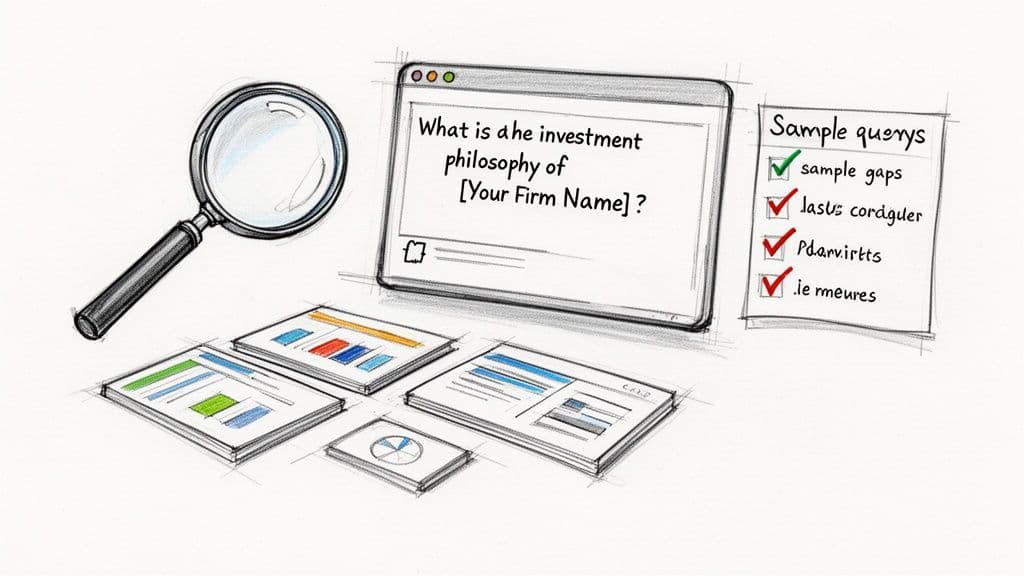
Before you can start optimizing anything, you have to know where you stand. Think of an AI visibility audit as a diagnostic check-up, a way to see your firm through the "eyes" of AI models. This isn't your standard SEO analysis; you’re actually going to query these systems to see what kind of digital reflection they've pieced together about you.
The goal here is twofold. First, are you even mentioned? Second, what is the context, accuracy, and sentiment of those mentions? This initial deep dive gives you the raw data you need to build a smart strategy, showing you exactly where the gaps, the misinformation, and the real opportunities are hiding.
Crafting Your Diagnostic Queries
The best way to start your audit is to think like a prospective client. You'll want to use a mix of broad and very specific prompts to test how well your online presence holds up. It’s absolutely critical to test this across multiple platforms—think ChatGPT, Perplexity, and Google’s AI Overviews—because they all pull from different data cocktails and can give you surprisingly different answers.
Kick things off with direct questions about your firm and its key people. These prompts test the AI’s most basic ability to find and relay factual information.
- Firm-Specific Prompts:
- "What is the investment philosophy of [Your Firm Name]?"
- "Who are the key partners at [Your Firm Name] and what are their specializations?"
- "Summarize the services offered by [Your Firm Name]."
Now, let's get more specific. Try running queries that a high-intent prospect would use when they’re looking for specialized expertise. This is the real stress test for your AI visibility for financial advisors.
- Niche and Location-Based Prompts:
- "Who are the leading financial advisors for tech executives in [Your City]?"
- "Find a fiduciary financial advisor specializing in retirement planning for university faculty near [Your State]."
- "Which wealth management firms in [Your Metro Area] have experience with cross-border tax planning?"
This layered approach gives you a much richer, multi-dimensional view of how you're currently perceived. To see how this fits into your wider digital footprint, our comprehensive site audit checklist is a great resource for the foundational elements that AI relies on.
Analyzing the AI Responses
Once you’ve gathered a good collection of responses, it’s time to analyze them. I can't stress this enough: document everything. Take screenshots of the AI's answers and organize them. You're searching for patterns across three crucial areas: presence, accuracy, and authority.
From my experience, the most alarming discovery you can make during an audit isn't finding negative information—it's complete invisibility. If an AI can't find you when asked a direct question about your niche, you have a foundational problem that needs to be fixed immediately.
As you review the results, ask yourself these questions:
- Presence: Does your firm show up at all? It’s one thing to appear for direct name searches, but do you surface for the high-intent, niche questions that your ideal clients are asking?
- Accuracy: Is the information correct? Double-check everything—your firm’s name, address, services, and the specialties of your advisors. AI models are known to "hallucinate" or pull from outdated sources, which can lead to seriously damaging misinformation.
- Authority: How are you being mentioned? Are you a top recommendation with a solid description of your expertise, or are you just another name in a generic list? Pay close attention to whether the AI cites its sources. Are they linking back to your website, a reputable directory, or a third-party media mention?
This initial audit is your blueprint. The gaps you uncover here—whether it’s a total lack of visibility in your niche, incorrect service descriptions, or weak authority signals—will tell you exactly what technical fixes and content you need to prioritize next.
Building a Digital Foundation That AI Understands
With a clear picture from your audit, it’s time to roll up your sleeves and get to work. Gaining visibility in AI-driven search isn't just about writing great articles; it's about building a technically sound digital ecosystem that machines can actually understand. AI models crave structured, unambiguous data, and our job is to feed it to them.
This means fine-tuning everything from your on-page elements and website code to your local directory listings. The goal is simple: create a clean, interconnected web of trust signals that AI can quickly parse, verify, and use to recommend your firm to the right prospects.
Structuring Your Expertise with Schema Markup
Think of schema markup as digital signposts for your website's content. It’s a layer of code you add to your site that tells search engines—and, more importantly, AI models—exactly what your information means. For a financial advisor, this is no longer optional.
By implementing schema, you remove all the guesswork for the AI. You're explicitly defining who you are, what you do, and why you’re an expert.
By clearly defining your services, credentials, and the people behind your firm, you're essentially handing AI models a verified dossier. This dramatically increases the chances they will feature you accurately in relevant financial queries.
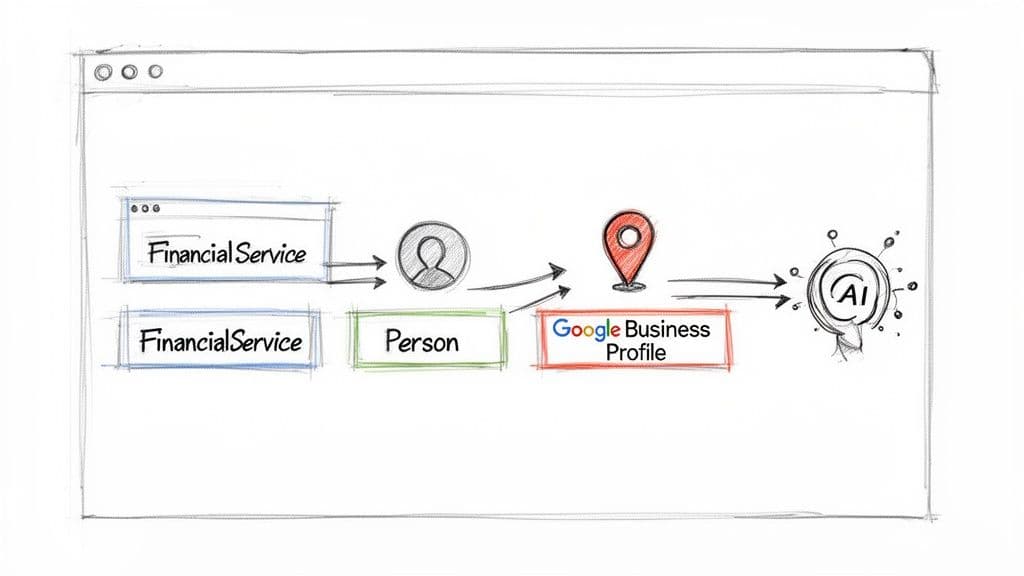
The two most critical schema types for advisors are FinancialService and Person.
Key Schema Markup for Financial Advisors
This table breaks down these essential schema types, showing how they help AI models accurately represent your advisory services.
When you combine these, you create a powerful, interconnected data structure. The FinancialService schema establishes your firm's identity, while multiple Person schemas link your team's individual expertise directly to it. This technical foundation is a massive step toward top-tier AI visibility for financial advisors. Of course, these technical elements work best when your site is well-organized; you can dive deeper into this in our guide on effective site architecture for SEO.
Turning Content into Knowledge Assets
Generic blog posts just don’t cut it anymore. To be cited by an AI, your content needs to be framed as a “knowledge asset”—a definitive resource that directly answers a specific, high-intent question. This requires a shift from writing about broad topics to tackling hyper-specific scenarios.
For example, instead of writing "A Guide to Retirement Planning," you should create a more targeted piece like "Tax-Efficient Withdrawal Strategies for Retiring Physicians in Texas." This kind of specificity does two things:
- It mirrors the complex, long-tail queries that high-net-worth individuals are actually asking AI.
- It immediately positions your firm as a subject-matter authority in a well-defined niche, a signal that AI models are trained to value highly.
Each knowledge asset should be built to answer questions from top to bottom, using clear headings, bullet points, and data to make the information easy for both humans and machines to digest. Understanding how to implement AI in business is no longer a future-facing strategy; it's a present-day necessity for growth.
Mastering Your Local Directory Footprint
Your website isn’t the only place AI models look for information. They lean heavily on high-authority directories, and your Google Business Profile (GBP) is at the top of that list. An incomplete or inconsistent GBP profile is a major red flag for any AI trying to verify your firm's legitimacy.
Make sure your profile is 100% complete and accurate. Pay close attention to:
- Consistent NAP: Your Name, Address, and Phone number must be identical everywhere online. No exceptions.
- Service Categorization: Use the most specific categories available, like "Financial Planner," not the generic "Financial Services."
- Detailed Service Descriptions: Clearly list your specializations. Think "estate planning" or "investment management for tech executives."
- Active Q&A Section: Don't wait for questions to come in. Proactively populate the Q&A section with common client queries and provide your own detailed, authoritative answers.
This data is a primary source for AI when it generates localized recommendations. The urgency here can't be overstated. Consumer reliance on AI for financial advice has already hit a tipping point, with 51% of consumers now using it. More telling is that searches on large language models have skyrocketed 150% year-over-year, completely dwarfing the 20% growth of traditional Google searches. This is the foundation that gives AI the confidence to recommend your firm correctly.
Building Citable Expertise and Authority
Getting your technical foundation right is the ticket to the game. But to actually win, your firm has to evolve beyond standard content marketing. It's time to start creating "knowledge assets"—deep, authoritative resources that AI models will cite as the source of truth for complex financial questions.
AI isn't just scanning for keywords anymore; it's hunting for genuine expertise. When a potential client asks, "What are the tax implications of exercising ISOs versus NSOs as a tech executive?" the AI wants a definitive answer, not just another generic blog post. This is where building citable authority becomes your most powerful play for real AI visibility for financial advisors.
From Blog Posts to Knowledge Assets
The real shift happens when you reframe your content strategy around answering specific, high-stakes client questions. Stop thinking in broad topics and start thinking about becoming the undisputed primary source for a niche problem. This means you have to get serious about understanding the actual pain points your ideal clients are wrestling with.
For example, a standard blog post might be titled "Tips for Retirement Savings." A citable knowledge asset, on the other hand, would be something like "A Comprehensive Guide to Optimizing Your 401(k) and Deferred Compensation Plan at a Fortune 500 Company."
See the difference? The second option is infinitely more valuable to an AI because it:
- Targets a specific audience (Fortune 500 employees).
- Grapples with a complex, multi-faceted issue (401(k) and deferred compensation).
- Signals deep, specialized knowledge that generic sources just can't match.
To start building these, map out the top 10-15 questions you hear over and over from your best clients. Every single one of them is a potential knowledge asset. Your mission is to create the most thorough, clear, and well-structured answer to that question available anywhere online. You can dig deeper into this approach in our guide on Answer Engine Optimization.
Publishing Original Research and Data
One of the fastest ways to plant your flag as a primary source is to create and publish your own original data. AI models are wired to recognize and prioritize unique information. And you don't need a massive research department to pull this off.
Think about commissioning a small, focused survey on a topic that’s dead-center for your niche.
Scenario: Let's say your firm specializes in retirement planning for small business owners.
- Research Idea: Survey 200 small business owners about their biggest fears regarding succession planning.
- Knowledge Asset: Publish a report titled "The 2024 Succession Planning Crisis: 78% of Small Business Owners Lack a Formal Exit Strategy."
- The Result: This report instantly becomes a citable source. When other publications, and then AI models, discuss this topic, they'll reference your firm's data. That’s how you build a powerful authority signal.
This whole shift toward citable content is happening as the market itself is exploding. The AI search engine market is on track to grow from 16.28 billion** in 2024 to a staggering **50.88 billion by 2033, with North America leading the way. You can explore more insights on this expanding market on Grand View Research. Firms that stake their claim as primary sources now will capture a massive share of that visibility.
Securing External Validation and Authority Signals
Creating brilliant content on your own site is crucial, but AI also looks for external validation. It needs to see that other authoritative sources trust your expertise. Getting mentions, quotes, and backlinks from reputable financial publications isn't just a "nice-to-have"—it's a non-negotiable part of this strategy.
Think of it this way: AI is like a diligent researcher compiling a report. It's going to trust a source that’s cited by The Wall Street Journal or Investopedia far more than one that exists in a vacuum. Every high-authority mention is a powerful vote of confidence.
This means your public relations and content efforts must be tightly integrated. When you publish that original research, you need to proactively pitch the key findings to journalists and bloggers who cover the financial industry.
- Proactive Outreach: Offer your advisors as expert sources for articles on tax planning, market volatility, or recent changes in estate law.
- HARO (Help a Reporter Out): Make a habit of regularly responding to queries from journalists who need expert financial commentary. A single quote in a major publication can give your AI credibility a significant boost.
- Guest Posting: Write articles for well-regarded financial blogs or industry trade publications. This doesn't just put your expertise in front of a new audience; it creates a powerful backlink and authority signal that AI can't ignore.
By weaving together the creation of in-depth knowledge assets with a smart strategy for external validation, you build a resilient and authoritative digital presence. You're no longer just part of the conversation; you are becoming the source that AI models—and ultimately, your future clients—turn to for answers.
Monitoring Performance and Maintaining Compliance
Getting your firm noticed by AI isn't a one-and-done project. Think of it as tending a garden. AI models are constantly re-evaluating the web, updating their knowledge base, and changing what they show users. Your firm's position today could be gone tomorrow.
This means you need a continuous cycle of monitoring, refining your strategy, and staying obsessively compliant. If you don't, you risk having outdated or just plain wrong information about your services served up to potential clients. That’s often worse than not showing up at all.
Establishing Your Key Performance Indicators
To know if you're winning, you need to keep score. But the old-school web metrics like website traffic and keyword rankings only tell part of the story. For true AI visibility for financial advisors, you have to dig deeper and track the KPIs that actually reflect your presence in AI-generated answers.
Here’s what I’m talking about:
- Mention Frequency: How often does your firm or one of your advisors get mentioned when someone asks a relevant question? Tracking this shows you if your efforts are actually moving the needle.
- Sentiment Analysis: When your name does come up, is the context positive, neutral, or negative? A positive mention might single out your expertise, while a neutral one just lumps you in with a list of other firms.
- Source Citation Quality: This one is huge. Is the AI citing your website's core content, your Google Business Profile, or a high-authority industry publication that quoted you? The quality of the source is a massive trust signal.
- Positional Ranking: If an AI lists multiple advisors, where are you on that list? Getting mentioned first or second is worlds more valuable than being buried at the bottom.
This really boils down to a foundational process: you have to do the research, create the right content, and earn the right citations. That's how AI systems learn to recognize and reward your authority.
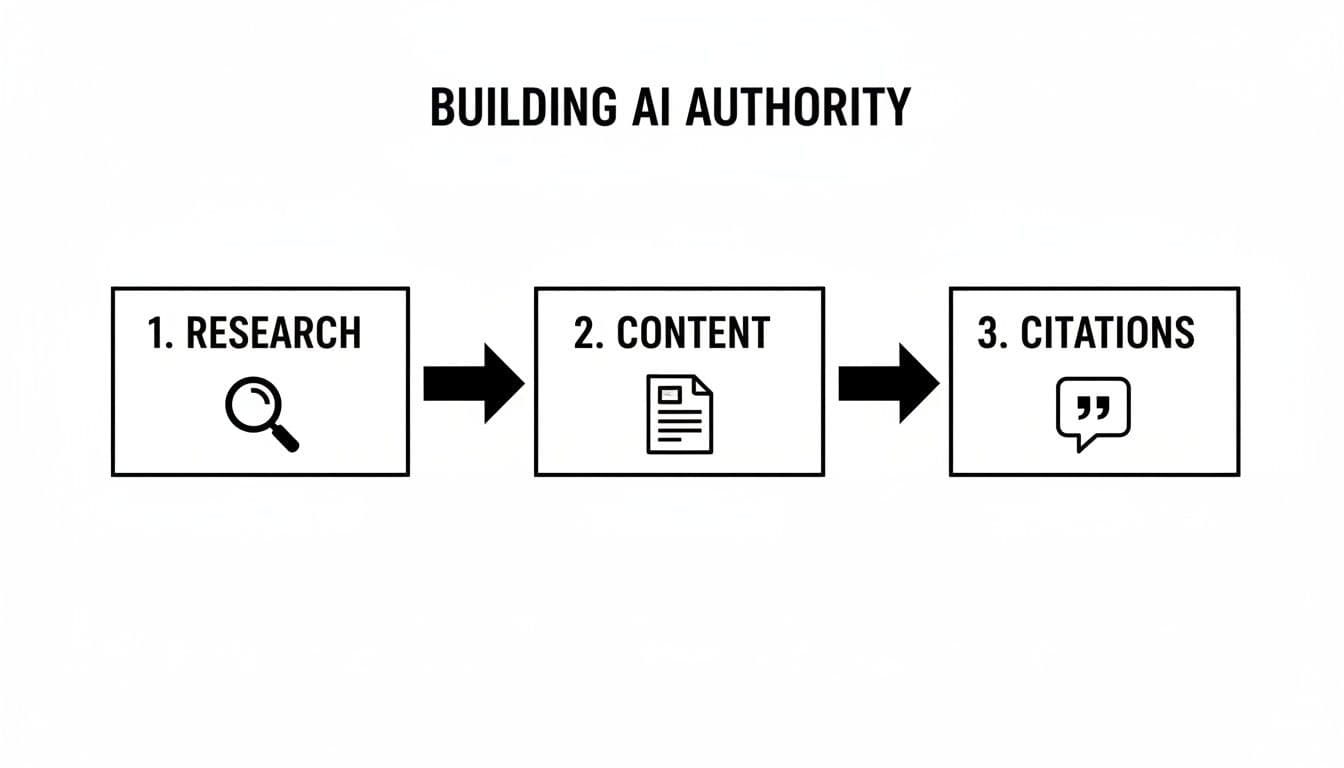
This loop of discovery, creation, and validation is what keeps you visible over the long haul.
Navigating the Compliance Maze
For financial advisors, every marketing conversation—even one with an AI—is under a regulatory microscope. The information AI models surface about your firm is subject to the same FINRA and SEC rules as your website or a brochure. This is a new, and frankly, tricky challenge.
You don't get to write the AI's script, but you are absolutely responsible for the accuracy of the source material it finds online. Keeping your digital footprint compliant is a non-negotiable, ongoing job. For instance, a deep understanding of Regulation Best Interest (Reg BI) is essential to ensure every piece of content reflects that you put your clients' interests first.
Being proactive here is your only real defense. We cover how to set up the right tracking systems in our guide on AI brand monitoring, which you can find here: https://attensira.com/blog/ai-brand-monitoring.
The old compliance rule still holds: you can't make misleading statements or unsubstantiated claims. If an AI misrepresents your services because it scraped an old webpage, the regulatory heat still comes down on your firm.
Creating a Correction and Refinement Workflow
Sooner or later, you'll find something wrong. When you do, you need a plan. A quick and precise response is the only way to protect your reputation and stay compliant.
First, identify the source. You have to play detective and trace the bad information back to its origin. Is it an old service description on a third-party directory? A poorly worded blog post on your own site? Find the root of the problem.
Next, correct the source data. This might mean logging into a directory to update a listing, rewriting a page on your website, or clarifying ambiguous language in an article. Fix it at the source.
Then, request a re-index. For your own website, pop into Google Search Console and ask it to re-crawl the updated page. This gives the AI a nudge to find the new, accurate information faster.
Finally, monitor and verify. For the next few weeks, keep checking the AI queries where the bad info was appearing. You need to confirm that your correction has been picked up and the AI's response has changed for the better. This is how you ensure your firm's digital presence isn't just visible, but also accurate and trustworthy.
A Few Common Questions About AI Visibility
When you start digging into AI-driven search, a lot of questions pop up. It's a new frontier for most financial advisors, so it’s natural to feel like you’re navigating uncharted territory. Let's clear up some of the most common points of confusion I hear from firms just like yours.
The idea here is to give you clear, straightforward answers so you can focus on what actually moves the needle.
How Is This Really Different From Old-School SEO?
It’s a fair question. With traditional SEO, the whole game is about getting your website to rank high on a Google results page. You want someone to see your link and click on it, bringing them into your digital world.
But AI visibility for financial advisors is a different beast altogether. The goal isn't just to get a click; it's to have your firm's expertise and data become the answer that the AI delivers. You're aiming to be the source, not just a link.
Sure, the fundamentals of SEO—like having a high-quality site and building authority—still matter immensely. But AI visibility puts a much heavier emphasis on things like structured data (Schema markup is huge here) and creating very specific, citable answers to the kinds of questions your ideal clients are asking.
If I Only Do One Thing, What Should It Be?
Look, I know you're busy. If you have limited time and resources, the single most powerful action you can take is to implement comprehensive and accurate Schema markup across your website. This is the non-negotiable foundation for getting noticed by AI.
By using FinancialService and Person schema, you're essentially speaking the AI's language. You’re handing it a clean, structured file that says, "Here’s who we are, here are our credentials, this is where we're located, and this is exactly what we specialize in."
Think of it this way: proper schema removes all the ambiguity for the AI. It’s like giving it a perfectly organized, pre-verified dossier on your firm, making it incredibly easy for it to trust and cite your information for relevant financial questions.
How Long Until I Actually See Results?
This is a marathon, not a sprint—I can't stress that enough. After you get the foundational pieces in place, like tightening up your Schema and fully optimizing your Google Business Profile, you might start seeing some influence within 1-3 months. That's about how long it takes for AI models to recrawl your site and process the new, structured information.
But building the kind of authority that gets you cited consistently? That's a longer game. For significant, repeatable improvements in your AI visibility, you should be thinking in terms of 6-9 months of consistent effort. Sporadic, one-off tweaks just won't cut it.
Should We Try This In-House or Hire Someone?
Honestly, it depends on your team's bandwidth and technical chops. Many firms are perfectly capable of handling the foundational work themselves. Things like optimizing your content and keeping your Google Business Profile updated are well within reach for most in-house marketing teams or even a savvy advisor.
Where you might want to call in a specialist is for the more technical, nuanced work.
- Complex Schema Implementation: Getting structured data right without errors that could hurt you is tricky.
- Strategic Outreach for Citations: Building the relationships needed to get mentioned on authoritative financial sites is a specialized skill.
- Performance Monitoring: Setting up the right dashboards to actually track your AI mentions and analyze sentiment isn't straightforward.
For most advisory firms, a hybrid approach works best. Handle the content and basic profile management internally, but bring in an expert for the initial technical audit, setup, and high-level strategy. It ensures you’re building on a solid foundation from day one.
Ready to stop guessing and start measuring your firm's AI visibility? Attensira provides the tools to track your mentions across major AI platforms, identify content gaps, and get actionable insights to optimize your presence.