


Boost your ai visibility for hospitality brands by auditing your presence, optimizing content for AI, and driving direct bookings.
AI visibility is a new frontier for hospitality brands, and it's all about one thing: making sure your hotel or resort shows up when a potential guest asks an AI assistant like ChatGPT or Gemini for a recommendation.
Travelers are already using these tools as a personal concierge to find and book their stays. If your brand is invisible in these AI-generated answers, you're not just missing out—you're handing direct bookings to your competitors. Optimizing for AI isn't a "nice-to-have" anymore. It's about survival.
The New Digital Front Desk: AI Search

The old playbook of just ranking on Google's first page is quickly becoming outdated. Today, your potential guests are having direct conversations with AI. They’re asking specific questions like, "Find me a pet-friendly hotel in downtown Austin with a rooftop pool," or "Compare the best all-inclusive resorts in Cancun for a honeymoon."
The answers to those prompts are the new digital front desk. And right now, many brands don't even have a presence there.
This fundamental shift represents the move from traditional Search Engine Optimization (SEO) to what we now call Generative Engine Optimization (GEO). SEO was about getting clicks to a webpage. GEO, on the other hand, is about influencing the information itself within the AI's conversational answers.
Traditional SEO vs. Generative Engine Optimization (GEO)
To really grasp this change, it helps to see the two disciplines side-by-side. The old rules of the game focused on keywords and backlinks, but GEO demands a much broader approach centered on structured data, factual accuracy, and brand reputation across the entire web.
This table makes it clear: GEO isn’t just a new name for SEO. It’s a completely different way of thinking about your digital presence, requiring you to manage your brand's narrative across countless sources, not just your own website.
A Massive and Growing Visibility Gap
Just how big is this problem? It’s staggering. Many hoteliers I talk to assume their strong Google presence automatically translates to visibility on AI platforms. The data, however, paints a very different picture.
A groundbreaking 2026 study from Hotelworld AI, which analyzed 2.36 million data points across 810,000 global hotels, uncovered a harsh reality: only 16.7% of these properties appeared in AI search results.
That means over 675,000 hotels are completely invisible to anyone using AI for travel planning. This isn't a minor gap; it's a massive blind spot that directly impacts booking opportunities.
This isn't just a technical issue; it's a commercial one. When an AI like ChatGPT suggests a competitor instead of your property, you've lost a potential guest before they even visit your website. The AI has become the new gatekeeper.
The first step to taking back control is understanding where you stand. An AI visibility audit is no longer optional—it's a critical baseline for any modern hospitality brand. It shows you where you appear, where you're absent, and which competitors are already winning in this new arena.
With features rolling out that show how users can now shop on ChatGPT, the connection between AI visibility and direct revenue is only getting stronger. This playbook will walk you through exactly how to audit, optimize, and monitor your presence for this new reality.
How to Audit Your Brand's AI Visibility
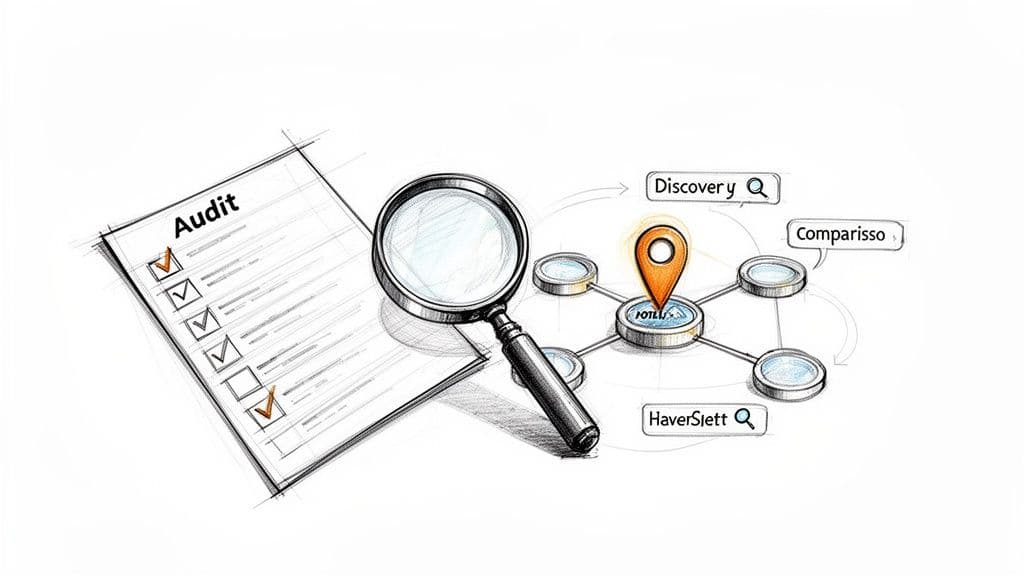
Before you can start improving how your brand shows up in AI-powered search, you need to know where you stand. An AI visibility audit isn't just about typing your hotel’s name into a chatbot; it's a systematic deep dive into how you appear—or don't—when potential guests use generative AI to plan their trips.
The real goal here is to map out your presence across the AI platforms that matter, based on what travelers are actually asking. It’s a very different beast from a traditional SEO check. If you're curious about that process, our guide on how to perform an SEO audit offers a good point of comparison.
To start, you have to prioritize the AI tools travelers are actually using. Concentrate your efforts on the big three:
- ChatGPT: The go-to for many people starting their travel planning with broad, conversational questions.
- Gemini: Its deep integration with Google’s data makes it absolutely critical for local discovery and recommendations.
- Perplexity: This one is interesting because it provides cited sources, giving you direct clues about which websites the AI trusts for information.
Auditing Across the Traveler Journey
A proper audit means thinking like a real traveler. You need to test a wide variety of prompts that mirror the different stages of their planning process, from vague initial ideas to very specific, ready-to-book questions.
Start with discovery-phase prompts. Think about the broad questions a guest might ask at the very beginning of their journey. If you manage a boutique hotel in Charleston, for instance, you’d want to test prompts such as:
- "What are the best boutique hotels in Charleston, SC for a romantic weekend?"
- "Find hotels near the French Quarter with historic charm."
- "Recommend a quiet, upscale hotel in Charleston with an on-site spa."
From there, you can shift into consideration and comparison prompts. This is the stage where travelers are starting to narrow down their choices. You want to see if your hotel makes the shortlist and, just as importantly, how it's described.
The core of your audit is to document everything. Note which AI platform you used, the exact prompt, and the full response. Pay close attention to which competitors are mentioned when your brand is absent.
For example, you could prompt the AI with queries like:
- "Compare [Your Hotel Name] with [Competitor Hotel A] for amenities and price."
- "Which has better reviews for customer service, [Your Hotel Name] or [Competitor Hotel B]?"
This comparative analysis is where you'll find some of the most powerful insights. It doesn’t just show you where you’re invisible; it highlights the perceived strengths of your competitors. This data-driven map—pinpointing where you appear, where you’re missing, and who gets recommended instead—becomes the foundation for a truly effective Generative Engine Optimization strategy.
Optimizing Your Digital Assets for AI
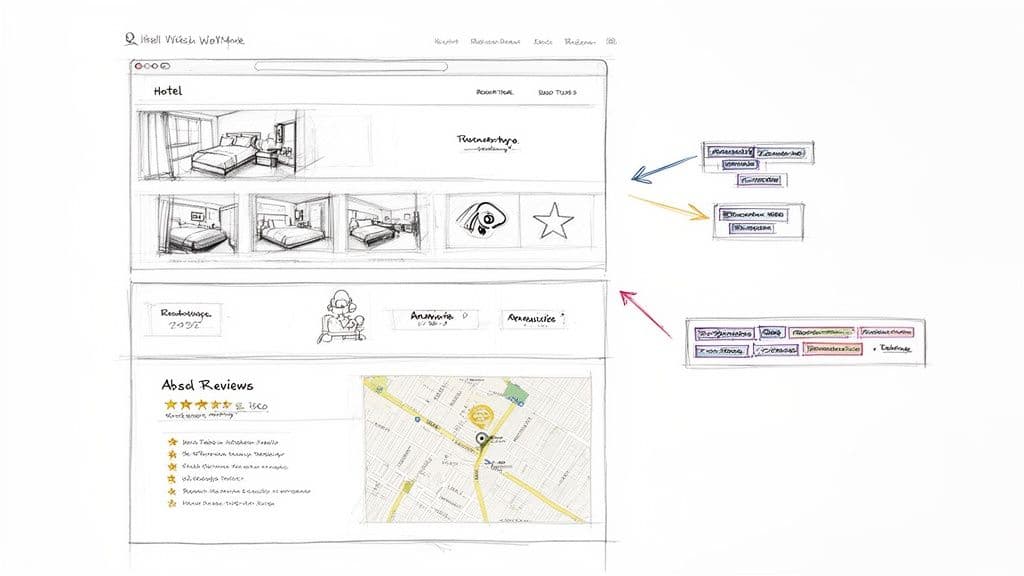
Once you’ve pinpointed where you’re falling short in AI-driven conversations, it’s time to fortify your own digital real estate. Generative AI models don't browse your website with the same eye as a potential guest. They're data-mining machines, parsing your site for cold, hard facts they can use to construct answers.
This is exactly why they so often lean on third-party review sites and online travel agencies (OTAs). Those platforms are engineered as treasure troves of structured data—think reviews, ratings, amenity checklists, and location details—making them incredibly reliable sources for an algorithm.
The data backs this up. A 2026 AirOps report on AI search dynamics found that brands are 6.5 times more likely to be cited through a third-party source than their own website in early-stage discovery questions. With a staggering 85% of brand mentions coming from these external platforms, there's a massive opportunity for hotels to step up and reclaim their authority.
To win in this new landscape, your website must become a more trustworthy and accessible data source than the aggregators.
Implement Robust Schema Markup
The single most effective tool in your arsenal is schema markup. I like to think of it as a universal translator that converts your website's content into a language AI models can instantly and fluently understand. It’s the technical foundation of earning better ai visibility for hospitality brands.
Instead of making an AI guess what a page is about, you can use schema to explicitly tell it:
- This is a
Hotel. - These are the
amenityFeature(s), like "free Wi-Fi" and "rooftop pool." - Here is the official
starRating. - These are the
openingHoursfor the lobby and restaurant. - This is a
GuestReviewwith a specificreviewRatingandreviewBody.
By implementing detailed schema for everything from your room types and rates to your precise geographic coordinates, you make it incredibly easy for AI to pull facts directly from the source—you. The underlying principle is very similar to the optimizations needed for Google's featured snippets. We actually have a whole guide on how to optimize for featured snippets that explores these parallels further.
Transform Content into Definitive Sources
Beyond the technical side, your content strategy needs to evolve. Forget about writing generic blog posts. The new focus is on creating comprehensive, entity-based content that cements your property's reputation as a definitive local expert.
An AI assistant’s main job is to give the most complete and helpful answer possible. Your job is to create content so thorough and well-structured that your brand becomes an indispensable part of that answer.
Think about what happens when a traveler asks, "What are the best things to do near SoHo, NYC?" A hotel that has published a detailed neighborhood guide—complete with specific restaurants, shops, and attractions—is far more likely to be cited as a primary source.
Here’s a practical look at how a standard blog post gets an AI-ready makeover:
This strategic shift turns your website from a simple brochure into a rich, structured knowledge base. When you combine robust schema with in-depth, authoritative content, you're actively training AI models to see your brand not just as another option, but as a primary source of truth.
Building a Proactive Generative Engine Optimization Strategy
Securing lasting visibility in AI answers isn't something you can "set and forget." It demands a continuous, proactive strategy that goes way beyond one-off technical tweaks. This is where we need to shift our focus from just optimizing assets to building a real, long-term Generative Engine Optimization (GEO) program. It’s less about chasing keywords and more about building a complete, cohesive brand narrative across the entire web.
This strategic pivot is quickly becoming a major competitive advantage. New research from Conductor shows a fascinating trend: nearly one-third of digital marketing leaders now see Generative Engine Optimization as their biggest hurdle for growth.
Even though a staggering 97% are seeing positive results from their initial efforts, a performance gap is already opening up. The most forward-thinking hospitality brands are already spending almost twice as much on GEO as their competitors. This is cementing their AI visibility for hospitality brands and leaving others playing catch-up.
Cultivating Off-Site Authority and Trust
Your own website is the foundation, but that's only part of the story. AI models build confidence by verifying information across many different trusted sources. A smart GEO strategy, therefore, has to reach far beyond your own domain. This means actively growing your off-site authority through focused digital PR and smart partnerships.
Put yourself in the AI's shoes for a moment. It's far more likely to trust a detail about your hotel's new rooftop bar if it finds that information on your site, but also sees it mentioned on a popular travel blog, in a local news story, and on a high-authority review site like TripAdvisor.
The real aim here is to create a consistent, positive echo chamber around your brand. Every credible mention, link, and review acts as a vote of confidence, strengthening your brand's authority and making you a more reliable source for AI-powered answers.
Clearly Defining Your Brand's Story
Finally, your strategy has to make sure your brand's unique selling points (USPs) are communicated clearly and consistently, in a format that large language models (LLMs) can easily digest and repeat. You can't just assume an AI will figure out what makes your property special; you have to spell it out for them, literally.
Create a "single source of truth" for your most important brand attributes. This could be a dedicated page on your website or a structured data file that outlines things like:
- Your Brand Pillars: What are you known for? Luxury, sustainability, being family-friendly, or your historic charm? Be specific.
- Signature Amenities: Detail the unique offerings that set you apart. Is it the Michelin-starred restaurant, the saltwater infinity pool, or exclusive pet-friendly services?
- Guest Experience Philosophy: Clearly articulate your commitment to things like hyper-personalized service or a completely seamless digital check-in process.
This approach gives AI models a rich, factual, and consistent story to draw from when someone asks about your hotel. By building this 360-degree data foundation and actively cultivating authority, GEO shifts from a technical task to a primary driver of business growth. For a more detailed breakdown, you can read our complete guide on Generative Engine Optimisation.
Measuring Your AI Visibility and Proving ROI
So, how do you actually prove that your investment in Generative Engine Optimization (GEO) is paying off? It’s a fair question, especially since we can’t just point to familiar metrics like keyword rankings or organic traffic from Google Analytics. The world of AI assistants is different.
For a while, AI platforms like ChatGPT and Google's Gemini have been black boxes. There are no built-in analytics dashboards, leaving most marketing teams completely in the dark. Are you even showing up in these new conversational search results? Guesswork isn't a strategy. To demonstrate a real return on investment, we need to shift our focus to KPIs that matter in this new landscape.
This is where you move from just reacting to trends to proactively shaping your brand’s presence where it counts. It’s about building a system that ensures you’re not just visible today, but remain a top recommendation as these AI models continue to learn and change.
The New KPIs for Generative Engine Optimization
To get a true read on your AI visibility for hospitality brands, you need to track a handful of core metrics. Forget vanity numbers. These KPIs give you a clear, actionable picture of how your brand is actually performing in AI-generated answers.
Below is a quick overview of the essential metrics you should be tracking. These shift the focus away from traditional SEO and zero in on what truly matters for generative AI.
Key Performance Indicators (KPIs) for GEO
These metrics give you a framework for understanding not just if you're being seen, but how you're being perceived and where you stand against the competition.
The process for building a measurable GEO strategy follows a clear, cyclical path. It’s all about creating a strong foundation, building on it, and then measuring the results to inform your next move.
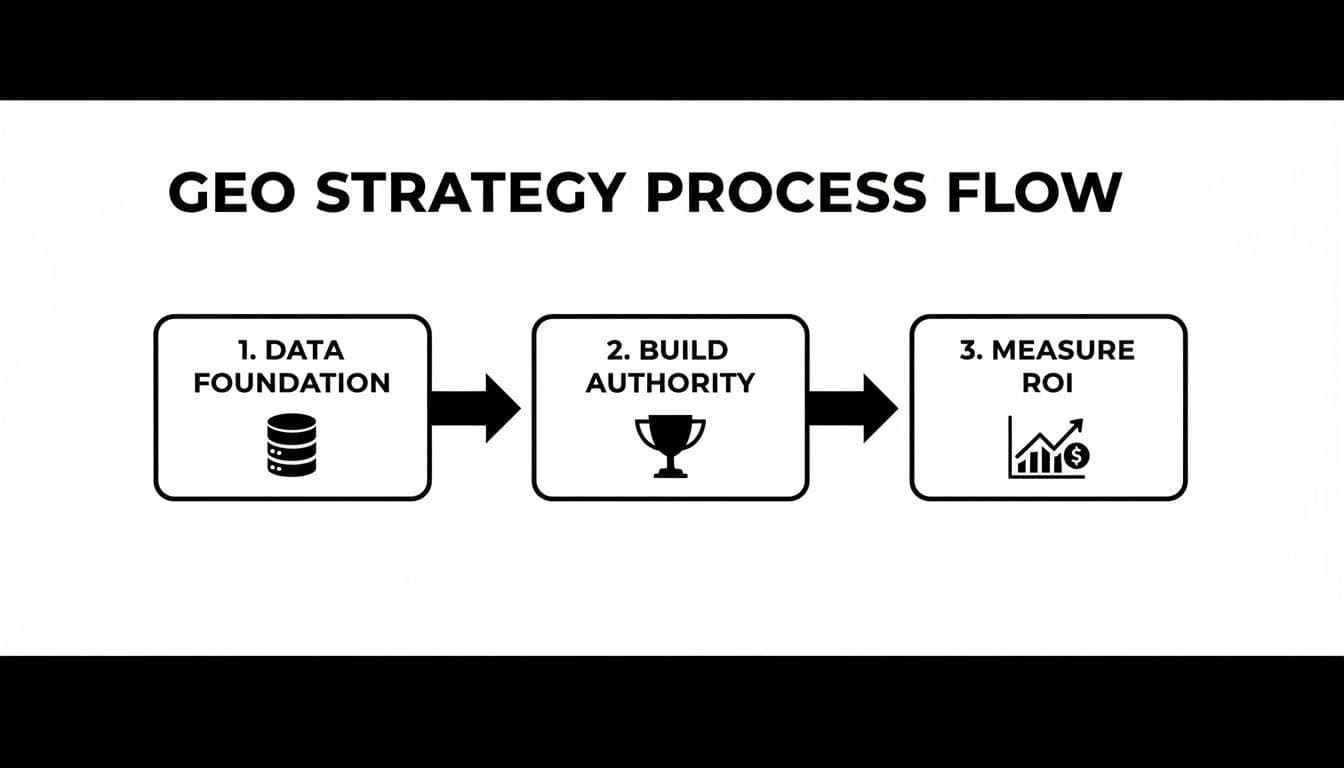
As you can see, this isn't a "set it and forget it" task. The goal is to create a continuous optimization loop where each step feeds directly into the next, driving sustainable growth.
A Workflow for Continuous Optimization
Monitoring these metrics has to be an ongoing effort. From my experience, the most effective approach is a simple loop: track, analyze, create, and measure again. Using a platform like Attensira, you can put much of this on autopilot.
Imagine setting up real-time monitoring for a high-value query like, "best hotels in downtown Denver for business travel."
From there, you can create automated alerts. For instance, you could get a notification any time a top competitor gets mentioned in an answer where your brand is absent.
This workflow transforms measurement from a passive reporting function into an active strategic tool. By spotting where competitors are winning, you can identify specific content gaps or authority-building opportunities to target in your next cycle.
Suddenly, you have data that connects your content creation and digital PR efforts directly to tangible improvements in your AI visibility. This disciplined process of tracking and responding is exactly how you prove the value of your GEO strategy.
For a deeper look at connecting these kinds of marketing activities to financial results, our guide on how to measure marketing ROI is a great resource.
Common Questions on AI Visibility in Hospitality
As hospitality leaders start to get their arms around this new AI-driven world, a lot of practical questions come up. The whole idea of optimizing for AI conversations can feel a bit overwhelming, but it's really about applying familiar marketing principles in a new arena.
Let's walk through some of the most common questions we're hearing from brands. This should clear up what you can do right now and help set the right expectations for the road ahead.
Is Generative Engine Optimization Just Another Name For SEO?
Not quite, though they are definitely related. Think of it like this: traditional SEO is about getting your website to show up on a search results page—that classic list of blue links. The whole game is about winning the click.
Generative Engine Optimization (GEO), on the other hand, is about making sure your brand’s most important information is woven directly into the AI's generated answer. The goal is to become a trusted source that an AI like ChatGPT will reference by name. This means putting a much bigger emphasis on structured data, making sure your facts are consistent everywhere online, and building authority beyond your own website.
How Can I Start Improving AI Visibility with a Limited Budget?
You absolutely don't need a massive budget to get started. In fact, some of the most powerful first steps you can take for AI visibility for hospitality brands are surprisingly low-cost. It's all about starting smart.
Here’s where I’d put my energy first:
- Perfect Your Google Business Profile: Treat this as non-negotiable. Fill out every single field accurately and keep it fresh. AI models, especially Google's own Gemini, lean heavily on this for local suggestions.
- Implement Basic Schema Markup: At a minimum, add
Hotelschema to your homepage andRoomschema to your main accommodation pages. This is probably the most critical technical step you can take to help AIs understand what you offer. - Encourage Detailed Guest Reviews: Get serious about asking for recent, descriptive reviews on the big platforms. The sentiment and specific details in these reviews are huge signals of quality and trust for AI.
- Monitor Key Queries: Start tracking a handful of your most valuable non-branded search queries (like "boutique hotels near me"). This gives you a baseline so you know where you stand today.
How Long Does It Take to See Results?
Improving your AI visibility is a marathon, not a sprint. While some technical fixes, like adding schema markup, can help AI interpret your site better within weeks or a few months, building real authority is a long-term game.
The biggest mistake hospitality brands make with AI visibility is inaction. Waiting to see how the landscape evolves allows competitors and third-party sites to establish themselves as the authoritative sources. By the time a brand realizes it’s invisible, regaining that ground becomes significantly more difficult and expensive.
Earning the kind of deep, topical authority that consistently gets you featured in AI answers is an ongoing effort. With a focused GEO strategy, you should expect to see a real, measurable impact within 6 to 12 months. The important thing is to start now. AI models are constantly learning and re-evaluating who to trust, and being proactive is the only way to secure your spot.
Ready to stop guessing and start measuring your brand's presence in AI search? Attensira provides the tools to track your visibility, analyze competitor performance, and optimize your content for the new age of discovery. Find out where you stand today.