


Unlock ai visibility for manufacturing with practical steps, clear KPIs, and a concise roadmap to boosting AI-driven outcomes.
AI visibility in manufacturing is all about making sure your company’s expertise, products, and solutions actually show up when a potential buyer uses an AI tool for research. Think of it as your new digital showroom, where AI assistants guide engineers and procurement managers straight to your best industrial solutions. This is a huge leap from traditional SEO—it's about feeding AI systems the right machine-readable data and authoritative content to win in this new era of AI-driven decision-making.
Defining Your Presence in AI-Driven Search
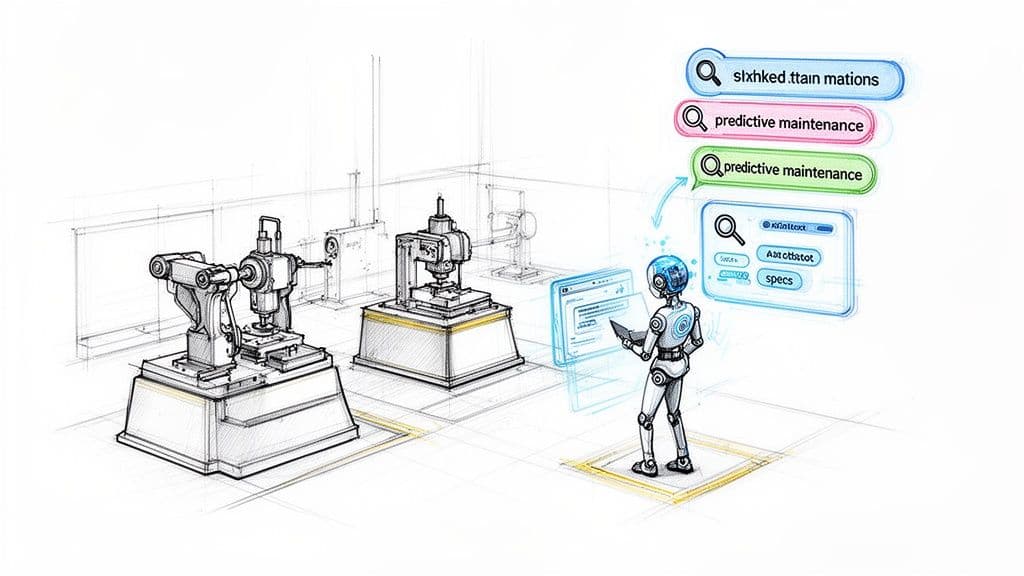
In manufacturing, visibility has always been about presence—getting noticed at trade shows, being featured in industry journals, and having your equipment on the factory floor. That same idea now applies to a new, intelligent digital space where your customers are asking AI for answers.
This isn't just another marketing buzzword; it's a strategic necessity. AI visibility is your company's direct line to being found, understood, and recommended by AI models like ChatGPT or Perplexity, which are quickly changing how B2B buyers find information.
From Keywords to Context
Traditional SEO was a game of keywords. A plant manager might search Google for "CNC machine predictive maintenance software." Simple enough.
But now, the queries are more complex and conversational. That same manager might ask an AI, "Compare the top three predictive maintenance platforms for a facility with over 50 Haas CNC machines, focusing on integration with existing ERP systems."
To handle a query like that, an AI isn't just looking for keywords. It's piecing together information from dozens of sources to deliver a direct, almost consultative answer. If your product specs, case studies, and technical documentation aren't structured for an AI to easily digest, your brand won't even make the shortlist. You simply won't exist in that final recommendation.
The Core Components of AI Visibility
Getting your brand to show up in this new ecosystem requires a few key things to work together seamlessly. To really get a handle on AI visibility, it helps to first understand the fundamentals of modern manufacturing operations.
The main pillars you need to focus on are:
- Data Presence: Are your product specs, pricing, and technical details machine-readable and easy to find? This is where structured data formats like JSON-LD and well-organized knowledge graphs become critical.
- Content Authority: Does your content actually prove you're an expert? You need in-depth articles, whitepapers, and practical guides that tackle the very specific, technical questions your audience is asking.
- Contextual Relevance: The AI has to understand exactly where your solutions fit. You achieve this by clearly connecting your products to specific problems, industries, and use cases with consistent messaging everywhere you have a digital presence.
When you get these components right, you ensure that when an AI acts as a research assistant for a potential buyer, your solutions aren't just an afterthought—they're presented as the best possible choice.
This shift demands a whole new mindset for digital marketing in the industrial space. It’s less about climbing up a search results page and more about becoming a trusted, foundational source in an AI's knowledge base.
For those looking to explore this further, Attensira offers specialized strategies for the manufacturing industry.
Why AI Visibility Is Essential for Manufacturers
The classic B2B buyer’s journey in manufacturing has been completely redrawn. For decades, procurement managers relied on a predictable mix of trade shows, thick supplier catalogs, and direct sales calls. Now, they have a powerful new research assistant ready to give immediate, complex answers: generative AI.
This is a fundamental change. If your products, technical specifications, and expert solutions aren't visible to these AI models, your brand essentially disappears during the most critical moments of the decision-making process. The sales cycle now often kicks off with a conversational query to an AI, long before your sales team even knows a potential customer is looking.
Picture an operations leader asking an AI, "Compare industrial robotic arms for a welding application with a payload capacity of 25 kg and a reach of at least 2 meters." The AI will instantly synthesize information from countless online sources to deliver a direct comparison. If your product data is buried in PDFs or your content doesn't answer these specific technical questions, your superior product won't even make the short-list.
The New Battlefield for Market Share
Being left out of these AI-generated recommendations is far more than a missed marketing opportunity—it's a direct threat to your revenue and market position. While you might be focusing on traditional SEO, your competitors could be capturing buyer attention by making sure their content and data are perfectly structured for AI consumption. This is exactly why ai visibility for manufacturing has become a competitive necessity.
This trend is only picking up speed. The global artificial intelligence in manufacturing market, valued at USD 5.32 billion in 2024, is projected to explode to USD 47.88 billion by 2030. This growth isn't just about factory automation; it signals a deep integration of AI into every part of the industry, including how parts and equipment are sourced.
Real-World Scenarios of Missed Opportunities
Let's walk through a couple of practical examples of how poor AI visibility can directly cost you business:
- Problem-Solving: An engineer is troubleshooting a nagging issue with a hydraulic press. They ask an AI, "What are common causes of pressure loss in a 500-ton hydraulic press, and what are the best replacement valve suppliers?" If your troubleshooting guides and product specs aren't easily processed by an AI, your competitor’s valves get the recommendation.
- Vendor Vetting: A procurement manager needs a new supplier for custom-machined parts that are ISO 9001 compliant. Their query is simple: "List top-rated CNC machining services in the Midwest specializing in aerospace-grade aluminum with documented quality control processes." Without clear, accessible data about your certifications and capabilities, you won't even appear on the radar.
In both situations, the opportunity is gone before your sales team can make a single call. Visibility has evolved beyond simple search rankings. For more on this, you might be interested in our guide on AI search visibility.
The core issue is that AI assistants are becoming the primary filter for B2B buyers. If your brand doesn't pass through this initial AI filter, you have zero chance of reaching the human decision-maker on the other side.
This is the urgent business reality facing every manufacturer today. Investing in AI visibility is no longer a forward-thinking experiment. It is a foundational requirement for survival and growth, ensuring your company remains a relevant, authoritative voice in an industry being reshaped by intelligent systems.
The Four Pillars of a Winning AI Visibility Strategy
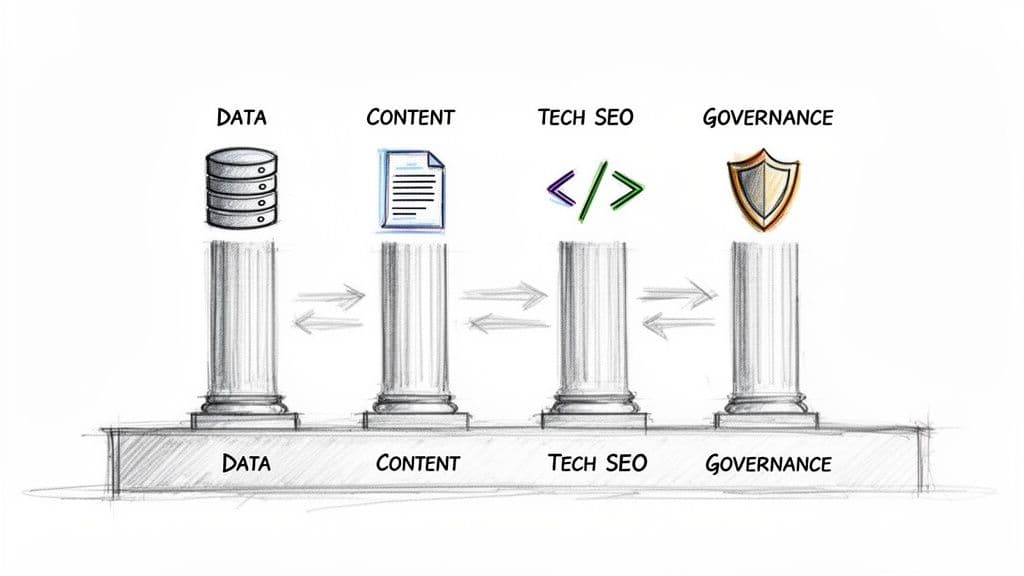
Building strong AI visibility for manufacturing isn't about chasing a handful of tactics. It's a methodical process, and the best way to get your arms around it is to think in terms of four interconnected pillars. This framework cuts through the noise and gives you a clear, actionable plan.
Each pillar represents a critical part of how AI models find, process, and ultimately recommend information about your company. If you get all four right, you build an authoritative presence that ensures your products and expertise surface when buyers are looking for solutions.
Let’s dig into each one.
Pillar 1: Your Data and Knowledge Base
This first pillar is the absolute foundation: making your company’s core information machine-readable. AI doesn’t browse a website like a person does; it parses structured data to understand concepts, connections, and characteristics. Your job is to create a clean, accurate, and easily accessible knowledge base for it to learn from.
This means translating your dense product specs, performance data, and engineering know-how into a format that AI crawlers can digest instantly. It's like turning a complex engineering blueprint into a simple, clearly labeled diagram that a robot can understand at a glance.
- Product Specifications: Make sure details like payload capacity, material compatibility, and operational temperature ranges are clearly defined with structured data.
- Company Information: Consistently present your certifications (e.g., ISO 9001), core competencies, and unique value propositions across all your digital properties.
- Case Studies: Structure your success stories with hard data points—like a 20% reduction in a client's downtime—that an AI can confidently cite as proof of your value.
Pillar 2: The Authoritative Content Ecosystem
If data provides the "what," then your content provides the "why." This pillar is all about demonstrating true expertise through high-quality, in-depth resources that answer the tough questions your engineering and procurement audiences are asking. Generative AI is being trained to prioritize sources that show genuine subject matter mastery.
This is where you go far beyond basic product pages. Your content needs to tackle the real-world challenges of smart factory integration, predictive maintenance, or supply chain optimization. The more you teach, the more AI models will see you as a credible source worth quoting.
This lines up with a clear trend in the industry. A recent AI in manufacturing survey of 350 manufacturers found that 41% believe AI will make their work more productive, while 38% see it as a tool for tackling more complex problems. To get noticed, your content has to deliver those deeper solutions.
Pillar 3: Technical SEO for an AI Audience
This is the technical glue that connects your data and content to the AI models. Technical SEO for AI isn't just about search engines anymore; it's about using specific code and formatting to explicitly tell AI crawlers what your content means. You’re essentially creating digital signposts that guide them to the right conclusions about your company.
The most important tool in your kit here is schema markup. By implementing this structured data vocabulary, you can precisely label key information on your site, such as:
Productschema to define your machinery and all its technical specifications.Organizationschema to detail your company's history, credentials, and areas of expertise.TechArticleschema to signal that your guides and whitepapers are expert-written technical documents.
Without this technical underpinning, even the most brilliant content can be misunderstood or completely ignored by AI systems.
Pillar 4: AI Governance and Continuous Monitoring
The final pillar is all about maintaining control and getting better over time. You can’t just set everything up and walk away. You have to actively monitor how your brand shows up in AI-generated answers to protect your reputation and ensure accuracy.
This means tracking mentions of your brand, analyzing the sentiment, and spotting any inaccuracies or "hallucinations" where an AI might misrepresent your products. This constant vigilance lets you refine your strategy, correct bad information, and discover new ways to strengthen your visibility. To learn more about this process, see our guide on AI search monitoring.
The Big Shift in Thinking AI visibility forces a move away from a keyword-first mindset to an entity-based one. It’s no longer enough to rank for "industrial robotics." The goal is for AI to understand your company as an entity that is a leading expert in manufacturing high-payload industrial robots specifically for welding applications.
Traditional SEO vs AI Visibility Tactics for Manufacturing
The transition to an AI-first world demands a significant evolution in strategy. What worked for a list of blue links on Google is no longer sufficient for getting your brand featured in a detailed AI-generated answer. The table below breaks down the key differences between the old approach and the new reality.
This shift doesn’t mean abandoning traditional SEO—a fast, well-structured site is still crucial. But it does mean layering on a new set of priorities centered on clarity, accuracy, and machine-readability to ensure your expertise is seen and understood by the next generation of search.
Measuring AI Visibility Success with KPIs
To get real value from AI visibility for manufacturing, you have to look past simple vanity metrics. It’s not enough to just show up in an AI-generated answer. You need to know if that mention is accurate, if it's persuasive, and—most importantly—if it’s helping your bottom line. Measuring this effectively means setting up clear Key Performance Indicators (KPIs).
These KPIs break down into three main groups: Presence, Quality, and Performance. Looked at together, they give you a complete picture of your AI visibility. You'll see if you're being found, how you're being portrayed, and whether any of it is actually driving business.
Presence Metrics: Gauging Your Share of Voice
Presence metrics are your starting point. They answer the most basic question: "Are we even showing up when potential customers ask the right questions?" This is the first real signal that your content and data strategies are beginning to pay off.
Here are the key presence KPIs to watch:
- Frequency of Mentions: This is a simple count. How often does your brand, a specific product, or even one of your key engineers get mentioned in AI responses to your target queries? For instance, if someone asks for "top suppliers of servo motors for automated packaging lines," you want to know how often your name appears.
- Share of Voice (SoV): This KPI adds crucial context by measuring your mentions against your top competitors for those same queries. If your brand shows up in 30% of AI answers for a critical topic while your main rival is in 60% of them, you've just identified a major visibility gap that needs attention.
Quality Metrics: Assessing Accuracy and Sentiment
Once you've confirmed you're being seen, the next question is about the quality of those appearances. A negative or factually incorrect mention can do more harm than not being mentioned at all. Quality metrics are all about brand protection and ensuring the information out there is actually right.
AI's impact on manufacturing is expected to be massive, with some projections showing a $3.8 trillion economic gain by 2035. This positions the sector to see some of the biggest benefits from AI adoption globally. As AI becomes a primary source of information, making sure it gets the facts right about your brand is mission-critical. You can read more about these groundbreaking AI statistics on nu.edu.
Two essential quality KPIs are:
- Sentiment Analysis: This KPI evaluates the tone used when your brand is mentioned. Is it positive ("a leading innovator in the field"), neutral ("is one of the suppliers"), or negative ("known for integration challenges")?
- Factual Accuracy: This is about auditing the details. You need to check AI summaries and product descriptions for correctness. For example, if an AI model mistakenly says your CNC machine has a spindle speed of 10,000 RPM when it’s actually 15,000 RPM, that's a critical error that needs to be traced back to its source and fixed.
Performance Metrics: Connecting Visibility to Business Value
At the end of the day, AI visibility needs to contribute to revenue. Performance metrics are how you tie your presence and quality efforts directly to business goals like lead generation and sales. This is how you prove the ROI of your entire strategy.
Think about tracking these performance-focused KPIs:
- AI-Assisted Referral Traffic: This measures how much traffic is landing on your website from links embedded in AI answers. It's a direct sign that people are finding the information compelling enough to act on.
- Assisted Conversions: This metric tracks users who came from an AI platform and later took a valuable action on your site, like filling out a "request a quote" form or downloading a technical whitepaper. It draws a straight line from AI visibility to lead generation.
Trying to track these KPIs manually across countless AI models and thousands of potential search queries is a fool's errand. It’s simply not scalable. This is precisely where a dedicated platform like Attensira is indispensable, giving you the comprehensive insights needed to monitor, analyze, and constantly refine your strategy. For a deeper look at what to measure, see our guide on the essential search metrics for improving SEO visibility.
Implementing Your AI Visibility Roadmap
Getting your manufacturing brand noticed by AI isn't a one-off project; it’s a systematic process. You need a clear, multi-phase roadmap to turn a complex goal into a series of manageable steps. Think of it as moving from an initial assessment to a cycle of continuous, data-driven improvement in how AI systems see and interpret your company.
The journey starts with establishing a presence, then moves to ensuring the quality of that presence, and finally, to measuring its actual performance.
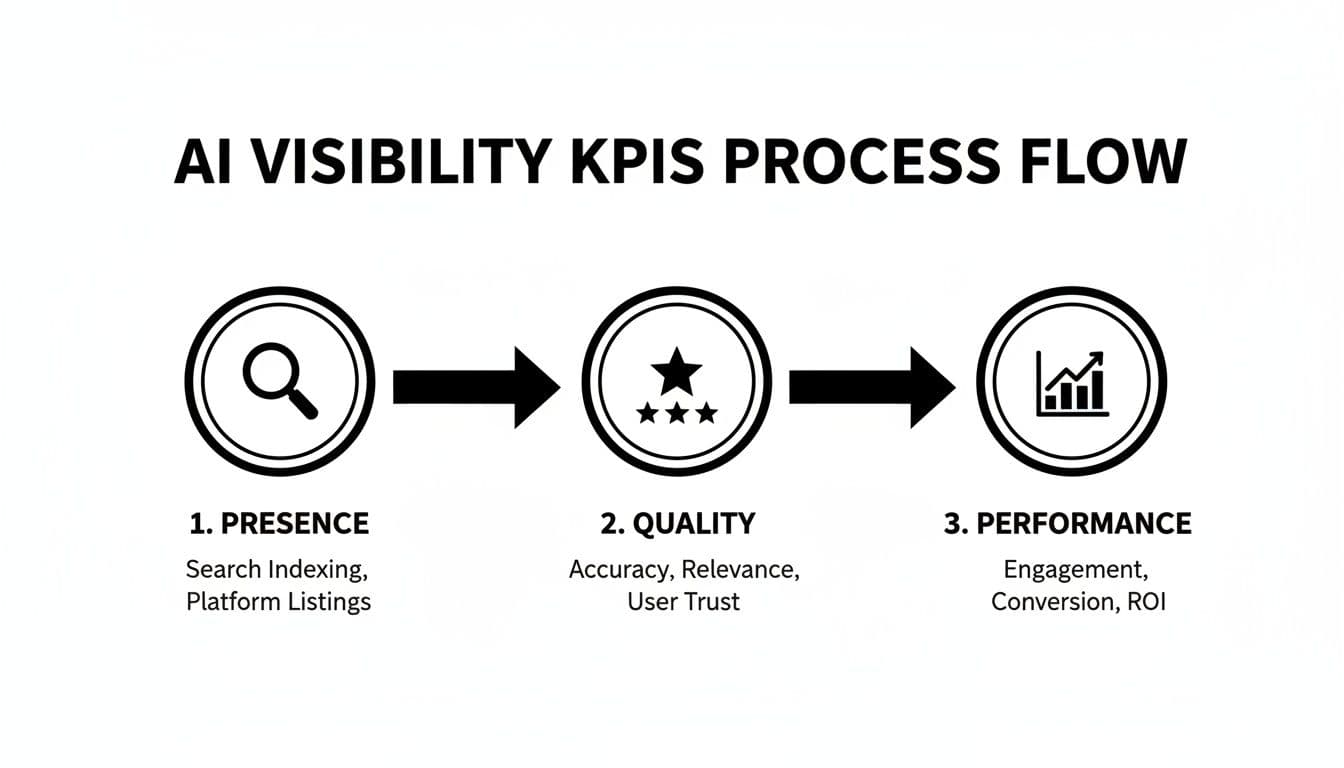
This flow highlights a critical point: just getting mentioned by an AI isn't the win. The real goal is driving tangible business outcomes from that visibility.
Phase 1: Audit and Benchmark Your Current Standing
Before you can map out a route, you have to know where you are. The first step is always to establish a clear baseline. You can't improve what you don't measure, so a thorough audit is non-negotiable for understanding your current AI visibility—or the lack of it.
This means digging deep to see how AI search results currently represent your brand, products, and key experts. Ask yourself a few tough questions:
- When a potential customer asks an AI about a problem your equipment solves, does your brand even show up?
- Are the AI-generated summaries about your company accurate and favorable?
- How do you stack up against direct competitors when it comes to high-value, purchase-intent questions?
Tools like Attensira are designed for exactly this. They give you the hard data to see your starting point, pinpoint the biggest gaps, and spot the most promising opportunities. This audit becomes the evidence you need to justify the investment and guide your entire strategy.
Phase 2: Develop a Machine-Readable Knowledge Graph
Once you have your benchmark, it's time to build the data foundation that AI models crave. This means creating a knowledge graph—a highly structured repository of interconnected facts about your company, your products, and your expertise.
Think of it as building a detailed, machine-readable encyclopedia for your business. This goes way beyond just listing product specs on a webpage. It's about defining entities and the relationships between them. For instance, you’d explicitly connect a specific CNC machine model (an entity) to "5-axis milling" (a capability) and its ability to work with "aerospace-grade aluminum" (a material compatibility). This structure ensures AI models understand the precise context and value you offer.
Phase 3: Create Targeted, Authoritative Content
The knowledge graph provides the "what," but your content must provide the "why." This phase is all about developing expert-level content that directly answers the complex, technical questions your B2B buyers are asking. This content becomes the primary source material that AI models draw from to formulate their answers.
Focus on creating resources that prove you know your stuff:
- In-depth technical guides that solve specific engineering or operational challenges.
- Comprehensive white papers exploring industry shifts, like smart factory integration or predictive maintenance.
- Detailed case studies that show quantifiable results, like a customer who achieved a 15% reduction in cycle time using your solution.
By consistently publishing high-quality, problem-solving content, you effectively train AI models to see your brand as a credible, authoritative source. This makes it far more likely they will cite your information in their responses.
Phase 4: Implement Technical Optimization
This is where the rubber meets the road. All your work on data and content won't matter if AI crawlers can't find and correctly interpret it. This phase involves the technical application of structured data using vocabularies like Schema.org. This code acts as a set of clear labels for the AI, explicitly identifying different pieces of information on your website.
For example, you’d use Product schema to mark up product pages, TechArticle for your guides, and Organization to define your company's credentials and expertise. This technical optimization is the bridge that connects your strategic work to the AI systems you want to influence. For a more detailed breakdown, learn more about AI overview tracking and its technical components.
Phase 5: Monitor Continuously and Refine
AI visibility is not a "set it and forget it" task. The AI ecosystem is in constant flux as models get updated and new data is ingested. This final phase establishes a continuous loop of monitoring, analyzing, and refining your strategy to maintain and improve your position over time.
It involves regularly tracking your KPIs for presence, quality, and performance. Using AI-powered monitoring can alert you to new brand mentions, track shifts in sentiment, and measure referral traffic from AI sources. These insights show you what's working and what's not, allowing you to fine-tune your content and data strategies for sustained success. This proactive management ensures your brand remains a prominent, trusted voice as AI-driven search becomes the new standard.
Conclusion: Securing Your Competitive Edge in the Age of AI
The shift to an AI-powered marketplace isn't some far-off prediction for manufacturing—it's happening right now. For years, a competitive edge was forged on the factory floor, built on the quality of your machinery and the speed of your production line. Today, that edge is increasingly determined by your AI visibility for manufacturing—how easily the intelligent systems guiding B2B buyers can find, understand, and ultimately recommend you.
We've walked through the complex strategy needed to succeed in this new arena. It’s a unified front, blending a solid, machine-readable data foundation with a rich ecosystem of content that solves real-world engineering problems. All of this must be fine-tuned with technical precision so AI models can process it accurately. This isn't just a marketing refresh; it's a complete rethink of how you demonstrate your value to the market.
The Lasting Advantage of Moving First
Manufacturers who take decisive action now are building a lead that will be incredibly difficult for others to overcome. As AI models learn and evolve, they compound their knowledge, continually reinforcing the authority of the first sources they learn to trust.
If you wait, you’re not just playing catch-up; you’re trying to shout over a chorus of competitors that AI has already crowned as the go-to experts. The price of standing still isn’t just a few missed leads—it’s total invisibility in the systems that matter.
The bottom line is simple: being the best manufacturer is pointless if AI doesn’t know you exist. Your digital presence must be as meticulously engineered as your physical products to claim your spot in the future of industrial buying.
Turning Your Strategy into Measurable Results
The road ahead demands a structured, methodical plan. You need to audit where you stand today, build out a comprehensive knowledge graph, and constantly monitor your visibility. This is where having the right partner becomes indispensable.
Ready to stop guessing and start measuring your influence?
Attensira offers the essential tools to audit your current AI visibility, pinpoint where you lag behind competitors, and transform your strategic blueprint into tangible results. Discover how Attensira can build your competitive edge and ensure your deep manufacturing expertise drives real, sustained growth.
FAQ
Diving into AI visibility for manufacturing naturally brings up a lot of questions. Let's tackle some of the most common ones to give your team a clearer path forward.
How Is AI Visibility Different from Traditional SEO?
It’s helpful to think of it like this: traditional SEO is about getting a human to click a link on a search results page. AI visibility is about convincing an AI model that your company is the definitive answer to a complex manufacturing problem.
SEO has always been about keywords, backlinks, and climbing the rankings. AI visibility is a deeper game. It’s about structuring your data so machines can understand it and creating authoritative content so AI tools trust your expertise. You’re not just trying to be a link on a list; you're aiming to become a foundational source in an AI's knowledge base.
Can Small Manufacturers Start with a Limited Budget?
Absolutely. You don't need a massive investment to get started. The trick is to be smart and focused.
Here’s a practical approach:
- Focus on Your Core Products: Pick one or two of your flagship product lines. Concentrate all your initial energy on making sure their technical specifications and documentation are perfectly structured and machine-readable.
- Answer Niche Questions: Start creating highly specific, technical content that addresses the tough questions your competitors overlook. This is more about investing time than money, and it quickly builds authority in your specific corner of the market.
- Clean Up Your Digital House: Go through your existing online footprint—from your "About Us" page to your product spec sheets—and make sure every detail is consistent and accurate. This foundational work doesn't cost much, but its value is immense.
A smaller manufacturer can outmaneuver larger competitors by being incredibly precise, targeting the specific areas where they provide the most expertise.
How Long Until We See Results from This Strategy?
This isn't like classic SEO where you might see a bump in traffic after a few months. The results from building AI visibility are more strategic and unfold over time. You're not looking for a sudden spike in visits.
You can expect to see early indicators within 3-6 months, like more accurate summaries of your brand in AI chats or seeing your name pop up for very specific, long-tail queries. A more substantial business impact, such as consistent referral traffic and AI-driven leads, typically takes 12-18 months to build as AI models gradually learn to trust your data.
Think of this as a long-term investment in your company's authority, not a short-term trick for a quick win. Patience and consistency are everything.
What Key Tools and Platforms Should We Consider?
While you can make progress with basic content and data hygiene, you'll eventually need specialized tools to scale your efforts and truly measure what's working. The most important platform you'll need is one that can monitor how your brand is being represented across various AI models.
Trying to track this manually is simply not feasible given the endless number of potential questions and different AI platforms. A dedicated tool is essential for a few key reasons:
- Audit Your Baseline: It shows you where you stand right now in AI-generated answers.
- Track Mentions and Sentiment: You can monitor when, where, and how your brand is being discussed.
- Analyze Competitors: It lets you benchmark your visibility against your direct rivals.
- Measure Performance: Most importantly, it connects your AI visibility efforts to real business metrics like website traffic and conversions.
This data is the only way to prove the ROI of your work and make smart decisions to refine your strategy.
Ready to stop guessing and start measuring your influence in the new age of AI-driven search? Attensira provides the critical tools to audit your current AI visibility, track your progress, and turn your strategic plan into measurable results. Discover how Attensira can secure your competitive edge.