


Unlock growth by mastering AI visibility for martech companies. This guide covers AI SEO, generative SERPs, and chat assistants to future-proof your brand.
Picture this: your ideal customer asks an AI assistant, "What's the best martech solution for my needs?" The AI gives a confident, detailed answer... and your brand is nowhere to be found. This isn’t a future problem; it's the new reality of brand discovery.
Welcome to the age of AI visibility, where your company's presence and reputation within AI-generated answers are quickly becoming your most valuable assets. For any martech company, getting this right is no longer just an option. This guide will walk you through exactly how to shift your strategy for this new world.
Why AI Visibility Is the New Digital Storefront
For years, we've thought of traditional SEO as setting up a shop on the busiest street in the digital world. You’d pick your location (keywords), build pathways to it (links), and hope to catch the eye of as much foot traffic as possible. But AI visibility changes the game entirely.
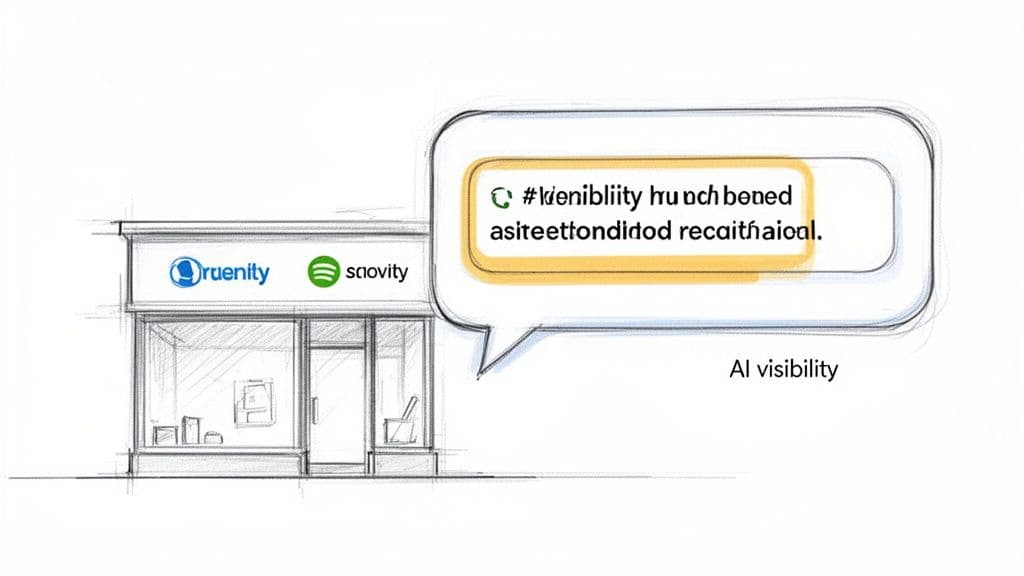
It’s less about having a storefront and more about being the top recommendation from a trusted, world-class expert. When a person asks ChatGPT, Google's AI Overviews, or Perplexity for a solution, the AI doesn't just show them a list of shops. It synthesizes information from thousands of sources to give one, authoritative answer.
Your job is to make sure your brand is an indispensable source for that answer.
To understand this evolution, it helps to compare the old model with the new one directly. The focus is shifting from ranking signals to reputational ones.
The Strategic Shift From Traditional SEO to AI Visibility
This table makes the new mandate clear: we're moving from a game of visibility on a search results page to a game of influence within an AI's knowledge base.
The Rush to AI-Powered Discovery
This isn't some far-off trend. It's happening right now. The growth in AI-driven search and discovery is undeniable, signaling a major adjustment for martech companies that live and breathe digital acquisition. While classic search engines are still king, AI assistants are quickly becoming the go-to for complex, purchase-intent questions.
The rise of AI-powered commerce is another clear sign of this change, and you can see a practical example in our analysis of how users can now shop on ChatGPT.
For martech companies, the takeaway is simple: If you are not visible to AI, you are effectively invisible to a growing, high-value segment of your target audience. Your brand's expertise and authority are now being evaluated—and amplified—by algorithms.
This shift from a page of blue links to a single, synthesized answer means that being on the first page of Google isn't the endgame anymore. The new #1 spot is being the source the AI cites in its response.
Why Martech Must Lead the Pack
Martech brands are at the very heart of this evolution. Your products are built to master the digital ecosystem, and your customers are some of the sharpest marketers out there. If your own brand doesn't show up in AI recommendations, it's more than just a lost lead—it’s a direct hit to your credibility.
For these companies, mastering AI visibility for martech companies isn't a "nice-to-have." It's fundamental to survival and growth. This isn't about adapting to another channel; it's about completely rethinking how you build and prove your brand's authority in an AI-first world.
Connecting AI Visibility Directly to Revenue
Let's be clear: AI visibility isn't some vanity metric you track for bragging rights. It's a direct line to your best leads and real, measurable revenue. For any martech company, drawing that line from an AI recommendation straight to a new customer isn't just a fantasy; it's quickly becoming the most important growth strategy.
Think about the difference in user intent. Traditional search often pulls in a wide net of people, many of whom are just kicking tires or in the early stages of research. But when someone asks an AI, "Which CRM has the best automation for a small sales team?" and your product is the answer, that person is ready to buy. They're deep in the funnel, actively looking for a solution.
A recommendation from a trusted AI like ChatGPT or Google’s AI Overviews is the new word-of-mouth referral, supercharged with high intent. It sends people to your site who are already half-sold on what you offer.
This changes how we should think about web traffic. The goal is no longer attracting the highest volume of visitors. Instead, the focus shifts to bringing in a smaller, more targeted group of high-conviction prospects. These are the leads your sales team actually wants to talk to—they’re informed, qualified, and ready to have a serious conversation.
The New Math of Zero-Click Searches
The rise of the "zero-click search" flips the old SEO playbook on its head. More and more, users get their answers directly on the search results page without ever clicking a link. With AI, this trend is only picking up speed. Being the cited source in an AI-generated answer is the new #1 ranking.
The numbers don't lie. Zero-click searches now account for roughly 60% of all searches. This is being supercharged by features like AI Overviews, which already show up in 30% of US SERPs. For B2B companies, the opportunity is massive. While Google still dominates search, AI platforms are proving to be referral powerhouses. Traffic from AI converts at an astounding 14.2%—that's nearly five times better than Google's average. Yet, almost no one is actively optimizing for it. You can dig into more of these AI SEO statistics over on the Semrush blog.
The data makes it obvious: optimizing for AI visibility for martech companies isn't an expense. It's a direct investment in acquiring your most valuable customers.
From AI Mention to Qualified Lead
So what does this look like in the real world? Let’s walk through how an AI mention turns into revenue.
- The High-Intent Query: A marketing director is looking for a solution and asks an AI, "What's the best martech platform to track competitor AI visibility?"
- The AI Recommendation: The AI pulls together information from across the web. It highlights your company, Attensira, citing your detailed guides and case studies as proof of your expertise and pointing out specific features that match the director's query.
- The Qualified Click: Armed with a trusted, third-party recommendation, the director clicks the citation link to your website. They don't land cold; they arrive with a clear idea of your value.
- The Efficient Conversion: The subsequent sales call is completely different. Instead of a generic intro, the conversation starts with, "The AI mentioned you have strong competitor tracking features. Can you show me how that works?" The sales cycle is shorter, the lead quality is higher, and you close the deal faster.
This flow shows the undeniable link between showing up in AI answers and growing your bottom line. It’s not about chasing clicks. It's about influencing decisions at the most crucial moment of the buyer’s journey. By focusing here, you improve not just lead quality but the overall efficiency of your sales funnel—a crucial part of understanding and boosting your marketing ROI.
Mapping the Key AI Channels for Martech Brands
The world of AI can feel a bit like a black box for marketers. But when you look closer, you start to see distinct territories and channels taking shape. For martech companies, getting noticed by AI—what we call AI visibility—is all about showing up in the specific places where your customers are asking questions and looking for solutions. You just need a map for this new terrain.
Think of it less as one giant AI and more as an ecosystem of different channels, each with its own rules. Getting seen in these channels isn't just about brand awareness; it's about driving real business results.
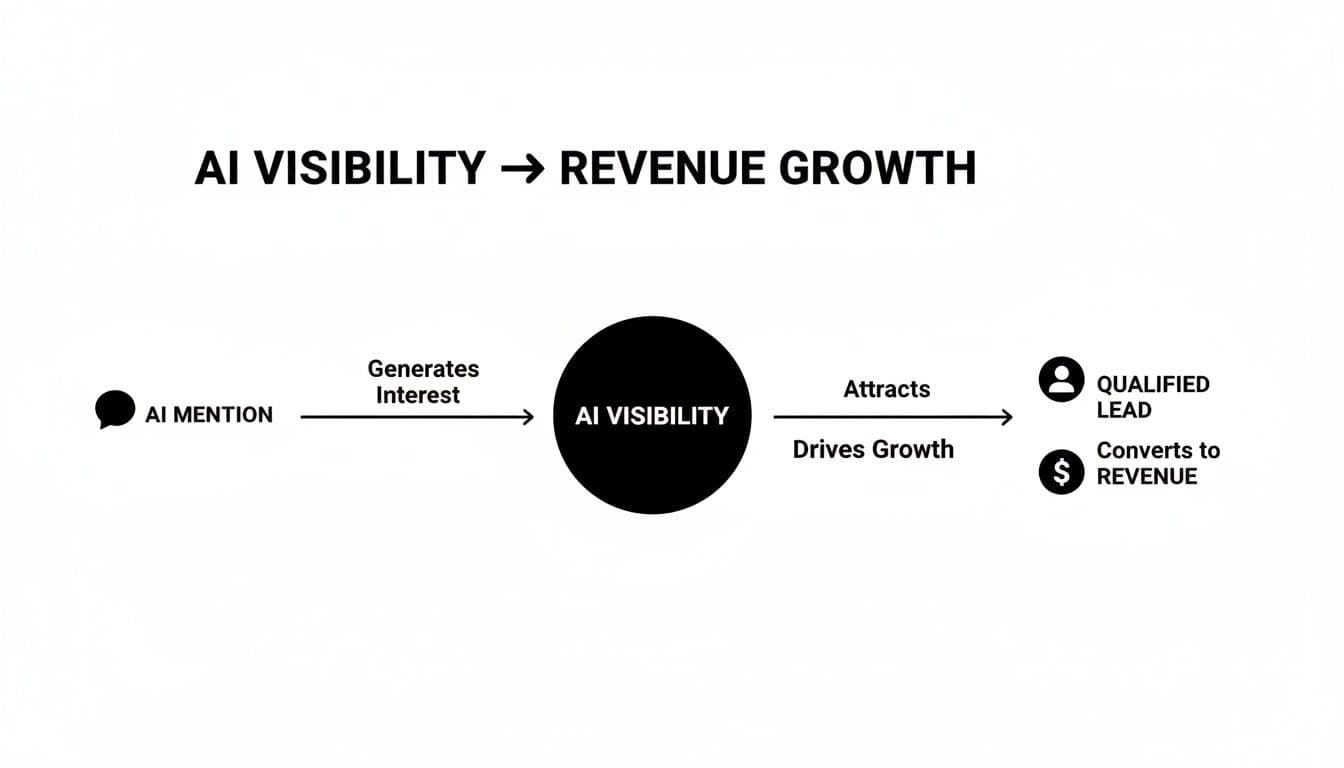
As this diagram shows, an AI mention is the first step on a direct path to revenue. It's the top of a new kind of sales funnel. Your goal is to strategically position your brand within three core AI-driven channels where your future customers are making decisions right now.
1. Generative SERPs and AI Overviews
The first, and most obvious, battleground is the search engine results page (SERP), which is rapidly changing. Platforms like Google are now integrating AI Overviews right at the top, creating a single, summarized answer to a user's query.
For a martech brand, showing up in that AI Overview is the new "ranking number one." When a CMO searches for "best tools for automating social media analytics," Google's AI doesn't just show a list of links. It builds a narrative, pulling from sources it trusts to recommend the best solutions.
Getting mentioned here is more than just a name-drop. The real win is when the AI cites your content—a guide, a case study—as the source for its answer. That citation establishes you as the authority before anyone even clicks through to your site.
To make this happen, your content needs to be structured to answer questions with clarity and authority. You have to make it incredibly easy for the AI to find your information and present it as the definitive answer. We cover more on this in our guide to achieving better platform visibility.
2. Conversational AI Chatbots
Next up are conversational AI assistants like ChatGPT, Gemini, and Claude. These aren't just search engines; they're dialogue partners. They give recommendations based on a back-and-forth conversation, which means context is everything.
A marketing manager might ask, "I need an email marketing platform that integrates with Salesforce and has strong A/B testing for a B2B audience. What are my options?" The AI's answer comes from its training data, and that's where your brand’s expertise needs to be deeply ingrained.
A successful mention in a chatbot looks like this:
- The Recommendation: The AI suggests your product by name.
- The Justification: It explains why your platform is a great fit, calling out the exact features the user asked about (e.g., Salesforce integration, B2B A/B testing).
- The Source: Ideally, it backs up the claim with public data, user reviews, or your own expert content.
Visibility here is the result of a strong, consistent digital footprint that clearly shows your authority on specific use cases. Your content can't just explain what your product does; it has to prove who it’s for and what problems it solves better than anyone else.
3. AI-Powered Recommendation Engines
The third key channel is the web of AI recommendation engines working behind the scenes on B2B software marketplaces like G2 and Capterra, as well as on major content platforms. These systems surface relevant tools and articles based on a user’s behavior and profile data.
Think about a user on G2 browsing project management tools. That "You Might Also Like" section isn't random. It’s powered by an AI algorithm that's analyzing their interests and comparing them to what similar users found valuable.
Getting your martech solution recommended here is a huge win. You're intercepting a buyer at the exact moment they're weighing their options. Success depends on having perfectly optimized profiles, a wealth of positive reviews, and content that lays out your unique value in a structured, machine-readable way.
Your Playbook for Winning in AI-Powered Search
Knowing the new lay of the land with AI-driven search is one thing, but actually conquering it is another. It’s time to move from theory to tactics. This is your playbook—the specific content and technical strategies martech companies need to build and amplify their visibility where it now matters most.
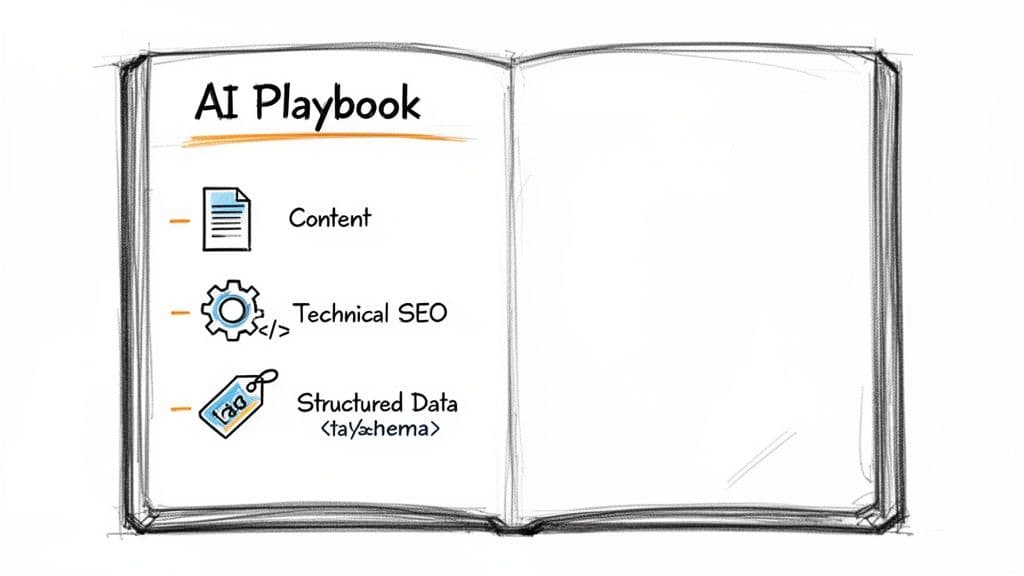
You need to start thinking of your website differently. It's no longer just a collection of pages; it’s a centralized data hub that actively trains AI models. Every piece of content, every product spec, and every customer review is a signal that teaches AI about your expertise. To win, your playbook must focus on two things: creating content that AI trusts and setting up the technical plumbing that makes your information easy for it to understand.
Crafting Content for AI and People
AI models are built to find and synthesize the most helpful, credible information out there. If you want your brand to become a preferred source, your content has to answer questions with real depth and clarity. This is where the idea of E-E-A-T (Experience, Expertise, Authoritativeness, Trustworthiness) goes from a guideline to a mandate.
A recent Salesforce study found that 76% of marketers are already using generative AI to help create content. This means the internet is getting flooded with more content, not necessarily better content. Just publishing articles won't cut it anymore. Yours has to be demonstrably richer and more trustworthy to even have a chance.
To build this kind of rock-solid authority, focus on these content plays:
- Build Comprehensive Topic Clusters: Stop thinking in terms of single keywords and one-off blog posts. Instead, build deep clusters of content around your core topics. A martech company shouldn't just write a post on "email automation." It should own that topic with a central pillar page supported by spokes on "A/B testing for B2B," "segmentation best practices," and "integrating email with your CRM."
- Use Natural, Conversational Language: Write for humans. It sounds simple, but it's critical. Use the same language your customers use when they ask questions. A well-built FAQ section on a product page is a goldmine because it directly mirrors user queries in a format that AI models love to pull from.
- Prioritize Facts and Data: Back up every claim. Use statistics, cite sources, and show real-world examples. AI models are getting smarter about sniffing out marketing fluff and prioritizing content that's supported by hard evidence.
When you focus on depth and clarity, you build a content library that proves your expertise. This is the foundation of achieving AI visibility for martech companies. For a more detailed look at this, our article on AI search engine optimization dives even deeper.
Fine-Tuning Your Technical SEO for Machines
Here's the thing: incredible content doesn't matter if AI crawlers can't find, understand, and categorize it properly. The technical side of AI SEO is all about making your site's architecture and code as machine-readable as possible.
Think of it as giving the AI a glossary and a map for your website. Schema markup, a type of structured data, is that glossary. It gives explicit context to your content, telling AI models exactly what something is—this is a Product, this is an Organization, this is a Review, and this is an FAQ.
This checklist gives you a practical starting point for both the content and technical sides of the equation.
AI Visibility Content and Technical Checklist
The table below outlines the essential tasks to get your content and technical SEO in order, making your brand a prime candidate for visibility in AI-driven search.
Executing on these technical items ensures the expert content you're creating isn't just sitting there, but is perfectly formatted for AI to find and feature. This one-two punch of deep content and flawless technical SEO is your most powerful strategy for winning in this new era of search.
How to Measure Your AI Visibility and ROI
If you can't measure it, you can't improve it. That’s a marketing truism, but when it comes to AI visibility for martech companies, the old rules of measurement simply don't apply. Traditional metrics like keyword rankings and organic traffic are great, but they don’t tell you if you’re showing up where it matters most: inside AI-generated answers.
It’s a fundamental shift in thinking. Measuring classic SEO is like counting foot traffic past your digital storefront. Measuring AI visibility, on the other hand, is like finding out how often the city's most trusted experts recommend your business by name. You’re moving from tracking volume to tracking influence.
Adopting New KPIs for Answer Engine Optimization
To get a real handle on your performance, you have to look beyond your Google Analytics dashboard. You need to start tracking metrics that show how your brand is performing within the AI models themselves. This is the heart of what we call Answer Engine Optimization (AEO).
Here are the key performance indicators that actually matter:
- Brand Mention Frequency: This is your north star. It’s a simple count of how often your brand, products, or even your key people are mentioned in AI responses to relevant questions.
- Share of AI Voice: Think of this as your competitive benchmark. It measures your brand mention frequency against your top competitors for a specific group of high-value questions. It answers: "When a potential customer asks about our solution, who does the AI trust most?"
- Quality of Referral Traffic: Not all clicks are created equal. This KPI digs into the behavior of users who click through from an AI citation. You're looking for clear signals of high intent—like higher conversion rates, lower bounce rates, and more time spent on your site.
There's a massive disconnect happening right now. While nearly 69% of websites are already getting traffic from AI, a staggering 22% of marketers are actually tracking it. This is a huge opening for proactive martech brands to get a serious advantage. The traffic is valuable, too. Platforms like ChatGPT and Claude are seeing conversion rates of 14.2% and 16.8% respectively, blowing Google's average 2.8% out of the water. You can see more data behind these trends in recent AI search statistics.
Setting Up Your Measurement Framework
Let's be honest: tracking these new metrics isn't easy. You can't just sit there manually plugging queries into different AI chatbots—the answers change, and it's impossible to scale. This is where specialized tools become non-negotiable. For a closer look at the mechanics, you can get into the specifics of AI search monitoring.
The first step, with or without a dedicated tool, is to set a baseline. You have to know where you stand today to show growth tomorrow. This means running a benchmark analysis of your brand and your top three competitors against a strategic list of 50-100 questions your ideal customers are asking.
As you build out your framework, it’s critical to connect your efforts back to the bottom line and improve marketing ROI with AI by focusing on what drives results.
Proving ROI to Stakeholders
Once you have this data, you can stop talking about AI visibility in hypotheticals and start showing real, financial impact. Picture yourself in a leadership meeting, presenting this:
"Last quarter, we launched our AI visibility initiative. Since then, our Brand Mention Frequency for queries like 'best B2B automation tools' has jumped by 45%. That push led directly to a 20% increase in referral traffic from AI platforms, and that traffic converts at 3x our site average. We can tie 15 new high-quality leads and an estimated $75,000 in new pipeline directly to this work."
That’s how you turn a new marketing concept into a proven revenue driver. It's the kind of data-driven story that secures budget, earns trust, and proves the tangible value of your team's expertise.
Putting Your AI Visibility Strategy into Action
We’ve covered the theory and the tactics. Now comes the hard part: turning all that strategy into something you actually do every day. This is where the rubber meets the road, and we make AI visibility for martech companies a real, repeatable process with measurable results.
Let’s be honest about the scale of this task. Manually keeping tabs on your brand’s presence across a constantly changing ecosystem of AI platforms is a non-starter. The answers they generate are personalized and fluid, pulled from dozens of different models. You can’t just run a few searches yourself and get a clear picture.
This is precisely why purpose-built platforms exist. They take you out of the world of guesswork and into a data-backed workflow. You don't need a team of data scientists to get going; a marketing manager can log in and start making a real impact in minutes.
The Modern AI Visibility Workflow
So, what does this actually look like? Imagine you're a marketing manager at a B2B SaaS company. Your goal is simple: stop being an afterthought in AI-powered search and start showing up as a top recommendation.
Here’s the step-by-step playbook you'd follow:
- Connect and Benchmark: First thing’s first. You connect your company’s domain to a platform like Attensira. The system gets to work immediately, running a baseline analysis by tracking hundreds of relevant customer questions across major AI models like ChatGPT, Gemini, and Claude.
- Analyze the Competitive Landscape: A few minutes later, your first report is ready. The dashboard reveals your brand's current Share of AI Voice is a meager 5% for critical, bottom-of-funnel questions. Even worse, you see your main rival is cleaning up with a 40% share, consistently appearing as the best solution.
- Pinpoint High-Value Content Gaps: The platform doesn’t just deliver bad news; it tells you why you're losing. It identifies specific content gaps your competitor is exploiting. For instance, their website features a massive guide on "integrating marketing automation with CRM," a topic your own site barely mentions.
This initial analysis gives you a stark, data-driven snapshot of where you stand.
A dashboard like this instantly shows you where the performance gaps are. You can see who is dominating AI mentions and, more importantly, where you need to focus your energy to start winning.
From Insight to Optimized Content
Armed with this competitive intelligence, your next moves become incredibly clear. You no longer have to guess which content to create. The data is practically handing you a to-do list.
You’re shifting from a reactive "let's hope this works" approach to a proactive one. Instead of guessing, you're using AI-driven insights to build content specifically engineered to be found and cited by other AIs. That’s the core of a modern AI visibility engine.
Using the platform, your action plan looks something like this:
- Generate an AI-Optimized Draft: You click a button to generate a content brief for that "marketing automation and CRM integration" topic you're missing. The system produces a detailed outline and a solid first draft, already structured with the key entities, facts, and question-answer formats that AI models eat up.
- Refine and Publish: Your team's subject matter expert takes that AI-generated draft and polishes it, weaving in your brand’s unique voice and perspective. Once it's perfect, you hit publish on the new, comprehensive guide.
- Track the Performance Lift: In the following weeks, you keep an eye on the dashboard. Sure enough, you start to see your brand’s mentions for related queries creep up, slowly but surely chipping away at your competitor's Share of AI Voice.
This is how you move from theory to tangible results. It's a clear, manageable workflow that lets any marketing team build a powerful AI visibility program without getting bogged down by the technical complexity.
Frequently Asked Questions
As marketing leaders grapple with this new era of AI-driven discovery, a lot of questions come up. We've gathered the most common ones we hear from martech professionals to give you the clear answers you need to adapt your strategy effectively.
What's the First Step to Improve AI Visibility?
Before you even think about writing new blog posts or articles, you have to get your technical house in order. Your first and most important step is to treat your website like a database that machines can easily understand. AI models need to be able to read and interpret what you already have, and that means prioritizing technical SEO for machine readability.
Start by implementing schema markup across your entire site. This isn't optional anymore. Focus on these three to begin with:
OrganizationSchema: Apply this to your homepage. It’s like giving the AI your business card—it clearly identifies who you are.ProductandServiceSchema: Use these on your offering pages to spell out exactly what you sell, including key features and common use cases.FAQPageSchema: If you have an FAQ section, mark it up. This makes your answers prime candidates for getting pulled directly into AI-generated responses.
Fixing this technical foundation is non-negotiable. It ensures any content you create later has the best possible shot at being found, understood, and used by AI.
How Is Optimizing for AI Different Than Traditional SEO?
While they're definitely related, the core objective is different. Traditional SEO is all about ranking a specific page for a specific keyword. AI visibility, which some call Answer Engine Optimization (AEO), is about positioning your brand as the definitive source within a generated answer.
Think of it this way: SEO gets your product on the store shelf. AEO makes you the expert the shopper trusts for a recommendation.
The goal isn't just to get a click anymore. It's to establish such deep authority and credibility that AI systems cite your brand as the go-to source. This demands a much stronger focus on comprehensive, fact-based content and structured data, not just keyword placement and backlinks.
Can We Just Use AI to Write All Our Content?
That’s a tempting shortcut, but it’s a risky one. A recent Salesforce report found that 76% of marketers are already using generative AI for content creation. The result? A flood of generic, look-alike articles that all say the same thing. To actually stand out, your content has to have a real point of view.
The smartest approach is a "human-in-the-loop" model. Let AI do the heavy lifting—generating first drafts, creating outlines, or summarizing research. Then, bring in your subject matter experts to refine the content, add unique insights, and inject the brand voice that an algorithm simply can't replicate. This gives you the best of both worlds: scale and authenticity.
Ready to stop guessing and start measuring your brand's presence in AI search? Attensira provides the complete platform to benchmark your AI visibility, uncover competitor strategies, and build a winning content plan. See how you stack up.