

Boost ai visibility for photographers with practical tips to showcase your work and be discovered in 2026.
When we talk about "AI visibility" for photographers, we're really talking about a fundamental shift in how your work gets discovered. It's about making sure your images—and the story behind them—can be easily found, understood, and even recommended by the AI systems that now power everything from Google Search to voice assistants.
This means going beyond old-school SEO and learning to make your photography completely machine-readable through a combination of structured data, rich descriptions, and clear signals of ownership.
The New Era of Exposure: Why AI Visibility Matters
The rules of exposure for photographers have changed, and I don't mean f-stops and shutter speeds. For years, the path was clear: master your craft and learn some basic SEO. But today, there's a new gatekeeper determining who sees your work: artificial intelligence.
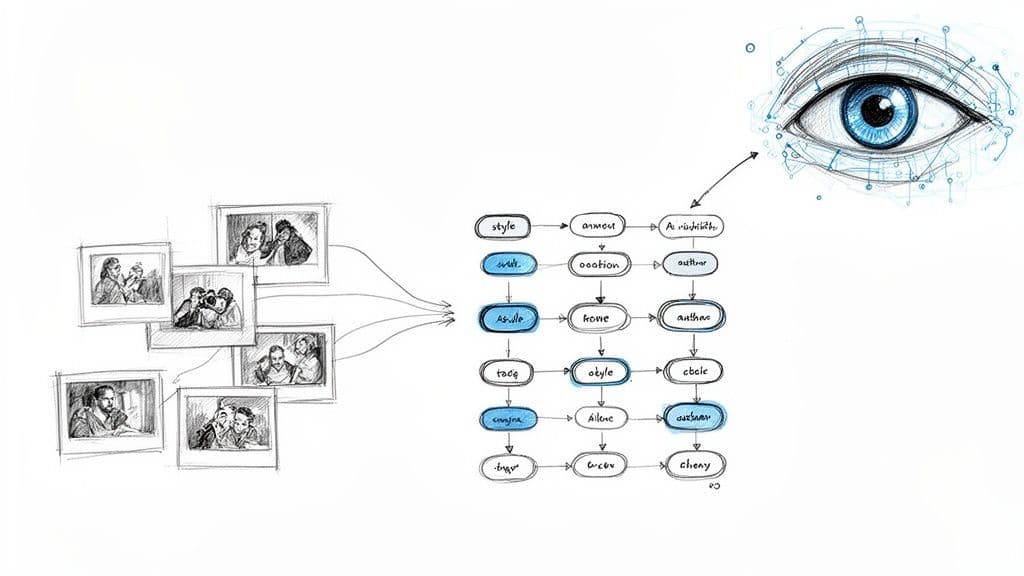
AI models are the unseen curators behind search results, visual discovery feeds, and even the answers Siri or Alexa give. If these systems can't "see" your photos and instantly grasp their context, style, and subject matter, you're practically invisible to your next client.
This isn't some far-off future; it's happening right now. You’re no longer just competing with other talented photographers. You're now up against an endless, ever-growing sea of AI-generated images.
The Challenge of Synthetic Media
Need proof? Just look at the stock photography market. It's a startling preview of what's to come.
In May 2023, AI-generated images were a tiny fraction of new uploads on Adobe Stock, around 2.5%. Fast forward to April 2025, and that figure has exploded to 47.85%. Projections show that synthetic media could easily make up half of all new stock photos by 2026.
This flood of synthetic content is making it incredibly difficult for authentic, human-created photography to get noticed.
To survive and thrive, photographers must learn to communicate directly with AI. This means feeding these systems the right signals—rich metadata, contextual content, and verifiable authority—so they recognize the value and authenticity of your work over a synthetic look-alike.
Your portfolio is no longer just a gallery of your best shots. Think of it as a dataset that needs to be meticulously prepared for machines.
From Keywords to Context
Traditional SEO was all about hitting the right keywords. AI visibility, on the other hand, is a much deeper game. It’s about building a comprehensive digital footprint that tells a complete story about who you are, what you shoot, and why it matters.
This requires optimizing not just your images, but all the content that surrounds them. To get a handle on the broader changes, you can explore our guide on the new age of AI search engine optimization.
The focus has shifted dramatically from simple keyword matching to proving your expertise and the authenticity of your work.
Traditional SEO vs AI Visibility Focus
This table breaks down the crucial differences in where you should be focusing your efforts. What worked yesterday for Google is simply not enough for the AI-powered tools of tomorrow.
As you can see, the new approach is far more holistic. It's about building a web of trust and context around your images so that AI has no doubt about their origin and value.
This new reality demands a multi-pronged strategy, blending technical precision with creative content. To really get ahead, it's also worth looking into powerful formats like photography viral video marketing strategies.
So, let's get practical. The following sections will walk you through the exact steps you can take to make sure your art gets the attention it deserves in this new AI-driven world.
Getting Your Images Seen by AI: A Technical Deep-Dive
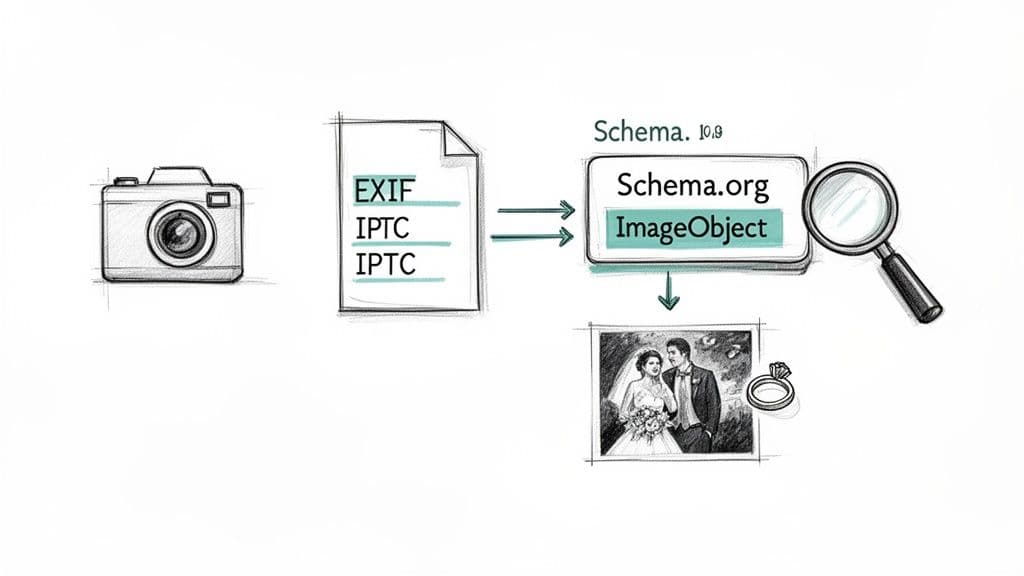
If you want your work to surface in AI-driven search, you have to start thinking about every image as a rich data asset. Simply adding ALT text isn't enough anymore. We need to get more technical and build a complete, machine-readable identity around your photography, starting long before a photo ever hits your website.
This process begins with something incredibly simple: your file names. A generic name like DSC_5829.jpg tells an AI absolutely nothing. It's a dead end.
Now, consider this: golden-hour-wedding-portraits-lake-como-italy.jpg. Suddenly, you've provided context. The AI now understands the subject, style, and location. This isn't just a label; it's the first clue you're giving the machine about what it's looking at.
Embed Ownership Directly into Your Image Files
Before you even think about exporting from Lightroom or Capture One, you need to get comfortable with your metadata fields. This is your single best opportunity to embed proof of ownership and authenticity directly into your work—a critical defense in an era of synthetic media.
This data, specifically EXIF and IPTC metadata, is baked right into the image file. It acts as a digital birth certificate, traveling with your photo wherever it’s shared online and creating a chain of custody that AI models are learning to prioritize.
Make it a habit to fill out these core IPTC fields:
- Creator/Author: Your name or your studio’s name.
- Copyright Notice: The formal statement (e.g., "© 2026 Your Name Photography").
- Creator's Website: A direct link back to your portfolio.
- Description/Caption: A clear, human-readable description of what’s happening in the photo.
This embedded data is the foundation of a solid optimization strategy. To get a more technical breakdown, check out our glossary entry on image optimization.
Translate Your Images for AI with Structured Data
Once your image is uploaded to your website, the next job is to explicitly tell search engines what it is using structured data. This is a specific type of code (Schema.org markup) that you add to your webpage to leave no room for interpretation. You're essentially speaking the native language of AI.
For photographers, two schema types are vital: ImageObject and Photograph. Using these, you can communicate that your content isn't just a generic image, but a specific photograph with unique attributes.
By meticulously applying structured data, you transform a simple image on a webpage into a rich data object that AI can understand, categorize, and confidently recommend. It's the difference between an AI seeing a "picture" and understanding it as a "photograph by Jane Doe, taken at a wedding in Tuscany."
A wedding photographer, for instance, can use schema to define an image with incredible precision, specifying the artist, the location where it was shot, and even the licensing details. This is the kind of detail that separates your professional work from generic stock or AI-generated visuals, dramatically improving your ai visibility for photographers and connecting you with clients who are looking for exactly what you do.
Crafting Content That Showcases Your Unique Expertise
Your images tell one story, but for AI, the real story is in the words you wrap around them. True AI visibility for photographers isn't just about beautiful photos; it’s about the rich, descriptive content that gives them context. AI assistants and new search engines need this context to understand what you do, who you do it for, and why you're the best at it.
It’s time to think beyond simple gallery pages. A portfolio titled "Recent Weddings" is practically invisible to an AI. Imagine a potential client asking their smart speaker, "Find a photographer specializing in ethereal golden hour portraits in the Scottish Highlands."
A generic gallery page won't stand a chance. But a blog post you wrote titled, "A Guide to Ethereal Golden Hour Portraits in the Scottish Highlands," puts you squarely in the running to be the answer.
Structure Your Content for AI Comprehension
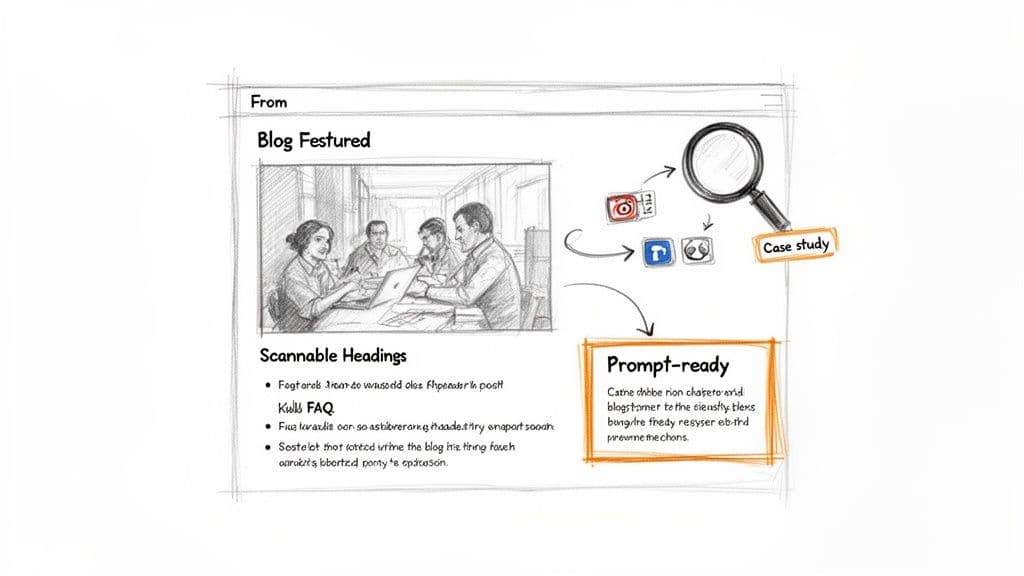
AI models don’t read a webpage the way people do. They parse it, looking for structure and patterns to understand the information. Your job is to make this process as simple as possible. Long, dense paragraphs are the enemy here; they create ambiguity and often get skipped.
Think of clear headings, lists, and FAQs as signposts. They help the AI map out the information, understand what's most important, and see how different ideas connect. When an AI can confidently extract your expertise, it's far more likely to serve it up in its responses.
By anticipating the questions your clients are asking and structuring your content to answer them directly, you turn your website from a passive portfolio into an active, authoritative resource. You're not just showing photos—you're providing definitive answers that establish you as the expert.
For example, a commercial product photographer could publish a detailed case study breaking down their entire process for a recent shoot. This not only proves their expertise but also feeds the AI a wealth of valuable, context-rich content it can use.
Create "Prompt-Ready" Content
One of the most effective strategies you can adopt is creating "prompt-ready" content. This means you’re deliberately thinking about the exact questions your ideal client would ask an AI assistant and then building content that directly answers them.
Here’s what that looks like in practice:
- Actionable Blog Posts: Instead of a simple "My Favorite Lenses" post, write something specific like, "How to Choose the Right Lens for Moody, Cinematic Wedding Photography."
- Detailed Case Studies: Don't just show the final images. Walk through a project from start to finish, outlining the client's goal, the challenges you faced, and how your specific approach delivered the results.
- FAQ Sections: Add a dedicated Frequently Asked Questions section to your main service pages. Answer common questions about your process, pricing, deliverables, and timeline upfront.
Every piece of well-structured content you create acts as a signal of your authority to AI systems. If you want to dig deeper into the mechanics of this, learning how ChatGPT indexes content can provide a technical edge. By taking this approach, you ensure that when a potential client asks an AI for help, your expertise is the first thing they see.
Establishing Your Authority and Proving You're Real
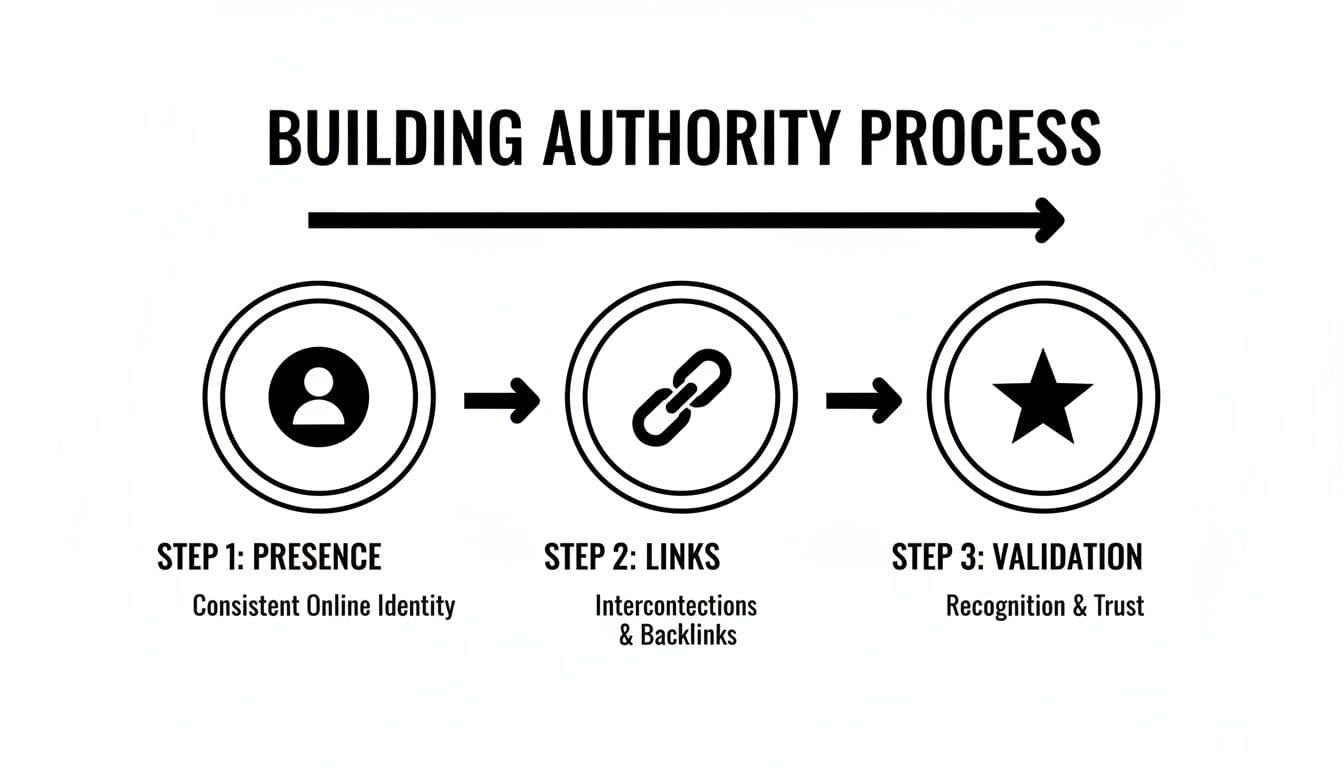
In a world overflowing with AI-generated images, proving you're a real, working photographer is more critical than ever. AI search algorithms and assistants are getting smarter, and they're actively looking for signals that an artist is a legitimate, trustworthy professional. Your job is to make it incredibly easy for them to connect the dots.
Think of it like building a case file on yourself. Your website is the central folder, but the real power comes from all the supporting documents—your professional profiles, features, and client reviews—that all point back to you. This creates a web of proof that machines can easily crawl and understand, confirming you are who you say you are.
Every link you create between your professional website, your Behance portfolio, your LinkedIn profile, and a listing in a respected photography directory acts as another piece of evidence. This interconnected network is what separates a genuine professional from an anonymous profile.
Weave Your Digital Identity Together
An isolated social media profile or a standalone website doesn't carry much weight with an AI. It's just a single, unverified data point. But when you link these profiles together, you start to paint a clear picture of a real person with a real business.
Consistency is everything here. Your name, your brand, and your professional details must be identical across every platform you use. This reinforces that all these accounts belong to the same, single entity—you.
This is also where industry-specific platforms become so valuable. A link from your portfolio site to your profile on a well-regarded platform like 500px or a feature in a major photography publication is a massive vote of confidence. These sites are seen as authoritative, and being associated with them tells AI that you're a recognized player in the field.
Ultimately, building this cohesive identity is a direct path to earning high-value search features, like your own Google Knowledge Panel.
The Undeniable Power of What Others Say About You
While connecting your own profiles is a foundational step, the most powerful trust signals come from other people. Genuine testimonials, client reviews, press features, and backlinks from other respected websites are all third-party endorsements that scream "expert."
These external signals are your proof. They tell AI algorithms that other people—clients, peers, and publications—vouch for your skill and professionalism.
Think about integrating these powerful forms of validation:
- Client Testimonials: Don't just post a quote. Feature detailed reviews on your website, and if you have permission, include the client's name and business.
- Press and Features: If your work gets featured on a blog or in an online magazine, make sure they link back to your website or portfolio. This is a huge authority signal.
- Community Backlinks: Get active in professional photography forums or online communities. A link from your profile in a respected community can add to your web of trust.
Every genuine review, feature, or backlink validates your expertise. It’s what separates your authentic work from the sea of anonymous, synthetic imagery. AI systems are built to find and elevate proven authorities, making these endorsements absolutely essential for getting seen.
This isn't just theory; it's a strategy that aligns with major shifts in the industry. As of 2026, 65% of professional photographers are already using AI tools in their work. More importantly, our data shows that photographers who actively build these kinds of trust signals see 50% higher engagement on their marketing campaigns. It's clear that visibility isn't just about the photo anymore—it's about being recognized by the machines that curate what the world sees. You can find more data on the growing role of AI in photography on wifitalents.com.
How to Measure and Refine Your AI Visibility Strategy
Doing all this work to get noticed by AI is one thing, but if you aren't measuring your progress, you're just guessing. You're flying blind. A truly effective strategy isn't a "set it and forget it" affair; it's a constant cycle of tracking, analyzing what you find, and then making smart adjustments based on real data. That's how you build a reliable process for growth.
The real goal here is to see exactly how your brand, your name, and your photography are showing up in AI-powered search and chatbot answers. Are you being mentioned as an expert in your niche? Are your images being surfaced for prompts like "best wedding photographer in Austin"? You need a structured way to get these answers.
Setting Up a Monitoring Workflow
First things first, you need to decide what to watch. This isn't just about stroking your ego by searching your own name. It's a systematic check on the queries that actually drive business.
I recommend starting with a core list of subjects to track:
- Your Brand Name: "Jane Doe Photography"
- Your Personal Name: "Jane Doe photographer"
- Key Services or Styles: "ethereal wedding portraits in Tuscany" or "moody food photography for restaurants"
- Competitor Names: To see how you stack up against others in your market.
Trying to check all of this manually across different AI models is a recipe for frustration. It’s not just tedious; the results can be wildly inconsistent. This is where a specialized tool for tracking ai visibility for photographers becomes a non-negotiable part of your toolkit.
Optimization without measurement is just speculation. To really improve your AI visibility, you need a data-driven workflow that tracks your presence, analyzes the competition, and shows you exactly what to do next.
Tools like Attensira are built for this. They automate the entire process, giving you regular reports on how you’re being represented in AI responses. This isn’t just about seeing if you were mentioned; it’s about understanding the context and quality of those mentions over time.
This kind of reporting helps you see the bigger picture. You can spot trends, uncover new opportunities, and act fast when a competitor suddenly starts dominating a keyword that should be yours.
From Insight to Action: A Real-World Scenario
Let’s look at how this plays out in practice. Imagine you're a food photographer who specializes in vibrant, farm-to-table shots. You use a tool like Attensira to track the prompt, "best techniques for natural light food photography."
The first few reports come in, and you see that while your images pop up here and there, the AI consistently names two other photographers as the go-to experts. It even links directly to their detailed blog posts on that exact subject. Right there, the data has handed you your next move: you have a clear content gap.
So, you get to work. You create an in-depth guide called "My Complete Guide to Natural Light Food Photography for a Farm-to-Table Look." You pack it with practical advice, behind-the-scenes shots, and you add all the right structured data. You publish it and keep your monitoring in place.
Sure enough, over the next couple of months, you see a change in your reports. The AI starts referencing your guide. Your name appears in more expert roundups. Your visibility for that crucial query starts to climb. You've just taken an analytical insight and turned it into real, measurable growth. This is the feedback loop in action. For a deeper dive into the mechanics, you can learn more about how to track your brand’s visibility in ChatGPT and other LLMs.
Common Questions About Getting Your Photography Seen by AI
Stepping into this new world of AI-driven search always brings up a few key questions. I get them all the time from other photographers. Let's tackle some of the most common concerns head-on to clear things up.
Think of improving your AI visibility as tending a garden, not flipping a switch. It’s a strategic effort that requires planting the right seeds and nurturing them over time.
How Long Until I See Results from AI Optimization?
Let's be realistic: you won't become an AI's go-to photographer overnight. While technical changes like structured data can get indexed in a few weeks, seeing a meaningful impact on your visibility in AI answers takes patience.
From what I've seen, you're typically looking at a 3 to 6 month timeframe for noticeable results. Consistency is everything here. Small, steady updates and optimizations build on each other, creating a powerful cumulative effect.
The first signs of success are often subtle. You might see a little bump in organic traffic to a blog post you just optimized, or maybe your name pops up in an answer to a super-specific, long-tail prompt. This is why using a monitoring tool is so important—it helps you spot those early wins and gives you the data to prove your strategy is actually working. Without it, you're just flying blind.
Do I Need to Be a Coder to Implement Structured Data?
Absolutely not. While structured data (or Schema) is technically a form of code, the tools we have today mean you never have to write it from scratch. This part has become incredibly accessible, even for the least tech-savvy among us.
If you're using a common platform like WordPress, popular SEO plugins like Yoast or Rank Math do most of the heavy lifting. They’ll automatically handle the ImageObject and Photograph schema, giving you simple fields to fill in your details.
For anything more custom, you still have great options. Google's free Structured Data Markup Helper is a fantastic tool. It lets you visually click on your webpage and tag key information—like your name, the photo's title, and copyright details—and then it generates the code for you to copy and paste.
The real skill isn't in the coding; it's in knowing what information to feed the AI. Your job is to focus on clearly communicating the who, what, where, and why behind your images.
Will AI Make My Unique Photography Style Obsolete?
It’s actually the complete opposite. AI makes your unique style and artistic voice more valuable than ever. AI models are great at churning out technically perfect but often generic, soulless images.
What can't they replicate? Your specific vision, the emotion you evoke in your subjects, or your signature post-processing style.
Your unique aesthetic is your biggest competitive advantage. You just need to lean into it and get really good at describing it in your website copy, blog posts, and image metadata. Don't just call yourself a "wedding photographer." Get specific.
- Are you known for "candid, documentary-style wedding photography"?
- Do you specialize in "vibrant and colorful brand portraits for female entrepreneurs"?
- Is your work all about "moody, cinematic landscape photography of the Pacific Northwest"?
This level of detail is exactly what helps AI systems understand your niche. More importantly, it helps them connect you with potential clients who are looking for that exact style. You’re not just getting found; you’re getting found by the right people.
Ready to stop guessing and start measuring your AI visibility? Attensira provides the tools you need to track your brand across major AI platforms, uncover competitive insights, and optimize your content for maximum impact. See exactly how your photography is being represented and turn those insights into growth. Learn more at attensira.com.