


Boost your practice with our guide on AI visibility for veterinarians. Learn actionable strategies to appear in AI search and attract more clients in 2026.
The way pet owners find you is changing. For years, the game was all about getting your clinic to the top of a Google search page. Now, that same pet owner is more likely to just ask their phone, smart speaker, or an AI like ChatGPT a direct question. This is the new front line for AI visibility for veterinarians, and it’s a battle you need to win.
If someone in your neighborhood asks an AI for help with their pet, is your practice the one it recommends? Because that single, direct recommendation is quickly replacing the old list of blue links.
The New Digital Front Door for Veterinary Clinics
Think about the classic search journey: a pet owner types "vet near me" into Google, skims a few websites, and then makes a call. That's becoming a thing of the past.
Today, the query is more conversational and specific. Something like, "Find a vet in my area that specializes in cat dentistry and is open on Saturdays." The AI's job is to give them one solid answer, not a list of options to research. If your practice isn't that answer, you're essentially invisible to a growing segment of potential clients.
This means your online presence can't just be built for people to read; it has to be structured for machines to understand. AI models need clear, authoritative, and well-organized data to feel confident enough to recommend your clinic. Without it, they'll simply pass you over for a practice whose information is easier to verify.
From Traditional SEO to AI Optimization
Getting your practice ready for this shift requires more than just traditional SEO. While the basics still matter—and you should absolutely have them covered—the focus has to evolve. You're no longer just trying to rank for keywords. The new goal is to become a citable, trusted entity that AI models use as a primary source.
For a refresher on those foundational elements, our complete guide to a modern local SEO checklist is a great place to start.
The journey a pet owner takes to find your clinic now looks a lot different, as this diagram shows. It’s no longer a linear path through a search engine results page.
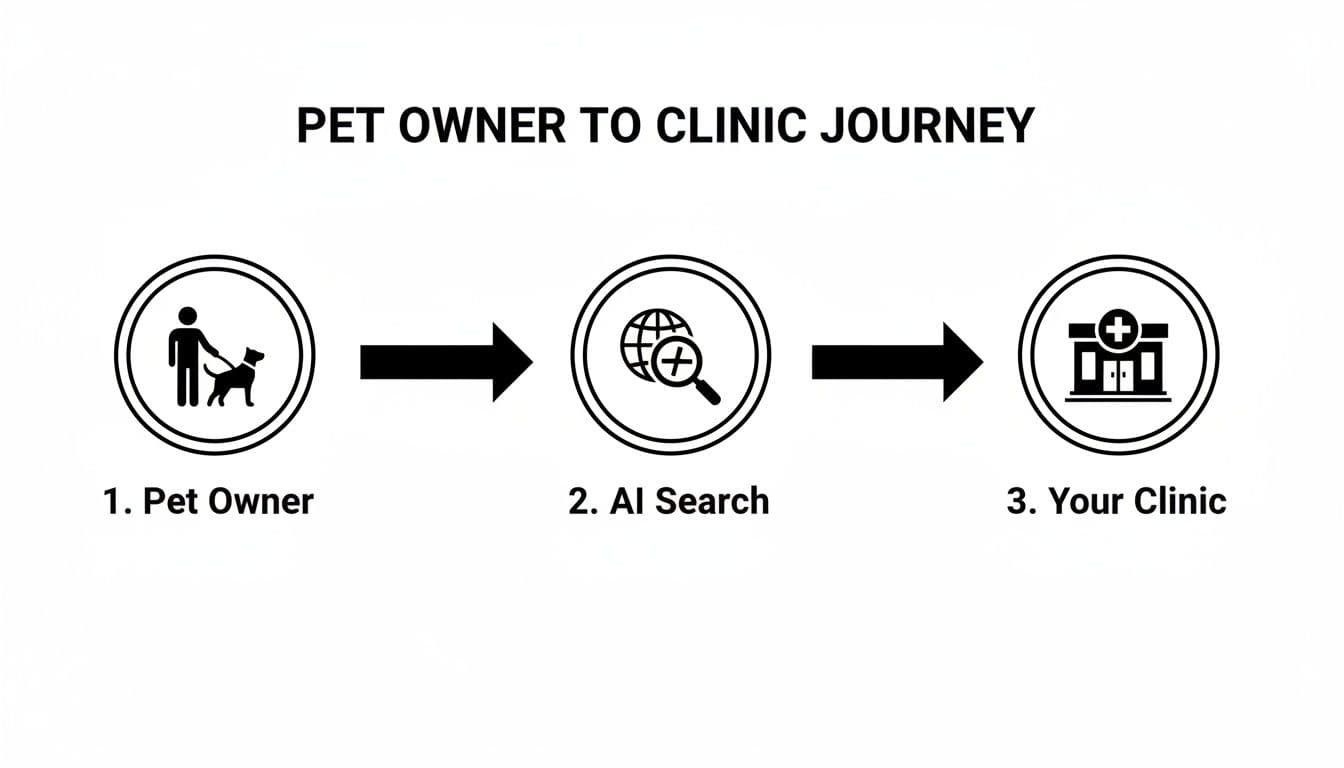
Being the destination at the end of an AI-driven search is where real growth will come from. To get there, you need a solid grasp of what works in today's digital environment. You can explore a detailed guide to effective marketing for vet practices to see how this fits into a bigger strategy for attracting and keeping clients.
Your practice’s growth now depends on being the answer an AI provides, not just a link on a results page. This requires a deliberate focus on structured data, authoritative content, and strong local reputation signals.
To really drive this point home, let's compare the old way of thinking with the new strategic focus required for AI visibility.
Traditional SEO vs AI Visibility Optimization
This table breaks down the fundamental differences between optimizing for traditional search engines and optimizing for AI-powered answer engines.
As you can see, the playbook is evolving. While the goals of traditional SEO are still relevant, they are now just the starting point. True visibility in the age of AI means proving to a machine that your practice is the most authoritative, relevant, and trustworthy choice for a pet owner's needs.
How To Audit Your Practice's AI Footprint
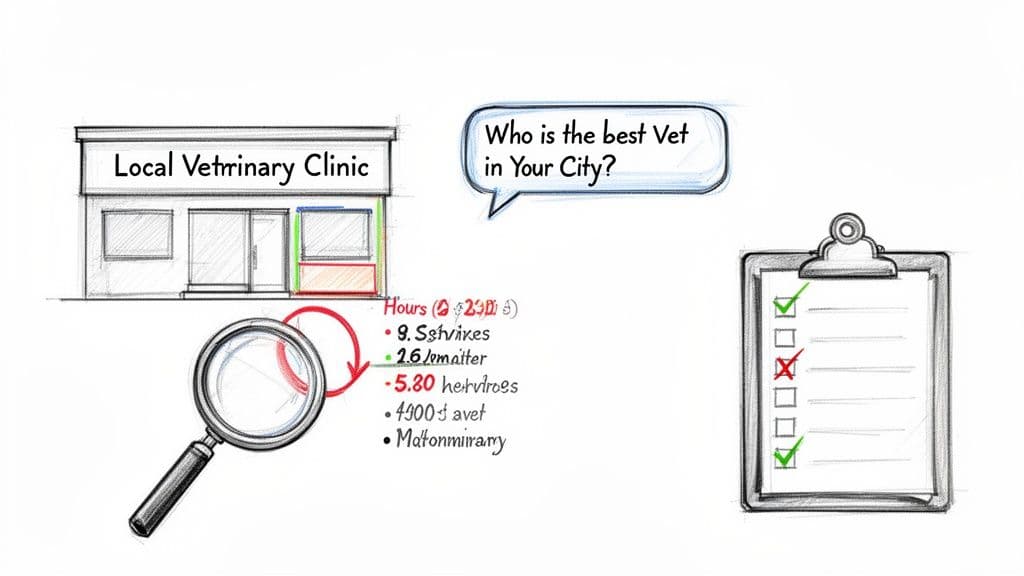
Before you can start improving your clinic’s presence in AI search, you have to know where you stand today. Think of this as a diagnostic check-up. The first step is always to establish a baseline, giving you a clear picture of your current AI footprint.
The goal is simple. You need to see your practice through the eyes of an AI. Are you even mentioned? Are the details right? Or are your top competitors getting all the attention? This initial audit is the foundation for boosting your ai visibility for veterinarians.
Probing AI For Your Clinic's Information
So, where do you begin? It starts by acting like a potential client. You'll need to query the major AI platforms—think ChatGPT, Gemini, and Perplexity. Don't just ask a single question and call it a day; you need to test a wide range of prompts a local pet owner would actually type in.
I recommend keeping a simple spreadsheet to document every response. Track whether your clinic was mentioned, the context of the mention (was it for a specific service?), and—most importantly—any inaccuracies you find.
Here are some specific prompts you can copy and paste to get started. Just swap out [Your City] and [Specialty] with your own information.
"Find a veterinarian in [Your City] that specializes in [Specialty, e.g., cat dentistry, exotic pets].""Who is the best emergency veterinarian near me in [Your Neighborhood/City]?""List veterinary clinics in [Your City] with the best reviews for puppy care.""What are the hours for [Your Clinic Name] in [Your City]?""Does [Your Clinic Name] offer payment plans or pet insurance?"
This process quickly reveals your starting point. If your clinic doesn't show up at all, you've just uncovered a major visibility gap. If you do appear but with the wrong hours or services, you’ve found a critical data problem that needs fixing, fast.
Analyzing The Audit Results
Once you have that data in hand, it’s time to look for patterns. A thorough analysis will show you where your digital foundation is solid and where it’s starting to crack.
As you review the responses, ask yourself these questions:
- Accuracy Check: Is your clinic’s name, address, phone number (NAP), and hours of operation consistently correct? Wrong information doesn't just confuse potential clients; it actively erodes their trust.
- Service Representation: Does the AI correctly highlight your specialties, like emergency services, advanced dental care, or surgical procedures? If not, you’re missing out on pet owners looking for exactly what you offer.
- Competitive Landscape: Pay close attention to which competitors are being recommended and why. Does the AI cite their great reviews, a specific service, or even a blog post from their website? This is intel you can act on.
- Reputation Signals: Is your clinic’s reputation or reviews mentioned? Seeing positive sentiment surface in AI-generated answers is a powerful third-party endorsement.
Tracking how your clinic shows up in AI conversations is no longer a "nice-to-have"—it's a core piece of modern reputation management. An inaccuracy can be just as damaging as a bad review, and being invisible means you are handing business directly to your competitors.
Understanding how to systematically check these mentions is crucial. For anyone looking to go deeper on this, our guide on how to track your brand’s visibility in ChatGPT and other LLMs provides more advanced techniques. The results of your audit become the blueprint for everything that comes next: fixing bad data, filling content gaps, and strengthening the signals that AI models depend on.
Building Your Website's AI Foundation With Structured Data
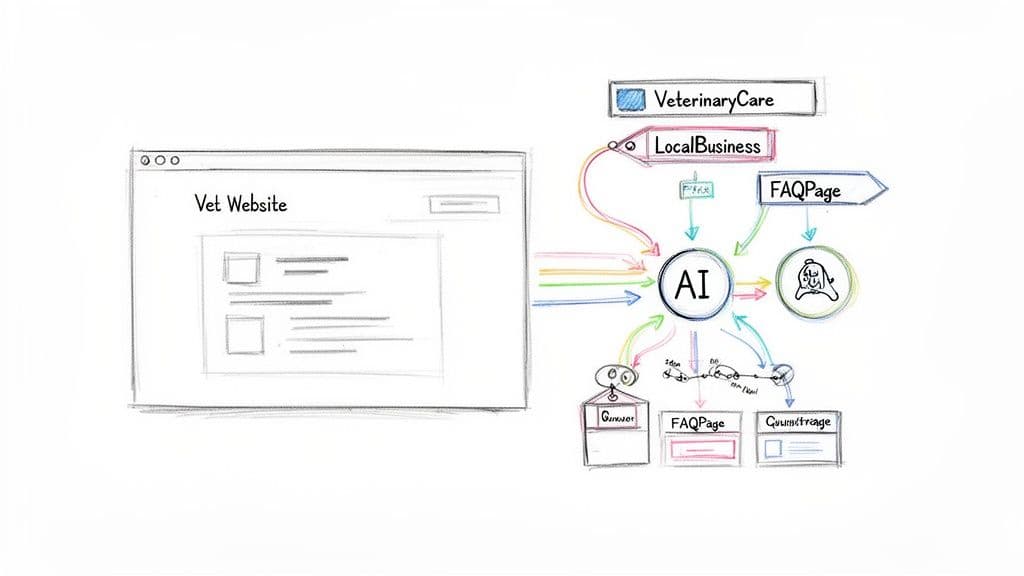
Getting an AI to recommend your clinic isn't about flashy design; it's about speaking its native language. For AI models, that language is structured data—a specific code vocabulary also known as Schema markup. It's how you translate your website content from human-readable text into machine-readable facts.
Without it, an AI is left to guess what your pages are truly about. But with structured data, you’re providing explicit instructions. You're telling it, "This page is a veterinary service," "This person is a board-certified veterinarian," or "Here are our clinic's precise hours and location." This clarity removes any ambiguity and gives the AI confidence in the information it finds on your site.
Putting this technical groundwork in place is no longer optional for improving ai visibility for veterinarians. It’s the most direct and effective way to feed AI engines the exact information they need to feature your practice in their answers.
Pinpointing Key Schema Types For Vets
You don't need to learn every word in the Schema dictionary. For a veterinary practice, the real wins come from a handful of markups that deliver the most impact. Implementing these correctly gives AI a detailed, unambiguous picture of who you are, what you offer, and why you're a trusted authority in your area.
Your priority should be these essential markups:
VeterinaryCare: This is your most important asset. It specifically identifies your business as a veterinary practice, separating you from every other local business in the AI's "mind."LocalBusiness: Use this on your location pages to spell out your clinic's name, address, phone number (NAP), and hours of operation. This is absolutely critical for local AI queries like "vets open near me now."PhysicianorPerson: Apply this to your veterinarian bio pages. It's how you build digital proof of your team's expertise, authority, and trustworthiness (E-A-T).FAQPage: If you have a frequently asked questions section, marking it up with this schema can get your answers pulled directly into AI-generated responses for those specific queries.
When you implement this code, you're effectively turning your website from a simple collection of pages into a structured database that AI can query instantly. If you want a deeper dive into the technicals, you can learn more about what Schema markup is and how it functions in our glossary.
From Theory To Practical Implementation
Let's ground this in a real-world example. Say you have a service page for "Puppy Wellness Exams." The text on the page describes the service beautifully for a pet owner, but the Schema markup is what makes it understandable for a machine.
You would wrap the key details on that page with VeterinaryCare schema, specifying the service being offered. This tells an AI model not just that the page is about a service, but that it's a specific type of veterinary care available at your clinic. The same logic applies to your vet bios—using Person schema to highlight credentials, specialties, and years of experience.
By marking up your core pages, you are essentially building a digital resume for your practice that AI models can read and verify instantly. This clarity is what separates a clinic that gets mentioned from one that gets ignored.
The growing role of AI in animal health makes this foundational work more urgent than ever. The global market for AI in animal health was projected to hit USD 2.00 billion in 2026, and a surprising 67% of veterinarians in the US already report using AI diagnostic tools daily. While 90.5% of vet workers admit to lacking formal AI training, 72.3% believe it will reshape the industry. This shows a clear desire to adopt modern tools, making a clinic's AI readiness a key differentiator. You can see the complete statistics on AI in the animal health industry to understand these trends better. Getting your data foundation right is how you attract clients who are actively looking for that kind of tech-forward care.
Creating Authoritative Content That Answers Pet Owner Questions
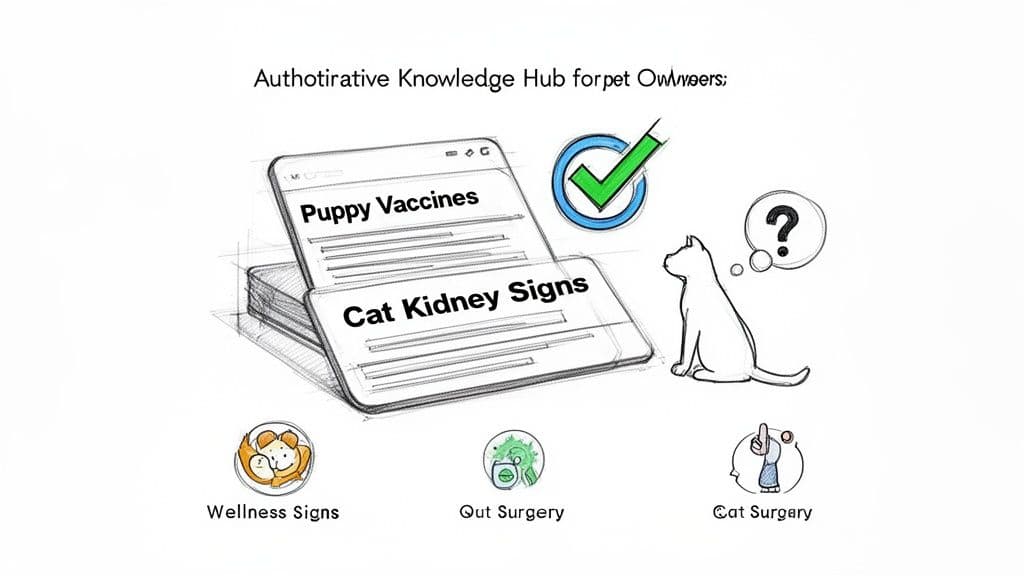
AI search engines are becoming more conversational every day. They're built to deliver direct, confident answers—not just a page of blue links. For your clinic to show up in these new AI-powered results, your website content has to change. It's time to stop thinking in terms of generic blog posts and start building a true knowledge hub that tackles the real questions pet owners are asking.
Think about the conversations you have in the exam room. The questions you answer over and over are a goldmine for your content strategy. A broad article on "feline health" is far less effective than a specific, in-depth guide answering, "What are the early signs of kidney disease in older cats?" This subtle shift is what separates content that gets found from content that gets ignored.
Identifying High-Intent Questions
The most powerful content ideas are sitting right in your clinic and your local community. Get into the habit of jotting down the questions you hear most often—during appointments, on the phone, and even through your website’s contact form. These aren't just questions; they're clear signals of what local pet owners need to know.
Next, you can validate these ideas with some simple keyword research focused on your area. You're looking for search queries that show someone is ready to take action.
- "How much do puppy vaccinations cost in [Your City]?"
- "What's involved in a dog dental cleaning?"
- "Is pet microchipping painful?"
Every one of these questions is a potential client looking for a veterinarian they can trust. When you provide the clearest, most authoritative answer, you immediately position your practice as that trusted expert.
Building Your Content Knowledge Hub
A well-organized website helps both people and AI models find the information they need. Think about structuring your content into logical categories that reflect your clinic’s expertise. Your knowledge hub should be built around a few key types of content.
- In-Depth Articles on Common Conditions: Don’t just define a condition. Create a truly comprehensive guide on topics like pet allergies, arthritis, or diabetes. You should cover symptoms, what treatment looks like at your clinic, and practical at-home care tips.
- Detailed Service Pages: A simple "Spay and Neuter" list item isn't enough. Build out a complete page explaining the procedure, what to do before the surgery, the recovery process, and answers to all the common questions about cost and safety.
- Comprehensive FAQ Sections: A dedicated FAQ page, neatly organized by topics like "New Clients" or "Surgery," is a fantastic resource. AI models love this format because it provides quick, direct answers to pull from. For more on this, see our guide on effective web content creation.
Creating this kind of deep, authoritative content isn’t just about SEO. It's about building a foundation of trust so strong that AI models feel confident citing your practice as the go-to source.
When an AI model cites your article to answer a user's question, it’s not just a referral; it's an endorsement. It tells the pet owner that your clinic is the definitive authority on that topic in your area.
This is especially relevant as AI plays a larger clinical role globally. A 2025 study showed that 71.0% of veterinary professionals in China use AI for clinical tasks like diagnosis, whereas only 39.2% in the US and Canada do, often for administrative work. Despite North American vets being more familiar with AI, the lag in clinical use highlights an opportunity to attract clients seeking modern solutions by showcasing your expertise online. You can discover more insights from this veterinary AI adoption study to see the full comparison.
How To Measure And Refine Your AI Visibility Strategy
Getting your veterinary clinic noticed by AI isn't a "set it and forget it" task. It's a living strategy that demands constant measurement and adjustment. Without a clear way to track what’s working, you're essentially just guessing. To really succeed, you have to adopt a data-driven mindset and focus on the metrics that actually matter.
This means looking past standard website traffic. The key performance indicators (KPIs) for AI visibility are different. They tell you one thing: how effectively you're becoming the go-to, trusted source for pet owners in your local area.
Defining Your Core AI Visibility KPIs
To really get a handle on your success, you need to track a new set of metrics that show how your practice appears in AI-generated answers. These KPIs give you a direct, unfiltered look at your performance and shine a light on where you need to improve.
Your focus should zero in on these specific data points:
- Mention Frequency and Sentiment: How often is your clinic named in AI responses for relevant queries? Just as important, is the mention positive? Platforms like Attensira are designed to monitor these mentions, giving you a clear window into your reputation within AI models.
- Referral Traffic from AI Platforms: Direct attribution is still a work in progress, but you should keep a close eye on your analytics for traffic from sources tied to AI-driven search. A noticeable uptick in direct traffic right after your optimization efforts can also be a strong positive signal.
- Visibility for Conversational Queries: Are you the answer when a pet owner asks, “What vet near me is best for anxious dogs?” Tracking your presence for these specific, high-intent questions is a direct measure of your AI visibility for veterinarians.
A competitor consistently being recommended for ‘senior pet care’ isn’t just a missed opportunity; it’s a roadmap. It tells you precisely where you need to build out your authoritative content to win back that visibility.
Establishing A Quarterly Review Process
Turning that data into real action requires a structured review. I've found a quarterly cadence works best. It's frequent enough to stay agile, but it also gives your changes enough time to take hold and produce measurable results.
Using a simple checklist to guide your review each quarter makes the process repeatable and ensures nothing slips through the cracks. Over time, this is how you build a finely tuned strategy.
Quarterly AI Visibility Checklist:
- Re-Audit Key Prompts: Run the same local and service-based queries you used in your initial audit. Take note of any changes in where you appear—or where your competitors are now showing up.
- Analyze Mention Sentiment: Dive into your tracking tools. Is the AI citing you for your expertise in feline dentistry, or is it just listing your clinic with an outdated phone number? The context is everything.
- Identify Content Gaps: Look at where other clinics are outperforming you. Are they owning the conversation around "emergency vet services"? These gaps become your top content priorities for the next quarter.
- Review Technical Data: Pop into Google Search Console to check for new Schema markup errors. You should also review the performance of any pages where you recently implemented structured data to see the impact.
This constant feedback loop is what keeps your strategy relevant in the fast-moving world of AI. For a more detailed look at the tools involved, you can explore our complete overview on tracking your brand's presence in AI search. This iterative approach is how you deliver a measurable return and stay ahead of the curve.
Common Questions About AI Visibility For Vets
It's natural to have questions when a new marketing channel like AI search emerges. Let's tackle some of the most common ones I hear from veterinary practices. The good news is that the answers are more about smart strategy than complex technology.
How Long Does This Really Take?
The big question everyone asks is: how long until I see results? We've all been conditioned by traditional SEO, where meaningful changes can feel like they take forever. AI optimization is a bit different.
Technical fixes, like implementing structured data, give search engines direct, clear information to work with. Once they crawl and process those changes, often within a few weeks, you can start seeing a difference. For very specific, long-tail questions, you might notice initial improvements in as little as 2-3 months.
But becoming the go-to, authoritative answer for broader questions—that’s a longer game. Building the kind of deep trust that makes an AI recommend you consistently takes time. This is an ongoing effort that builds on itself, with true dominance solidifying over 6-12 months as your content library and online reputation grow.
This isn't just about getting found; it's about becoming the AI's most trusted source for veterinary advice in your area. Think of it as a marathon with clear mile markers along the way, not an all-out sprint.
Do I Need To Be A Tech Expert?
Absolutely not. You might hear terms like "structured data" or "Schema" and think you need a developer on speed dial. Thankfully, that's rarely the case anymore. Modern website builders like WordPress or Squarespace have plugins and built-in tools that do most of the heavy lifting, often without you ever touching a line of code.
The truth is, the most powerful part of improving your ai visibility for veterinarians has nothing to do with code. It’s about what you already are: a veterinary expert.
- Creating genuinely helpful content that answers the real-world questions you hear from clients every day.
- Making sure your practice's name, address, and phone number are correct everywhere online.
- Actively encouraging reviews from happy clients to build a strong reputation.
Your job is simply to translate the incredible expertise you share in the exam room into a format that AI can read, understand, and then share with others. The tech is just the vehicle.
Is This Only For Getting New Clients?
Bringing in new patients is a huge upside, of course. But a strong presence in AI results is also a powerful tool for keeping the clients you already have.
Think about it. When one of your current clients asks their phone or smart speaker a question about their pet’s health, and your clinic’s answer pops up, it instantly reinforces their decision to trust you. It’s a subtle but powerful signal that they’re with a knowledgeable, top-tier practice. This also helps you control the narrative, ensuring the information AI shares about your hours, services, and policies is always accurate.
Ready to stop guessing and start measuring your clinic's AI visibility? Attensira provides the tools to track your mentions, analyze your competitive landscape, and build a winning strategy. See exactly how you appear in AI search by visiting https://attensira.com.