


gemini search optimization: unlock practical strategies to boost your B2B brand in AI Overviews and drive measurable results.
Gemini search optimization is all about retooling your brand's content and digital assets so they show up in Google's AI-generated answers, which they call AI Overviews. This goes way beyond traditional SEO. The focus shifts to structuring your information for a machine to understand, building authority signals that AI can verify, and creating concise, factual content that the model can easily grab and cite.
Why You Can't Afford to Ignore Gemini Search Optimization
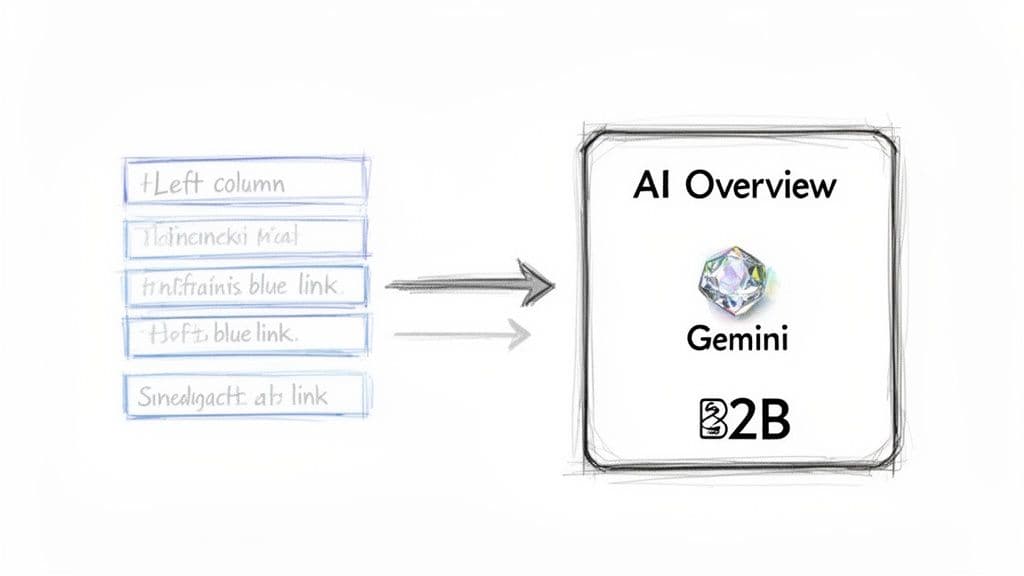
The customer journey has fundamentally changed. The old, familiar path—typing a query, scanning ten blue links, and clicking through to a site—is getting short-circuited by AI. Now, users get a synthesized, direct answer right at the top of the page, which often means they don't need to click at all. This isn’t some future trend; it's what’s happening right now for millions of people.
For B2B brands, this shift is especially sharp. Complex buying decisions that used to start with broad research across dozens of websites now kick off with a conversational question to an AI. If your expertise isn't the source material for that AI-generated summary, you're invisible during that critical discovery phase.
The Scale of the AI Search Shift
The sheer speed and scale of this transition make a dedicated Gemini search optimization strategy an urgent priority. You can't just wait and see anymore. The data tells a clear story of a market consolidating around AI-driven search.
Just look at Gemini's explosive growth. It went from a 5.7% market share in February 2025 to a staggering 21.5% by February 2026, almost quadrupling its footprint in a single year. That makes Gemini the second-largest AI platform in the world. And here’s the kicker: Google reports that 2 billion users see Gemini-powered AI Overviews every month right inside their normal search results.
This isn't just another new feature on the results page. It's a total redesign of how information is delivered and consumed. Your content isn't just up against other websites anymore; it’s competing to become the trusted source for the AI itself.
The New Rules of Visibility
Thriving in this new environment means adopting a new playbook. While the fundamentals of SEO are still important, they just aren't enough on their own. Understanding how SEO and SEM work together provides good context, but this new layer of optimization demands a focus on:
- Verifiable Authority: You need to prove your expertise with more than just backlinks. Think bigger—a wide array of digital signals that an AI can confirm.
- Machine Readability: Content must be structured with clear formatting and schema so an AI can parse it without getting confused.
- Answer-Centric Content: It’s all about crafting concise, citable snippets that get straight to the point and directly answer a user's question.
This guide is your framework for mastering these new rules. As you dig in, you might also want to check out our broader look at AI search engine optimization to see how it all fits together. The brands that get this right, starting now, will build a massive advantage and establish themselves as the go-to authorities in the age of AI search.
Auditing Your Brand's Authority Signals For AI
Gemini isn’t just scanning your website for keywords. It’s building a complex, web-wide understanding of your brand's authority, and to show up in its answers, you have to think like it does. This means evaluating the entire ecosystem of signals that prove you're a trustworthy expert, which is a much bigger job than just looking at domain authority or backlinks.
The first move is a deep-dive audit of your brand signals. The goal here is to map every single touchpoint where credible, third-party sources mention, review, or cite your brand. This creates a digital footprint that AI models can cross-reference to verify your claims of expertise and experience.
Moving Beyond Your Owned Properties
Your website is just the starting line. Of course, on-page E-E-A-T signals like detailed author bios and in-depth case studies are non-negotiable, but Gemini is looking for external validation. It’s on a mission to find unbiased, third-party proof that your brand is what it claims to be.
This means your audit needs to zero in on your presence—or your absence—in key external channels.
- Industry-Specific Forums and Q&A Sites: Are your subject matter experts actually in the trenches on Reddit, Stack Overflow, or niche industry forums? These conversations are raw, unfiltered proof of real-world expertise that AIs can easily parse.
- Third-Party Review Platforms: For B2B brands especially, mentions on sites like G2, Capterra, or TrustRadius are gold. Gemini can analyze these reviews to understand what your product actually does, how users feel about it, and what it's best for.
- Academic and Research Mentions: Getting cited in academic papers, legitimate industry whitepapers, or market research reports is a massive authority signal. It shows your brand is contributing to the knowledge base of your entire field, not just marketing itself.
When you start analyzing these external signals, you begin to see your brand through the eyes of an AI. It quickly becomes obvious where you need to build more credibility.
Think of it this way: Your website is your resume, but these third-party mentions are your professional references. Gemini calls those references to verify your credentials before it recommends you.
Conducting a Practical Signal Audit
To get this audit rolling, start by mapping out the key "entities" tied to your brand. This isn't just your company name. It's your flagship products, your C-suite executives, and your well-known internal experts. These are the search terms you'll use to hunt for signals.
A simple table is a great way to keep things organized and spot the gaps.
This systematic approach makes it painfully clear where your brand’s authority is solid and where it’s falling short. You might find that your CEO is a ghost in industry publications, or that your main product has a surprising lack of recent, in-depth reviews. These are the exact gaps you need to plug.
Ultimately, this audit forms the foundation of your entire Gemini search optimization strategy. Without a strong, verifiable digital footprint, even the most brilliantly crafted content will struggle to be seen as authoritative enough for an AI to cite.
Once you start building this authority, you can get more granular and learn how to track your brand's visibility in ChatGPT and other top LLMs to measure the impact. The insights from this initial audit will shape your PR, content, and expert engagement strategies for months, ensuring you’re building true, AI-verifiable authority.
How To Structure Your Content So AI Actually Understands It
For Gemini to cite your content, it needs to be structured for a machine to read and understand. This is a shift from just writing for human eyes. It means formatting your articles, guides, and landing pages so an AI model can easily parse the information, grasp its meaning, and feature it accurately.
The goal is to make your content the most convenient, reliable, and logical source for Gemini to pull from.
Think of it this way: long, narrative paragraphs force a human to infer meaning and connect the dots. An AI, on the other hand, will often just skip that in favor of content that's explicitly and clearly organized. A well-defined hierarchy isn't just good practice anymore; it's your primary tool for getting noticed by AI.
This simple audit process can help you pinpoint exactly where your content structure might be falling short.
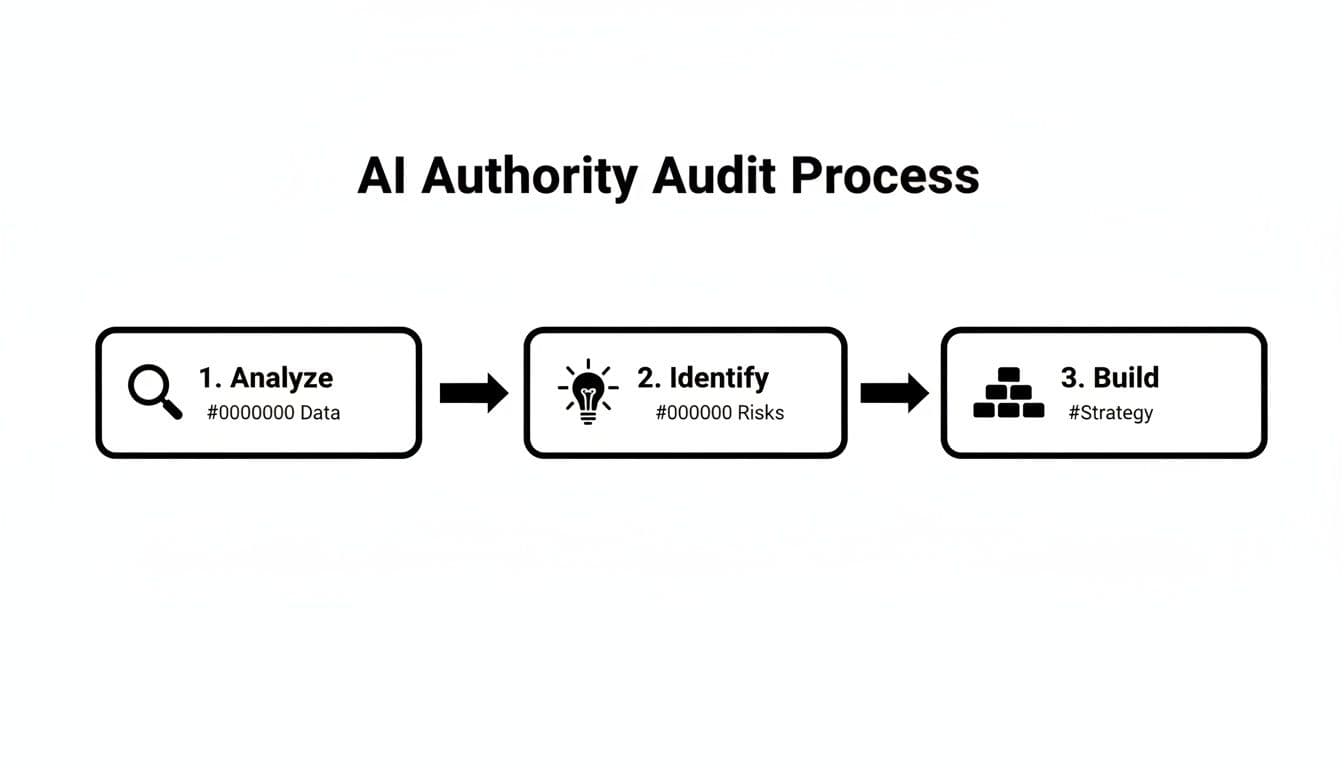
Moving from analysis to identifying risks and then building a strategy creates a repeatable loop. It turns the massive task of a content overhaul into manageable, focused steps.
Adopt A Clear Hierarchical Structure
Your content's architecture is a map for AI, signaling the importance of ideas and how they relate to one another. Using headings (H1, H2, H3) correctly creates a clean outline that a machine can follow, much like a table of contents.
For example, an H2 should always introduce a major topic, with H3s branching off to cover specific sub-points. This nested structure makes it crystal clear to Gemini that the information under an H3 is a direct child of the parent H2. This dramatically improves its ability to pull contextually accurate snippets. Ditch the clever, vague headings and opt for clear, descriptive language that plainly states what the section is about.
Deconstruct Information Into Atomic Blocks
Huge, dense paragraphs are a massive roadblock for AI. The new imperative is to restructure your content—both new and existing—into "atomic" blocks. These are small, self-contained units of information that answer one specific question or explain a single concept. This is a non-negotiable part of effective gemini search optimization.
These blocks are easiest for an AI to digest when formatted as lists or short, declarative sentences.
- Bulleted Lists: Perfect for breaking down features, benefits, or key components. Instead of cramming three benefits into a long sentence, give each its own bullet point. This isolates each idea, making it simple for Gemini to extract one or all of them as needed.
- Numbered Lists: These are your go-to for any step-by-step process, set of instructions, or ranked items. The inherent sequence in a numbered list provides an unambiguous structure that's ideal for the "HowTo" queries Gemini loves to answer.
By breaking your content down this way, you're essentially creating a library of easily citable facts and instructions. You can find more foundational tips on building pages that are friendly to both readers and AI in this guide to effective web content creation.
The objective is to make your content so granular and well-organized that Gemini doesn't need to interpret your meaning. You are serving it direct, quotable answers on a silver platter, reducing the risk of misinterpretation.
Prioritize Factual, Standalone Statements
Every sentence you write should be put under a microscope for clarity and brevity. AI models are naturally drawn to fact-driven statements that can stand on their own without needing the surrounding text for context.
Look at the difference in this quick rewrite:
- Before: "Our innovative platform, which leverages a sophisticated algorithm, can help businesses streamline their workflow by automating repetitive tasks, ultimately leading to significant time savings and allowing teams to focus on more strategic initiatives."
- After: "Our platform automates repetitive tasks. This saves teams significant time, allowing them to focus on strategic initiatives."
The "after" version is two distinct, factual statements. Each one could be pulled by Gemini to answer a specific query like "What does [Platform] do?" or "How does [Platform] save time?" This simple change makes your content far more versatile for AI-driven search. Crafting your content with this level of precision is how you become a go-to source for AI Overviews.
Using Advanced Schema to Guide Gemini
Think of structured data, or schema markup, as your direct, private line of communication with Google's Gemini. It’s a specialized vocabulary that cuts through the noise, telling the AI precisely what your content is about, who created it, what company it represents, and how all these different pieces fit together.
While most SEOs have basic schema covered, a serious gemini search optimization strategy demands a far more sophisticated approach. This isn't just about labeling your company's address; it’s about meticulously building a detailed, machine-readable map of your expertise. By explicitly defining entities and their relationships, you help Gemini connect the dots with confidence, dramatically increasing your odds of being featured accurately in AI Overviews.
Moving Beyond the Basics for Gemini
Too many websites stop after implementing Organization or Article schema. In the age of AI-driven search, that’s just table stakes. Gemini is on the hunt for much deeper context, which you can easily provide with more specific schema types that directly mirror the kinds of questions your audience is asking.
It's the difference between just telling someone a book's title versus handing them the title, the author's complete biography, and the full table of contents. The second option provides a much richer, more useful understanding.
FAQPageSchema: This is a goldmine for any page designed to answer a series of related questions. By marking up each question and its answer, you're essentially pre-packaging your content into a format that AI Overviews are built to consume. Gemini can lift these Q&A pairs directly into its responses.HowToSchema: Invaluable for any content that walks a user through a process. This schema lets you define every step, list necessary tools, and even estimate the time required. This highly organized format makes it incredibly simple for Gemini to generate step-by-step instructions and cite you as the source.
For B2B and SaaS companies, these schema types are especially potent. Explaining complex workflows and answering detailed technical questions are at the heart of what you do, and this is how you make that information machine-readable.
Defining Entities and Their Relationships
Truly advanced schema takes it one step further by defining the entities within your content—the distinct people, places, organizations, or concepts. By using properties like sameAs, you can link these entities to universally recognized, authoritative sources like a Wikipedia page or an official LinkedIn profile.
This process solidifies your digital identity and authority in the eyes of an AI. It confirms that the "Sarah Chen" listed as the author is the exact same Sarah Chen with a specific professional profile and a documented history of industry expertise. This verification is a massive trust signal for Gemini.
The right schema can transform a simple product page into a rich, interconnected data hub. Below is a breakdown of schema types that are essential for B2B brands looking to show up in AI-generated results.
Essential Schema Types For Gemini Optimization
This layered strategy gives Gemini a complete picture. It no longer sees just a page about a product; it sees a highly-rated product from a specific company, with content written by a verifiable subject matter expert. To brush up on the fundamentals, you can explore this guide to schema markup.
By implementing entity-based schema, you stop leaving interpretation up to chance. You are explicitly telling Gemini: "This is our product, these are our experts, and here is the proof from across the web that validates our authority."
This level of detail isn't just a "nice-to-have" anymore; it's a foundational pillar of any mature gemini search optimization program. Without it, you’re forcing the AI to guess, and in today's search environment, that's a risk you can't afford. When you provide clear, structured signals, you make your content the safest and most reliable choice for Gemini to feature.
Crafting Citable Snippets and Concise Answers
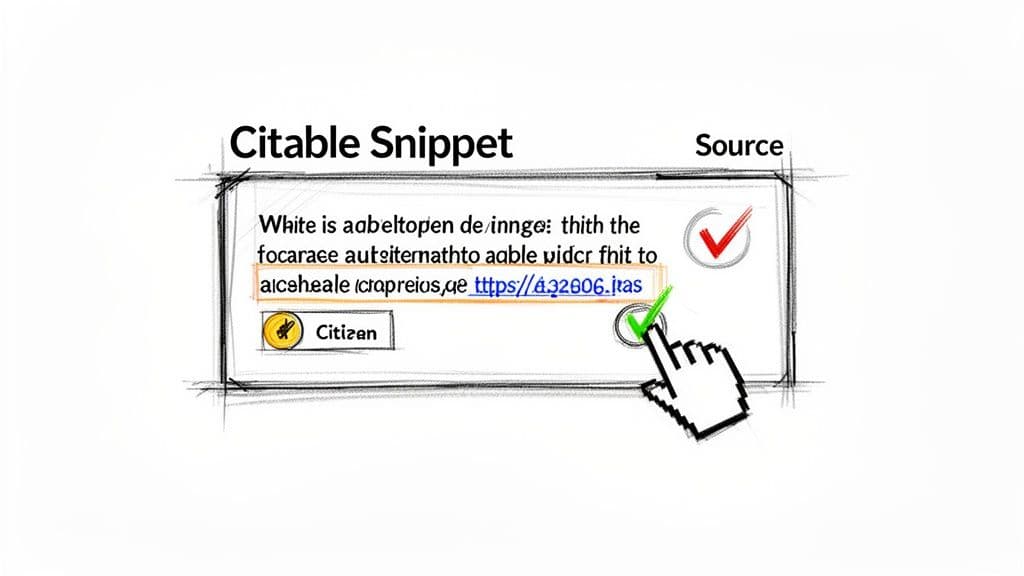
In this new era of AI-driven search, clarity and brevity have become your most powerful tools. Gemini, like other large language models, is built to find and present direct, authoritative answers. If you want to earn a citation in its AI Overviews, you have to master the art of crafting these "citable snippets."
Think of it this way: your goal is to make your content the path of least resistance for the AI. Every time Gemini has to wade through dense paragraphs to synthesize an answer, the odds of it misinterpreting your point—or just ignoring your content altogether—skyrocket. The most effective strategy is to engineer your content to be easily quotable from the start.
Adopt the Inverted Pyramid Model
Journalists have been using the "Inverted Pyramid" writing style for over a century for one simple reason: it gets the point across immediately. Start with the most critical information—the direct answer or the main conclusion—right up front. All the supporting details and background context can follow after you've landed the main point.
This structure is a perfect match for Gemini search optimization. When an AI model scans your page, it can grab the key takeaway from the very first sentence of a section. By front-loading the most important information, you satisfy the user's query instantly and signal to the AI that your content is efficient and authoritative.
Here’s a practical example of how to shift your writing:
- Before: "Through a detailed analysis of market trends and user behavior, our research indicates that implementing a dedicated customer success team can have a significant effect on retention."
- After: "A dedicated customer success team boosts customer retention by 25% on average. This impact stems from improved onboarding, proactive support, and stronger client relationships."
The second version is instantly citable and packed with value.
Engineer Your Content for Quotability
Beyond just structuring your content correctly, you need to be deliberate with your language. This means actively writing sentences and short paragraphs that are designed to be lifted directly from your page and dropped into an AI Overview. These are your citable snippets.
One of the easiest and most effective ways to flag these key takeaways for both people and AI is to use formatting to your advantage.
Think of blockquotes as a neon sign for Gemini. When you place a key statistic, a powerful insight, or a definitive statement within a blockquote, you are visually and semantically highlighting it as a prime piece of information worth citing.
This simple formatting trick does double duty: it breaks up your text for better readability and elevates your most important message. It's a low-effort, high-impact way to guide Gemini toward the exact snippet you want it to feature. If you want to explore this concept further, our guide to answer engine optimization offers more advanced strategies.
The Anatomy of a Perfect Snippet
So, what does a great, citable snippet actually look like? As you audit your existing content and create new assets, run your key sentences through this mental checklist. Your goal should be to seed dozens of these throughout every high-value page on your site.
An ideal snippet is:
- Declarative: It states a fact or makes a confident assertion. Cut out weak, hedging words like "might," "could," or "potentially."
- Self-Contained: It has to make perfect sense on its own, without any of the surrounding sentences for context.
- Attributable: Ideally, it contains a specific data point or a unique insight that is clearly tied to your brand's expertise or research.
- Concise: Aim for one to two sentences, max. Brevity is everything.
By consistently applying these principles, you start transforming your content from a simple article into a rich repository of AI-ready answers. You stop hoping Gemini understands your message and start directing it to the exact conclusions you want it to share—with your brand cited as the source.
Measuring and Refining Your GSO Strategy
A great Gemini Search Optimization strategy is never a "set it and forget it" affair. It’s a living, breathing process that needs constant attention and refinement. If you aren't tracking what's working and what isn't, you’re basically just guessing, hoping your content efforts somehow translate into results within AI Overviews. The goal is to ditch the guesswork and get systematic.
This means you need a real feedback loop to see how your brand shows up inside AI-generated answers. Let's be clear: traditional rank trackers are dinosaurs in this new world. You need to know exactly which questions get your brand mentioned, what the AI is saying about you, and—most critically—where you’re completely invisible.
Find Your Mention Gaps
Often, the biggest "aha!" moments come from finding where you should be, but aren't. These "mention gaps" are golden opportunities—high-intent conversations where your competitors or, even worse, less-reliable sources are answering questions for your potential customers. This is precisely why a dedicated monitoring platform is no longer a nice-to-have.
Imagine using a tool like Attensira to track your core product categories and brand name. The system can scan AI responses across thousands of queries and flag every single one where you’re missing. You might find a competitor is repeatedly cited in a crucial feature comparison, instantly highlighting a massive hole in your own content.
A mention gap isn’t just a missed opportunity. It's a crystal-clear roadmap for your next content move, showing you exactly what questions your audience has that you aren't answering well enough for an AI.
Turn Those Insights into Your Next Move
Once you’ve uncovered these gaps, the data should drive your content calendar and optimization sprints. Every decision, from planning a new blog post to updating an old FAQ page, should be informed by this analysis.
This shifts your whole approach from being reactive to proactive.
- Focus on What Matters: Put your energy into closing gaps around bottom-of-the-funnel queries or topics that directly tie to revenue.
- Strengthen Weak Links: If you're getting mentioned but the context is off or the snippet is weak, go back to that source page. It probably needs more citable facts or a cleaner structure.
- Build What's Missing: Create entirely new assets designed from the ground up to answer the specific questions where you’re currently a ghost.
This constant cycle—measure, analyze, iterate—is the very heart of a successful GSO program. By methodically tracking your presence and patching the holes, you build an unshakeable authority that Gemini and other AI models will learn to rely on. That's how you build a lasting advantage.
A Few Common Questions About Optimizing for Gemini
We get asked a lot of questions about this new world of AI-driven search, and a few pop up consistently. Let's tackle them head-on.
How is This Really Different From Old-School SEO?
This is probably the most common question we hear. While traditional SEO is all about getting a URL to rank in those top ten blue links, optimizing for Gemini is a different game entirely. Your goal isn't just to rank a page; it's to embed your brand's facts, figures, and perspectives directly into the AI-generated answer—the AI Overview.
The focus shifts from keywords and backlinks to machine-readable content and undeniable E-E-A-T signals. It's less about climbing the ranks and more about establishing your entire digital ecosystem as a citable, authoritative source that the AI can trust.
How Long Does This Actually Take to Work?
Everyone wants to know the timeline for results, and that's fair. The good news is that you can get feedback much faster than with traditional SEO, which can sometimes feel like a six-month waiting game.
Technical fixes, like rolling out advanced schema, can get noticed by Google in just a few weeks.
But let's be realistic. Building the kind of deep, verifiable brand authority required to show up for complex B2B queries doesn't happen overnight. To see a real, measurable impact in AI Overviews, you should plan for 3-6 months of focused, consistent work.
Can You Optimize for Both AI and Traditional Search at the Same Time?
Yes, absolutely. In fact, you should be doing both.
The best part is that the work you do for Gemini directly reinforces your foundational SEO. The two strategies are not at odds; they're perfectly complementary.
- Top-Notch Content: Creating clear, authoritative, and well-organized content is a non-negotiable for both AI and classic search rankings.
- Brand Authority: The work you do to build strong E-E-A-T signals will boost your performance everywhere, from AI Overviews to standard search results.
Think of Gemini optimization as an advanced layer you build on top of your core SEO strategy. By making your content crystal clear for an AI, you're also making it better and more authoritative for human users and traditional search crawlers. It’s not an either/or choice; it's a unified approach to being visible wherever your audience is looking.
Ready to stop guessing and start measuring your brand's visibility in AI search? Attensira provides the data-driven insights you need to find mention gaps and refine your content strategy. Discover how your brand appears in AI responses and get actionable recommendations at https://attensira.com.