


Learn what is conversational ai and how it can transform customer interactions, streamline operations, and drive growth.
So, what exactly is conversational AI? It's the technology that finally lets us have a real conversation with a machine—one that feels natural and, well, human. This isn't about rigid, pre-programmed scripts anymore. We're talking about software that can understand our intent, remember the context of our chat, and respond in a way that makes sense. It’s the difference between talking at a computer and talking with one.
Understanding Conversational AI
At its heart, conversational AI is a sophisticated suite of technologies working in concert to mimic human dialogue. It’s what powers the smart virtual assistants and next-generation customer support bots that can figure out what you mean, not just what you type.
Think about the difference between a basic chatbot and an experienced barista. If you ask a simple chatbot for "something strong, but not bitter," it will likely get stuck, searching for a command it doesn't have. It's following a strict decision tree.
Now, imagine asking that same question to a great barista. They instantly understand the intent behind your words. They process the key ideas—strong, not bitter—and might suggest a specific type of roast or a flat white, asking follow-up questions to get it just right. Conversational AI acts like that expert barista, navigating ambiguity to deliver a genuinely helpful result.
The Core Technologies at Play
This ability to have a fluid, intelligent back-and-forth isn't magic. It's powered by four key technologies, each handling a critical piece of the puzzle. When they work together, the result is a conversation that feels surprisingly natural.
To get a clearer picture of how it all works, let's break down the role each component plays in bringing a conversation to life.
The Core Components of Conversational AI
This table breaks down the four key technologies that power conversational AI, explaining the role each plays in creating human-like dialogue.
Simply put, each technology builds on the last, creating a seamless loop from listening and understanding to remembering and responding.
This powerful combination is why the market for conversational AI is exploding. It's projected to grow from 13.64 billion** in 2025 to **17.12 billion in 2026, which represents a massive compound annual growth rate of 25.6%. For a deeper dive into these numbers, you can explore the full conversational AI market research.
How Conversational AI Understands and Responds
For conversational AI to truly work, it has to go far beyond simply recognizing words on a screen. The real magic lies in its ability to grasp the nuances of human dialogue—the context, the intent, and the back-and-forth rhythm that we take for granted. This isn't one single technology, but rather a symphony of them working together.
Let’s break down how a simple question gets turned into a useful, intelligent answer.
It all begins with Natural Language Processing (NLP). You can think of NLP as the AI's ears. Its job is to take the raw, unstructured language you provide—whether spoken or typed—and convert it into a structured format a computer can actually work with.
Without this first step, a question like, "Show me blue running shoes in a size 9," is just a meaningless string of characters to a machine. NLP is what gives it the initial grammatical and structural framework to begin making sense of the request.
The Brains of the Operation
Once the language has been broken down, Natural Language Understanding (NLU) steps in. If NLP provides the structure, NLU provides the comprehension. This is the analytical core, focused entirely on figuring out the intent behind the words.
In our shoe example, NLU gets to work identifying the key pieces of information, which we call entities. It would pull out "blue" (color), "running shoes" (product type), and "size 9" (size). But more importantly, it identifies the user's primary goal, or intent: to find a product. This is the critical leap from just matching keywords to actually understanding a user's needs.
This simple flow chart gives a high-level look at how these pieces fit together, moving from initial input to a final, generated response.
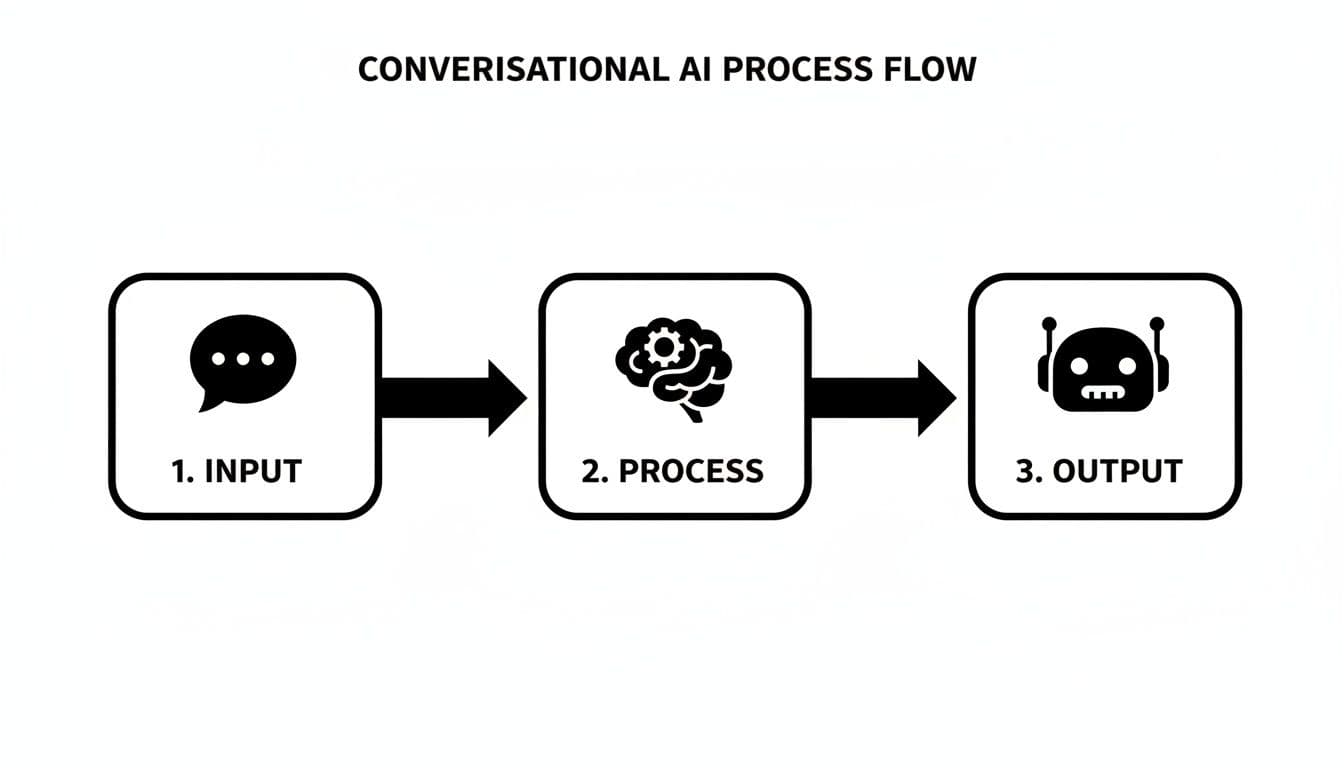
The "Process" stage is where all this complex interpretation happens, turning a simple query into an actionable command for the system.
Crafting the Perfect Reply
After the AI figures out what you want, it needs to talk back. That's the job of Natural Language Generation (NLG). Think of NLG as the AI's mouth. It takes the structured data and the identified intent and constructs a reply that sounds natural, not robotic.
So, instead of a clunky output like "RESULT: shoes, color=blue, size=9," NLG crafts a fluid, helpful response: "Absolutely. I found three pairs of blue running shoes in a size 9. Would you like me to show them to you?"
The entire point of NLG is to generate text that is indistinguishable from what a person would write. It has to consider tone, context, and even personality to make the interaction feel genuine.
Finally, a component called Dialog Management holds the entire conversation together. It’s the choreographer, keeping track of the conversation's history so it can handle more complex, multi-step interactions.
This is what allows you to ask a follow-up question like, "What about in red?" Dialog Management remembers that you're still talking about size 9 running shoes, so you don't have to start over. This ability to retain context is what separates a truly advanced conversational AI from a basic chatbot.
Real-World Business Applications and ROI
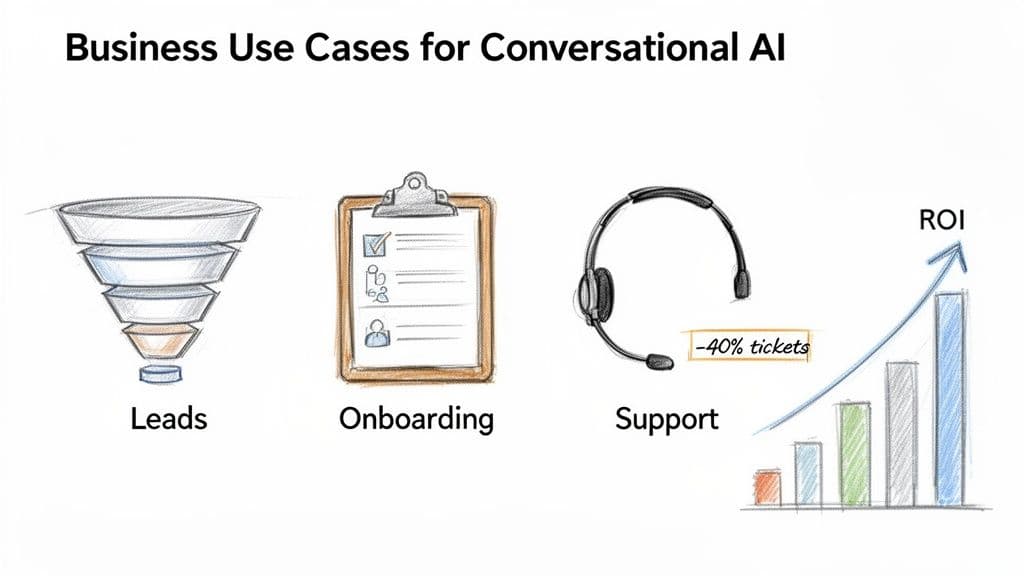
It’s one thing to understand the tech behind conversational AI, but it's another thing entirely to see how it actually makes a business money. The real value isn't in the technology itself, but in how it’s applied to solve expensive, time-consuming problems and open up new avenues for growth. This is no longer just a cool concept; it's a practical tool delivering a clear return on investment.
We're seeing intelligent AI deployed everywhere from marketing and sales to HR and tech support. These systems are doing more than just answering basic questions—they're fundamentally changing how businesses run and connect with people.
Driving Sales and Qualifying Leads
Talk to any sales team, and they'll tell you one of their biggest headaches is sifting through leads to find the real buyers. Conversational AI is the perfect solution, acting as a tireless front line that engages visitors 24/7, long before a human rep ever gets involved.
Picture an AI on a B2B software website. Instead of just showing a static contact form, it starts a conversation: "Welcome! Are you looking for a solution for a small team or an enterprise-level deployment?" Depending on the answer, it can dig deeper, asking about budget, timelines, and specific pain points.
The impact here is huge.
- Filters High-Intent Leads: It pinpoints the prospects who fit your ideal customer profile and hands them off to your sales team, ready to talk.
- Reduces Sales Cycle Time: Reps get to skip the initial discovery calls and jump straight into meaningful conversations.
- Gathers Crucial Data: Every chat is a goldmine of information about what your market actually wants, which is invaluable for refining your strategy.
The result is a pipeline full of high-quality leads and a sales team that can focus on what they do best: closing deals.
Streamlining Employee Onboarding and HR
The benefits of conversational AI aren't just customer-facing. It's also having a massive impact internally, especially in Human Resources. Onboarding a new employee usually means answering the same questions over and over about company policies, benefits, and IT setup. An AI-powered internal assistant can handle all of it.
A new hire can just ask, "How do I set up my 401(k)?" or "Where do I find the company holiday schedule?" The AI gives them an instant answer, walks them through forms, or even schedules their introductory meetings.
This frees up HR professionals from the administrative grind, letting them focus on bigger-picture initiatives like employee development, retention, and culture. The ROI is measured in thousands of hours saved every year.
The applications in this space are broad and growing. To see how other companies are innovating, check out these practical Conversational AI use cases for more examples.
Delivering Proactive and Scalable Support
Customer support is where conversational AI first made its name, and its influence continues to grow. The technology is reshaping B2B operations, with chatbots now commanding a staggering 62.23% of the market share. In 2024, support applications accounted for 42.4% of the total chatbot market, which is valued at 11.58 billion** and projected to swell to **41.39 billion by 2030.
But today's AI does more than just wait for questions. For instance, a SaaS company can use it to spot a user who seems to be struggling with a particular feature. The AI can then proactively start a chat, offering a quick tutorial or a link to a help article. It solves the problem before the user even thinks to create a support ticket. One company famously cut its support tickets by 40% with this exact approach.
This proactive support doesn't just cut costs; it builds incredible customer loyalty. We're also seeing these conversational systems merge with e-commerce, changing how people buy things online. You can read more about how users can now shop on ChatGPT in our recent analysis. By resolving issues instantly and efficiently, businesses build stronger relationships and keep customers coming back.
Distinguishing AI from Basic Chatbots
It’s easy to get the terms “chatbot” and “conversational AI” mixed up, and many people use them interchangeably. In reality, they represent entirely different classes of technology. Comparing them is like putting a simple calculator up against a supercomputer—both work with inputs, but the power and intelligence are on completely different levels.
A basic chatbot is just a script. Think of it as a slightly more interactive FAQ page or an automated phone menu. It’s built on a rigid, rule-based system designed to recognize specific keywords and fire back pre-written answers. If you ask a question it hasn’t been programmed for, you’ll likely get the dreaded "I don't understand" and the conversation hits a dead end.
These simple bots have their place. They’re great for handling highly repetitive, straightforward tasks like checking an order status or telling a customer your business hours. But there’s no real intelligence there; they can't grasp context, learn from past conversations, or handle any query that deviates from their script.
The Leap to True Conversation
Conversational AI, on the other hand, is built for genuine, back-and-forth dialogue. It doesn’t rely on rigid rules. Instead, it uses a sophisticated blend of machine learning and the core technologies of NLP, NLU, and NLG to figure out what a user actually wants. This is what allows it to handle ambiguity, manage complex questions, and remember the context of a conversation from one turn to the next.
For example, imagine a user asks a basic chatbot, "I need a flight to New York." If the user then says, "What about from Chicago?" the chatbot is lost. It has no memory of the destination. A conversational AI platform instantly understands the user means, "I need a flight from Chicago to New York," and carries on the dialogue without a hitch.
This ability to maintain context is often powered by incredibly complex models. You can get a deeper look at how large language models (LLMs) make this possible in our guide on what is an LLM.
The core distinction is simple: A basic chatbot responds to keywords. Conversational AI understands intent and context. This shift from reaction to comprehension is what enables truly human-like interactions.
To make these differences even clearer, let's look at a side-by-side comparison that also includes the common "virtual assistant."
Conversational AI vs Chatbots vs Virtual Assistants
A comparative analysis to clarify the differences in capabilities, intelligence, and application between these commonly confused technologies.
Ultimately, the right choice always comes down to the business goal. If all you need is a tool to answer the same five questions over and over, a basic chatbot might do the job. But if you’re looking to create meaningful, intelligent, and scalable customer experiences that actually drive business results, a true conversational AI platform is the only way forward.
Your Strategic Implementation Roadmap
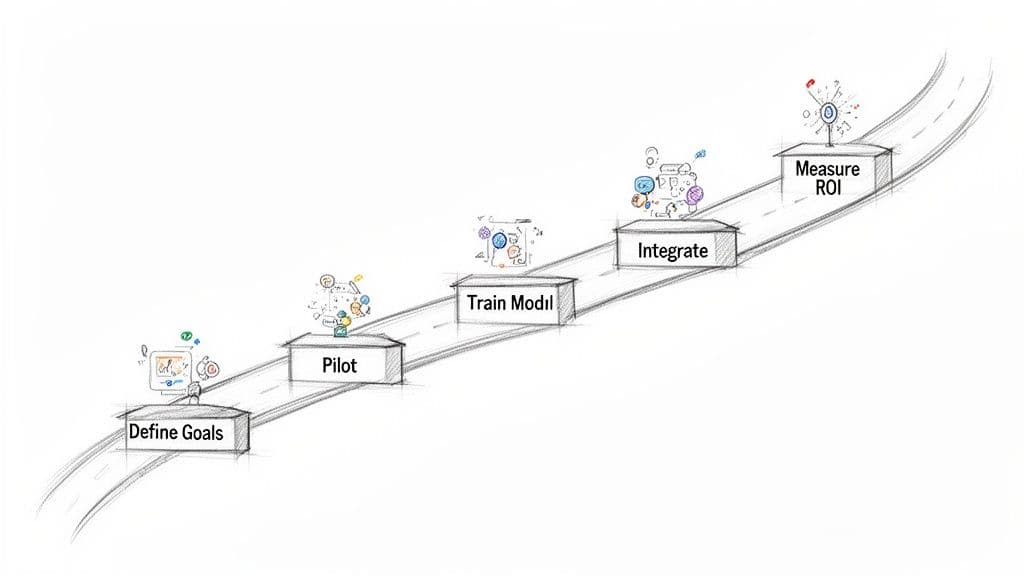
Getting a conversational AI initiative off the ground is about more than just technology. It’s about strategy. A successful launch demands a clear plan that ties every feature directly to a business outcome, avoiding common pitfalls and ensuring you see a return on your investment from the very beginning.
It all starts with a simple, foundational question: What specific problem are we solving? It’s not enough to have a vague goal like "improving the customer experience." You need to get granular.
For example, a sharp, measurable objective might be to reduce customer support agent workload by 30% or boost marketing-qualified leads from the website by 15%. These numbers become your North Star, guiding every decision you make down the line.
Define Your Scope and Start Small
Once your goals are crystal clear, fight the urge to build an all-knowing, all-doing AI right out of the gate. The smartest, most successful projects always begin with a tightly focused pilot project. This isn't just about caution; it's about minimizing risk and proving value fast.
Look for a high-volume, low-complexity use case to start. Think about things like:
- Fielding the top 10 most common customer support questions.
- Automating appointment scheduling for your sales team.
- Walking new hires through their initial onboarding paperwork.
Starting small gives you room to learn and adjust without the immense pressure of a company-wide deployment. It also builds a powerful business case for future expansion. To see just how far these systems can go, it helps to understand the capabilities of advanced platforms like Google AI beyond chatbots.
Choosing the Right Platform and Preparing Data
With a focused use case in hand, your next move is picking the right platform. The best choice hinges on your team's technical skills, your budget, and how much you need to scale. Some platforms offer low-code solutions perfect for getting started quickly, while others are built for deep, complex enterprise customizations. A great first step is to evaluate your company's AI readiness score to get a clear picture of your internal strengths.
Just as critical is the data you'll use for training. Remember, a conversational AI is only as good as the information it learns from.
Your training data—conversation logs, support tickets, product guides—must be clean, relevant, and truly representative of how your users actually talk and what they ask. This isn't a small detail; poor data quality is the number one killer of AI projects.
Market dynamics also play a role here. North America currently leads the conversational AI space, accounting for 33.62% of global revenue in 2025. But the real story is in the Asia-Pacific region, which is projected to grow at a blistering 24% CAGR through 2033. This global shift can impact everything from platform support to feature availability.
Launch, Iterate, and Measure for Success
Deployment isn't the finish line—it's the starting gun. Once your pilot is live, you need a tight feedback loop for constant improvement. Dive into the user interactions and find out where the AI shines and, more importantly, where it stumbles.
Use that analysis to refine its answers, expand what it knows, and get better at understanding what users truly want. It’s a cycle of learning and optimization. Keep a close watch on those initial KPIs to prove the ROI, which will build the momentum you need to scale your conversational AI strategy across the entire organization.
Optimizing Your Brand for Conversational Search
The way people find information online is undergoing a massive shift, all thanks to conversational AI. The familiar page of ten blue links is quickly being replaced by direct, AI-generated answers. People aren't just typing keywords anymore; they're asking full questions and getting a single, definitive response.
This changes everything for brands. Visibility is no longer about climbing to the #1 spot. It’s about becoming the trusted source that AI models quote directly. If your brand isn’t providing that final answer, you might as well be invisible.
Creating Answer-Focused Content
To stay relevant, your content strategy needs to pivot. Forget just targeting broad keywords. The new game is about creating content that directly and thoroughly answers the specific questions your customers are asking. Every article, blog post, or guide should be the ultimate resource for a particular query.
This means you have to get inside your customer's head and understand their intent. You need to anticipate the exact questions they'd ask an AI assistant and then build your content to deliver a perfect, easy-to-understand answer.
- Frame Headings as Questions: Ditch the vague titles. Structure your H2s and H3s like real questions (e.g., "How Does This Feature Save Me Time?" is much better than "Feature Benefits").
- Answer First, Explain Later: Start your sections with a direct answer to the question in the heading. Once you've provided the core information, then you can dive into the details. This format is gold for AI crawlers.
- Build Out Robust FAQ Pages: Your product and category pages should have detailed FAQ sections that capture all sorts of long-tail conversational questions.
This approach doesn't just feed the AI; it dramatically improves the experience for your human readers, too. If you're new to this concept, a good place to start is by understanding the basics of conversational search.
Building Authority and Trust
AI models don't pick answers at random. They are programmed to pull information from sources they consider credible and authoritative. Your job is to establish deep topical authority in your specific field, which sends a powerful signal to search engines that you are the expert. This isn't a one-off task; it requires consistently publishing high-quality, in-depth content around your core topics.
Another critical piece of the puzzle is structured data (you might also hear it called schema markup). Think of it as a set of behind-the-scenes labels you add to your website's code. These labels help search engines understand exactly what your content is about—whether it's a product, a review, or a step-by-step guide. By making your content machine-readable, you make it far easier for AI to pull your information and present it accurately.
The goal here is simple: make your brand's expertise impossible to ignore. The easier it is for an AI to understand and trust your content, the more likely it is to feature you in its answers.
Monitoring Your AI Visibility
In this new world, you can't just hope for the best. You absolutely need to know if, when, and how your brand is showing up in AI-generated responses. Tracking this visibility is the only way to find content gaps, see what competitors are doing, and make smart adjustments to your strategy.
This is exactly what platforms like Attensira are designed for. They monitor your brand’s footprint across different AI engines, giving you the data you need to fine-tune your content. This kind of continuous feedback loop allows you to adapt on the fly, ensuring your brand isn't just surviving but actually winning in the era of AI-powered search.
Frequently Asked Questions
As you consider bringing conversational AI into your business, you're bound to have some practical questions. Let's dig into a few of the most common ones we hear from leaders and marketing teams.
How Long Does It Take to Implement?
There’s no single answer here, as the timeline really depends on the project's complexity. But we can set some realistic expectations.
A simple, tightly focused pilot—say, an AI that handles your top 10 most common support questions—can be up and running in as little as 4 to 6 weeks. This assumes you have clean, organized data ready for training.
For a more involved deployment, like a sales-focused AI that qualifies leads and plugs into your CRM, you’re likely looking at 3 to 6 months. Big, enterprise-wide projects that cross multiple departments, support several languages, and require deep system integrations can easily take a year or more. The trick is to start with a manageable scope to get some early wins on the board.
Can Conversational AI Understand Industry Jargon?
Yes, but you have to teach it. An out-of-the-box model won't know your company's internal acronyms or the specific terminology of your industry. This is where the quality of your training data is everything.
To get an AI to grasp niche language, you have to train it on a dataset that's full of your specific jargon. That means feeding it real examples from your support tickets, internal documents, and customer chat logs.
This is the process that teaches the AI the context behind terms like "SKU velocity" or "MRR churn," which is what allows it to give back accurate, helpful responses. If you skip this targeted training, the AI is almost guaranteed to misunderstand what users are asking for and create a frustrating experience.
What Are the Biggest Adoption Risks?
While the upside is huge, bringing in conversational AI isn't without risks you need to manage. For most businesses, the two biggest worries are protecting customer data and avoiding brand damage from a clumsy user experience.
- Data Privacy and Security: Your AI will be handling sensitive customer information. You have to be certain your chosen platform is compliant with regulations like GDPR and CCPA and that all data is encrypted and secure. This is non-negotiable.
- Poor User Experience: An AI that gives wrong answers, gets stuck in loops, or just doesn't understand people can be incredibly frustrating. This can erode customer trust faster than you can build it and do more damage to your reputation than having no bot at all.
Thorough testing, constant monitoring, and giving users an easy escape hatch to a human agent are your most important safeguards. A great AI builds loyalty; a bad one destroys it.
Ready to see how your brand is showing up in AI-generated answers? Attensira provides the critical insights you need to monitor and optimize your content for the new era of conversational search. Start tracking your AI visibility today.